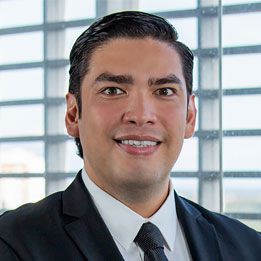

Institutional affairs manager | FEXPOCRUZ


Hugo Andrés Hinojosa Peláez
Institutional affairs manager | FEXPOCRUZ
Team size: 20
What are the most significant cases, projects and/or transactions that you and/or your legal team have recently been involved in?
Digitalisation of all legal department documents and the use of AI across contract management, legal reporting, due diligence, compliance, document management and regulatory monitoring, while safeguarding confidentiality, legal privilege, accuracy and professional responsibility.
Over the past year, the legal team has also become a key contributor to business decision-making. Today, our focus is increasingly on doing more with fewer resources, improving efficiency and demonstrating greater productivity and value to the organisation.
How do you approach managing legal aspects during periods of instability or crisis to ensure the organisation’s resilience?
My priority is to identify and anticipate risks that could affect business continuity, assess their potential impact, and provide senior management with practical alternatives that enable the organisation to move forward safely, ensuring that the legal function does not become an obstacle to business operations.
We work closely across all areas of the organisation, as crises often involve a combination of legal, contractual, financial, employment and reputational risks. Our ultimate objective is to protect the organisation, preserve its key relationships and decision-making capacity, and create the conditions necessary to seize opportunities even in times of uncertainty.
What strategies do you employ to ensure the successful digital transformation of a legal department while maintaining compliance with your country’s data protection laws?
A successful digital transformation of the legal function should begin by identifying processes that can be simplified, automated or managed more efficiently through technology, prioritising tools that deliver real value to the organisation. This involves progressively implementing document management solutions, contract automation and artificial intelligence tools, supported by continuous training to help the team develop new capabilities and embrace technology as a strategic enabler.
At the same time, innovation must be guided by clear principles of security, confidentiality and data protection. Before implementing new tools, I assess what information will be processed, where it will be stored, who will have access to it and the potential risks involved, establishing appropriate internal controls and protocols in line with applicable regulations. Digital transformation should not mean taking on greater risks, but rather using technology to build a more agile, efficient and secure legal function.
Have you had any experiences during your career as a lawyer that stand out as particularly unique or interesting?
Yes. My professional experience and work in institutional relations have given me the opportunity to engage with a wide range of prominent figures from around the world, including government leaders, diplomats, representatives of international organisations and other influential institutions. These interactions have significantly contributed to both my personal and professional growth.
Given the current geopolitical shifts and growing uncertainties around international free trade, has your company’s risk profile evolved, and are you taking measures to address these challenges?
To address these challenges, I believe it is essential to strengthen risk monitoring and assessment mechanisms, promote close coordination between legal, commercial and operational teams, and develop contingency plans that enable the organisation to respond quickly and effectively to adverse scenarios.
Based on your experiences in the past year, are there any trends in the legal or business world that you are keeping an eye on that you think other in-house lawyers should be mindful of?
Being a strong legal specialist is no longer enough. Organisations need lawyers who have a deep understanding of the business, engage early in decision-making processes, and are able to translate legal risks into practical solutions for senior management. In my view, the ability to combine sound legal judgement, business acumen, technology and a strong understanding of the broader environment will be one of the key differentiators for in-house lawyers in the years ahead.
How can general counsel foster a corporate culture that supports ESG principles and compliance across all levels of the organisation?
A general counsel can foster a strong corporate culture by ensuring that ESG principles and regulatory compliance are no longer perceived as responsibilities belonging exclusively to the legal department but instead become naturally embedded in the way the organisation makes decisions and conducts business. Achieving this requires strong support from senior management, clear policies, effective communication of responsibilities, and a culture in which ethics, transparency and sustainability are embraced at every level of the organisation.
AI has been taken seriously as a potentially revolutionary technological change in the legal world for a number of years now. Has it had a meaningful impact in how your legal team works in this time?
Artificial intelligence is a powerful support tool, but not a substitute for professional judgement. Its implementation must be accompanied by human oversight, appropriate information safeguards and clear rules governing its use. The true value of this technology lies in combining its processing capabilities and efficiency with business knowledge, professional experience and the legal judgement of in-house counsel.
What is a cause, business or otherwise, that you are passionate about? Why is this?
I strongly believe in the ability of companies and business institutions to create employment, promote investment, foster innovation and generate opportunities that positively transform their communities. Throughout my professional career, I have sought to ensure that the practice of law goes beyond resolving legal issues and contributes to building stronger, more responsible and sustainable organisations.
What factors influence your team’s decision to use external legal services versus handling matters in-house, and what criteria are used to evaluate their performance?
We seek to manage matters internally whenever we have the necessary expertise and capabilities, engaging external specialists when their involvement provides additional technical knowledge, experience or perspective that strengthens our position.
How does your team contribute to the overall business strategy of the company? Can you share an example of a recent legal-led initiative that had a significant impact?
Our role is not limited to identifying risks; we also develop structures and practical alternatives that enable the organisation to achieve its objectives in a secure, efficient and sustainable manner.
A recent example was our involvement in adapting the organisation’s pricing policy in response to a highly volatile economic environment. From a legal perspective, we helped structure contractual mechanisms designed to preserve the value of transactions, provide legal certainty to the parties and maintain commercial competitiveness. This initiative required close coordination with the commercial and financial teams and enabled us to turn a legal and economic challenge into a solution aligned with the organisation’s financial sustainability.
Looking forward, what trends do you foresee in the legal landscape over the next 5–10 years that companies should prepare for?
Many legal tasks will become increasingly automated, meaning that the true value of in-house counsel will lie in professional judgement, a deep understanding of the business, and the ability to translate risks into strategic decisions. Legal teams that successfully combine technology, business acumen, proactive risk management and active participation in senior management will be better positioned to strengthen their organisations’ resilience and competitiveness.
Gerente de asuntos institucionales | FEXPOCRUZ
Institutional affairs manager | Fexpocruz
Gerente de asuntos institucionales | Fexpocruz