
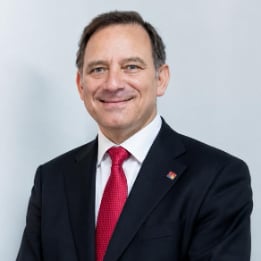
General counsel | Banco del Estado de Chile



Álvaro Larraín Fierro
General counsel | Banco del Estado de Chile
Team size: 60
Career Biography
Álvaro Larraín Fierro holds a law degree from the Pontificia Universidad Católica de Chile (2007) and a Master of Laws (LL.M.) specialising in Corporate Law (2012) from the same institution, where he also earned a Bachelor’s degree in Theology (1998).
After joining the law firm Alcaíno, Rodríguez, Sahli in 2006, he joined the Legal Department of Banco del Estado de Chile in 2012. Over the course of 14 years, he served as Head of the Legal Research Unit, Chief Counsel for Personnel and Suppliers, Deputy Manager of Legal Research, and Deputy Manager of Corporate Legal Affairs and Research. Effective March 13, 2026, he was appointed General Counsel of BancoEstado by the President of the Republic, José Antonio Kast.
Under BancoEstado’s Organic Law, the General Counsel provides legal advice to the bank’s authorities regarding the institution’s governance and ensures that the Bank’s resolutions, acts, and contracts comply with banking legislation and current sectoral regulations, thereby supporting the provision of banking and financial services within a complex and challenging regulatory environment.
Prior to his appointment as General Counsel of the state-owned bank, he served as a director of BancoEstado Corredores de Bolsa (Stockbrokerage) and as an alternate director of BancoEstado Corredores de Seguros (Insurance Brokerage) and BancoEstado Administradora General de Fondos (Asset Management).
He was recognised as a leading lawyer in the field of Finance in the 2019 GC Powerlist.
Since 2019, he has also served as a professor of Banking Law in the Master of Laws (LL.M.) program at the Pontificia Universidad Católica de Chile Law School. Between 2015 and 2017, he taught the Banking Law and Financial Contracting course at the Alberto Hurtado University Law School. He is a co-author of the book “Banking Law” (Thomson Reuters, 2018) and author of the article “Analysis of the Regulatory Recommendation by the Competition Tribunal regarding services associated with the use of universally accepted credit and debit cards”, published in the volume “Notable judgments of 2017” by the Libertad y Desarrollo Institute.
He is a member of the Chilean Bar Association.
How does your team contribute to the overall business strategy of the company? Can you share an example of a recent legal-led initiative that had a significant impact?
For an in-house lawyer, there is no greater asset than firsthand experience of the business and a deep understanding of its day-to-day operations. While external counsel provide invaluable expertise in specialised areas such as antitrust, corporate law, M&A, consumer protection and financial regulation, no advisor can possess the same level of institutional knowledge as the legal team that operates from within the organisation.
At BancoEstado, our legal department seeks to be much more than a provider of legal opinions. We strive to act as a strategic partner to management, helping the institution navigate an increasingly complex regulatory and business environment. Our role is to identify legal and regulatory risks before they materialise, assess their potential impact, and contribute to decision-making processes that support the Bank’s long-term objectives.
A general counsel must be capable of understanding not only the legal implications of a decision but also its operational, reputational and strategic consequences. In that regard, the legal function serves as an early-warning system, helping management anticipate challenges and respond with confidence. This approach enables the Bank to pursue innovation and growth while maintaining the highest standards of legal compliance and governance.
Over the past year, our team has been heavily involved in supporting strategic initiatives associated with the modernisation of Chile’s financial sector, including the implementation of new regulatory frameworks affecting digital banking, payment systems, open banking initiatives and financial technology providers. These projects require close coordination among legal, business, risk and technology teams to ensure that innovation is implemented in a manner consistent with the Bank’s public mission, regulatory obligations and commitment to customer trust.
Looking forward, what trends do you foresee in the legal landscape over the next 5–10 years that companies should prepare for?
The banking industry is undergoing one of the most significant transformations in its history. The emergence of fintech companies, open banking ecosystems, digital assets, artificial intelligence and new forms of financial intermediation is reshaping the traditional boundaries of financial services.
These developments create extraordinary opportunities for innovation and customer inclusion, but they also introduce new legal, regulatory and operational challenges. In the coming years, I expect regulatory frameworks around data governance, cybersecurity, digital identity, artificial intelligence and financial resilience to become increasingly sophisticated and demanding. Legal departments will need to develop a multidisciplinary perspective that combines traditional legal analysis with technological understanding and risk management capabilities.
One of the key challenges for in-house counsel will be helping organisations strike an appropriate balance between innovation and stability. Financial institutions operate in a business fundamentally built on trust. Customers entrust us with their savings and expect security, reliability and transparency. While innovation is essential, it must be implemented in a way that preserves the solvency, integrity and resilience of the financial system.
For this reason, I believe the role of the general counsel will continue evolving from that of a legal advisor to that of a strategic business leader. The most effective legal departments will be those capable of understanding regulatory developments, technological change and market dynamics simultaneously, while helping their organisations adapt to an environment of constant transformation. In many respects, the future of in-house legal practice will depend on our ability to connect legal certainty with business innovation, ensuring that both can advance together rather than in opposition.
Sub-manager of legal studies | Banco del Estado de Chile (BancoEstado)
Álvaro Larraín Fierro has been a lawyer in the legal department of Banco del Estado de Chile, a public Chilean bank, since January 2012. Last year was an important one...

General counsel
Banco del Estado de Chile (BancoEstado)
View Powerlist



Sub-manager of legal studies
Banco del Estado de Chile (BancoEstado)
View Powerlist
General counsel
Banco del Estado de Chile (BancoEstado)
View Powerlist