Group General Counsel & General Director of Legal Affairs and Corporate Governance | GEK TERNA



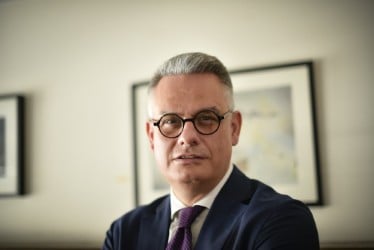
Yannis Kourniotis
Group General Counsel & General Director of Legal Affairs and Corporate Governance | GEK TERNA
Yannis Kourniotis is Group General Counsel and General Director for Legal Affairs & Corporate Governance of GEK TERNA Group, one of Greece’s largest publicly listed groups and a leading participant in infrastructure, concessions, and energy.
Before moving in-house, Yannis spent more than 25 years as a partner at two of Athens’ largest and most respected law firms, advising banks, sponsors, investors, and the Greek State on many of the country’s landmark infrastructure, concession, and energy transactions. His experience spans the full project lifecycle, from development, procurement and financing through implementation, operation, and major corporate transactions.
In infrastructure and concessions, Yannis has advised on virtually every major Greek concession project over this period. His work for the State included the privatisations of the Athens Ring Road and Egnatia Motorway, transactions yielding approximately €3.27 b. and €1.5 b. respectively to the State. In energy, he has advised on the development and financing of major thermal and renewable power projects and drafted Greece’s first oil lease agreements, which became the basis for subsequent E&P Open Door tenders. He has also advised oil majors, sponsors, and financiers on strategic natural-gas infrastructure, including the Trans Adriatic Pipeline (TAP), the Greece–Bulgaria Interconnector (ICGB) and the Alexandroupolis FSRU, alongside numerous M&A and project-finance transactions.
Yannis has been consistently recognised by the principal international legal directories, including Chambers, IFLR and The Legal 500, across banking, project finance and development, and energy, with recognition including The Legal 500 Hall of Fame.
At GEK TERNA, Yannis is responsible for the coordination, organisation, and management of the Group’s legal services and for shaping its legal strategy and corporate-governance framework in Greece and across the jurisdictions in which the Group operates. His current role combines long-standing transactional experience with responsibility for legal risk, governance and strategic execution within a major listed infrastructure and energy group.
Yannis holds a law degree from the University of Athens, a full-time MBA from the University of Strathclyde, an LL.M. in EU Law from the University of Leicester and a Certificate of Advanced Studies in Arbitration offered jointly by the Universities of Neuchâtel and Lucerne and the Swiss Arbitration Academy. He is also a certified natural-gas trader with the Hellenic Energy Exchange and maintains a strong professional interest in international arbitration.
Team size: Six
How do you approach managing legal aspects during periods of instability or crises, and how does your legal strategy align with the broader business strategy to ensure organisational resilience?
Organisations rarely become resilient during a crisis. They simply reveal how resilient they already were. Crises tend to expose decisions that were taken, or not taken, much earlier. That reality has shaped the way I think about legal strategy.
This is particularly true in motorway concessions. Regardless of economic uncertainty, political change or operational disruption, critical infrastructure must remain operational 24/7. Service levels must be maintained, contractual obligations continue, and users, public authorities and lenders rightly expect continuity. There is very little room for pause or reset.
In long-term project finance ventures such as motorway concessions, uncertainty exists alongside continuity. Economic conditions may change, costs may increase, supply chains may be disrupted and regulatory requirements may evolve, yet the roads must continue operating every day. In times of uncertainty, my role is to help the organisation absorb change without losing focus or direction.
Over the last few years, our motorway portfolio has expanded significantly through the integration of projects with different histories, cultures and operating models. In that environment, the greatest challenge is often not complexity itself, but overcoming resistance to adaptation whilst ensuring the organisation operates as a coherent whole.
I am also convinced that resilience depends on how knowledge is distributed. Fast-growing organisations can become overly dependent on a small number of individuals who hold institutional memory and critical expertise. A significant part of my role is therefore developing talented lawyers and ensuring that legal knowledge becomes embedded across the organisation.
How do you balance being a legal risk manager with being a strategic business enabler, and where do you see the biggest tensions?
For a general counsel to evolve from a legal risk manager into a strategic business enabler, especially during periods of rapid expansion, one must be prepared to change roles. There comes a point where being the executive’s trusted legal ‘go-to’ person is no longer what is really needed behind closed doors. The challenge is to become the person who can take an idea expressed in broad strokes, and often lacking legal certainty, help shape it into a strategic vision aligned with the organisation’s core values, and translate it into clear, practical and cost-conscious steps that management can actually implement.
To be successful in this role over the long term, a general counsel must be able to do all of this without stealing the spotlight from the executive.
I like to think of strategic legal advice as the gearbox rather than the brakes of an organisation. The gearbox’s purpose is not to stop the vehicle from moving, but to help it move in the right direction and at the right speed. Equally, the purpose of the legal function is not to prevent the organisation from moving until every conceivable legal risk has been examined and assessed, but to help it move forward safely whilst remaining agile enough to seize emerging opportunities. As businesses grow, gear selection must match the organisation’s momentum.
The objective is to help the organisation move confidently from ambition to execution, with the assurance that the general counsel is every bit as invested in the success of the journey as the executive team itself.

General legal counsel, corporate secretary, member of ESG committee
Gek Terna
View Powerlist
General legal counsel, corporate secretary, member of ESG committee
Gek Terna
View Powerlist