
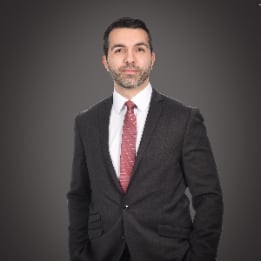
Interim chief executive officer and chief legal officer | Windsor-Detroit Bridge Authority

Chuck Andary
Interim chief executive officer and chief legal officer | Windsor-Detroit Bridge Authority
Career Biography
Chuck Andary serves as Interim chief executive officer and chief legal officer of the Windsor-Detroit Bridge Authority (“WDBA”), a federal Crown corporation responsible for the C$6.4 bn. Gordie Howe International Bridge, one of the most complex bi-national infrastructure projects in North American history.
In January, 2026, just months before the bridge’s anticipated opening, Chuck was appointed interim chief executive officer of the WDBA while maintaining his role as chief legal Officer. Before Chuck had even completed his first month as Interim CEO, the US administration threatened to block the Bridge’s opening. Chuck became involved in high level briefings while also developing WDBA’s legal strategy in response to the discourse. Ultimately, as events unfolded in the public, the bridge opened to traffic in July, 2026.
Upon his appointment, Chuck assumed responsibility for directing all corporate operations, strategic planning, stakeholder relations, and business execution during the most critical phase of the project’s lifecycle.
As CEO, Chuck’s mandate extends far beyond legal risk management. He directs a multi-disciplinary executive team overseeing capital delivery including design and construction, border operations, asset management, finance, legal and insurance, and stakeholder and community relations. He reports directly to a government-appointed Board of Directors and ultimately to Parliament through the Minister of Housing, Infrastructure and Communities. He leads WDBA’s engagement with critical government partners, including Housing, Infrastructure and Communities Canada, Transport Canada, Global Affairs Canada, the Department of Justice, the Michigan Department of Transportation, the Michigan Governor’s Office, and the Attorney General of Michigan.
Chuck’s leadership demands political acumen and diplomatic finesse. Managing a bi-national infrastructure project during geopolitical instability requires balancing Canadian sovereignty interests with cross-border partnership obligations. He navigates federal parliamentary oversight, responds to media scrutiny, defends budget decisions before legislative committees, and maintains productive relationships with Bridging North America, the multinational consortium responsible for design, construction, financing, operation, and maintenance under the public-private partnership agreement.
While Chuck retains his chief legal officer title administratively, his day-to-day focus is unequivocally executive: setting strategic direction, making high-stakes operational decisions, managing stakeholder expectations across multiple jurisdictions, and positioning the WDBA for long-term commercial success. His role shifted from advising on risk to owning organizational outcomes. He now executes the corporate strategy, drives competitive market positioning, and is wholly accountable for the WDBA’s commercial success.
What are the most significant matters, transactions, or legal initiatives you and your team have been involved in over the past 12–18 months?
In my role as chief legal officer, I am the lead advisor in relation to all disputes and legal strategy in relation to potential disputes that arise on the $6.4 bn. Gordie Howe International Bridge Project. I am also responsible for managing all jurisdictional legal considerations and numerous important stakeholder issues at various levels of government in the United States and Canada while providing the Bridge Authority with advice regarding all legal issues and governance issues.
How has your organisation’s risk profile evolved in response to geopolitical uncertainty, trade dynamics, particularly Canada–US relations, or regulatory change, and how has the legal function adapted?
The Gordie Howe International Bridge is a new major crossing at the busiest trade corridor between the US and Canada. In 2026, shortly after I was appointed as interim CEO, the project was subject to commentary at the highest levels of US and Canadian politics. The organization, and the legal team, had to adapt to a new political landscape which introduced new risks particularly right before the opening of the crossing.
This process also involved briefing public officials at the highest levels and participating in strategy discussions regarding the new risks associated with the crossing. For the legal team, cross-border considerations on permitting, constitutional authority, trade, and contract became prominent where using both in-house and external resources became critical for both WDBA’s position as well as WDBA’s advice to government.