
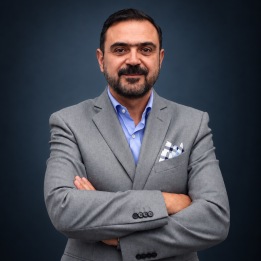
Head of Legal (GC) | Parks Industrial


Vicente Tamés
Head of Legal (GC) | Parks Industrial
Career Biography
Vicente Tamés Gómez is a seasoned attorney with more than twenty-five years of experience advising and leading organisations in highly regulated industries, with particular expertise in real estate, infrastructure, corporate compliance, government affairs and complex transactions.
Throughout his career, he has combined the technical rigour of a business lawyer with the strategic perspective of a senior executive, playing a direct role in the development, structuring and operation of large-scale real estate projects across Mexico. He currently serves as Head Legal (GC) of Parks Industrial, one of the country’s leading industrial development platforms, overseeing legal matters related to a portfolio exceeding eleven million square metres of industrial assets across multiple strategic markets nationwide.
His experience encompasses the negotiation and structuring of real estate acquisitions, industrial lease agreements, trusts, joint ventures, financing and sophisticated corporate transactions. He has been actively involved in matters related to institutional investment vehicles, including the creation and consolidation of some of Mexico’s leading real estate platforms. In addition, he has led negotiations involving domestic and international investors, government authorities and global corporations across a broad range of industries.
Prior to his current role, he held senior leadership positions at O’Donnell Group, where he served as Chief Legal and Compliance Officer, overseeing legal, compliance and corporate governance functions for various real estate portfolios with a nationwide presence. He also built a distinguished career in both the federal public sector and the financial services industry, serving with the Federal Attorney for Environmental Protection (PROFEPA) and Grupo Financiero Bancomer (BBVA).
Widely recognised for his ability to align legal strategy with business objectives, Vicente is distinguished by a commercial mindset that extends beyond the traditional practice of law. His approach focuses on value creation, risk mitigation, institutional strengthening and the development of long-term relationships with investors, clients and government stakeholders.
He earned his Law Degree from Escuela Libre de Derecho, completed studies in Strategic Public Policy Management at the Goldman School of Public Policy, University of California, Berkeley, and obtained an MBA from Universidad Antonio de Nebrija.
His professional profile reflects the rare combination of lawyer, negotiator and business leader capable of transforming legal functions into sustainable competitive advantages for the organisations he serves.
What do you think are the most important attributes for a modern in-house counsel to possess?
In today’s business environment, technical legal expertise is merely the starting point. A modern in-house counsel must first and foremost be a business leader who understands how legal decisions affect growth, risk, operational efficiency and long-term value creation.
The most important attribute is the ability to align legal strategy with business strategy. General counsel are no longer expected simply to identify risks; they are expected to facilitate opportunities, provide practical solutions and help the organisation achieve its objectives while maintaining the highest standards of governance and compliance.
Another critical quality is adaptability. Businesses are operating in an increasingly complex environment shaped by geopolitical uncertainty, technological disruption, evolving regulatory frameworks, cybersecurity challenges and heightened stakeholder expectations. Effective legal leaders must be capable of anticipating change, managing ambiguity and helping their organisations remain resilient under rapidly changing circumstances.
Equally important is commercial judgement. The best in-house lawyers understand that every decision involves balancing legal risk against business objectives. Being able to communicate complex legal concepts in clear, actionable terms allows legal departments to become trusted advisers to executive leadership and business teams.
For companies operating at scale, particularly in sectors such as industrial real estate and infrastructure, collaboration and stakeholder management are also essential. A successful General Counsel must build partnerships across functions, including commercial, operations, finance, development, tax, construction, compliance, sustainability and human resources, ensuring that legal considerations are embedded in strategic decision-making rather than addressed after the fact.
Finally, I believe integrity remains the defining characteristic of any great legal leader. Trust is the foundation of the General Counsel role. Boards, executives, investors, customers and employees rely on legal leaders to provide independent judgement, uphold ethical standards and protect the organisation’s reputation. In an era when reputational risk can be as significant as legal risk, integrity is not only a professional obligation but also a competitive advantage.
In short, the modern in-house counsel must combine legal excellence, commercial acumen, strategic vision, adaptability, leadership and unwavering integrity to create sustainable value for the business.
General counsel often speak of the need to be strategic to reach the pinnacle of the profession. What does being strategic mean to you?
In my opinion, being strategic means looking beyond legal risk and understanding how the legal function can create value, accelerate growth and support the company’s long-term objectives. A strategic General Counsel is not simply an adviser who answers legal questions; they are a business partner who helps shape decisions before they are made.
In the industrial real estate sector, where I have developed my professional career, legal decisions are closely linked to investment, development, operations, financing, and customer relationships. Being strategic requires understanding the business drivers behind every projectand aligning legal solutions with the company’s commercial goals while maintaining appropriate governance and risk management standards.It also means thinking ahead. The most effective legal leaders anticipate regulatory changes,market trends, geopolitical developments, and emerging risks before they impact the business. By identifying opportunities and challenges early, the legal department can help the organizationmake informed decisions with greater confidence and speed. Equally important is the ability to balance risk with opportunity. A strategic General Counsel understands that avoiding all risk is neither practical nor desirable. The objective is to enableresponsible growth by helping the business take calculated risks while protecting its people,assets, reputation, and stakeholders.Finally, being strategic means building trust and influence across the organization. Legal leadersmust collaborate closely with executive management and business teams, ensuring that legal considerations are integrated into decision-making from the outset. When legal is seen as asolution-oriented partner rather than a gatekeeper, it becomes a true driver of sustainable value creation.