
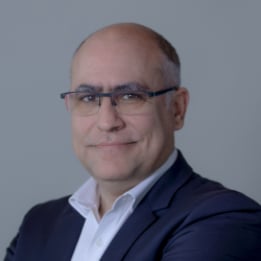
Group General Counsel, Vice President Legal, Risks and Compliance, Company Secretary | Colas Group

Emmanuel Rollin
Group General Counsel, Vice President Legal, Risks and Compliance, Company Secretary | Colas Group
Team size: 250
How do you ensure the legal function supports business resilience during periods of uncertainty or disruption?
The legal function supports business resilience by helping the company anticipate risk, prepare for disruption, and make sound decisions when circumstances change rapidly. Our contribution begins well before a crisis occurs. We monitor geopolitical, environmental, regulatory, and economic developments, assess how they may affect operations, and translate uncertainty into practical scenarios for management. This forward-looking approach enables the business to identify vulnerabilities, preserve strategic options, and respond with greater speed and confidence. Three priorities underpin this work: recruiting adaptable professionals, fostering innovation, and building a strong global legal team.
Selective recruitment is therefore essential. Legal expertise remains the foundation of our profession, but it is no longer sufficient on its own. Lawyers must also demonstrate sound judgement, curiosity, strong interpersonal skills, adaptability, and an open mind. They need to understand the business model, listen closely to operational teams, and distinguish between risks that must be avoided and risks that can be managed. These qualities allow them to develop innovative solutions, communicate clearly under pressure, and deal constructively with unfamiliar situations. Resilience also depends on continuous learning: we must develop existing team members, expose them to different jurisdictions and business environments, and prepare them to assume broader responsibilities when normal reporting lines or established processes are disrupted.
Innovation is the second lever. The legal function must adapt its services and operating model to digital transformation and an increasingly global business environment. Technology can improve access to reliable information, automate routine tasks, accelerate document review, and provide decision-makers with a clearer view of legal exposure across the organisation. However, innovation is not simply a matter of deploying new tools. It also requires simpler processes, consistent data, clear governance, and appropriate controls. In a crisis, these foundations make it easier to identify the relevant facts, coordinate advice across jurisdictions, and provide timely recommendations. They also allow lawyers to devote more attention to strategic analysis, negotiation, and the human dimensions of difficult decisions.
Team spirit is equally important. A shared sense of purpose and belonging strengthens the global legal community and ensures that colleagues support one another when local teams face exceptional pressure. This cohesion is built on common values, professional standards, and objectives, including the delivery of high-quality analysis and advice while continually pursuing greater efficiency. It also depends on strong networks: people must know whom to contact, feel comfortable asking for help, and be willing to share experience across countries and areas of expertise. Regular collaboration before a crisis creates the trust and reflexes needed during one. A global legal function can then redeploy resources, compare responses across jurisdictions, and maintain consistency while remaining sensitive to local constraints.
During periods of uncertainty or disruption, our managerial role becomes critical. We must set clear priorities, define responsibilities, make timely decisions, and maintain close communication with both our teams and business leaders. The legal function should help management understand not only what the law requires, but also the available courses of action, their consequences, and the safeguards needed to implement them. At the same time, we must protect the wellbeing and effectiveness of our teams by managing workloads, encouraging escalation, and ensuring that difficult decisions are documented. After the immediate disruption has passed, we should capture lessons learned and use them to improve contingency plans, contractual protections, compliance processes, and training. In this way, the legal function does more than respond to crises: it strengthens the organisation’s capacity to absorb shocks, adapt, and continue pursuing its strategic objectives.
What is the biggest shift you have seen in the role of General Counsel over the past five years, and how do you see it evolving further?
Over the past five years, two developments have most significantly reshaped the General Counsel’s role: the global expansion of compliance obligations and the rapid growth of digital technologies, particularly artificial intelligence.
First, compliance responsibilities have expanded worldwide as governments have adopted regulations with extraterritorial reach across multiple jurisdictions. General Counsel now design compliance processes, tools, and training programmes, while also overseeing internal investigations, sanctions matters, and negotiations with financial institutions and prosecuting authorities. Having become more closely involved in business operations and strengthened their negotiation and contract-engineering capabilities, General Counsel are now broadening their focus to encompass corporate matters and enterprise-wide risk management.
Second, digitalisation and artificial intelligence are creating opportunities to improve efficiency through process automation and the large-scale review, analysis, and drafting of documents. These technologies are reshaping both how the legal function operates and how it is organised. They are also transforming professional development: tomorrow’s senior lawyers will follow different learning paths, requiring us to recruit professionals with new skill sets while helping current team members adapt.
Together, these developments are transforming the General Counsel from a legal adviser into a broader business leader responsible for legal expertise, legal operations, compliance, and enterprise-wide risk management.
What is one leadership principle or practice that has had the greatest impact on your career as a General Counsel?
Trust has been the leadership principle with the greatest impact on my career as a General Counsel.
Trust cannot be established by decree. It may develop rapidly during a crisis, when people must rely on one another, but it is usually built over time through consistent actions and strong working relationships.
Trust between the CEO and the General Counsel is fundamental to our role. The General Counsel must have the CEO’s full trust in order to provide candid, high-quality advice. The matters we handle are becoming increasingly sensitive as compliance obligations expand and regulations acquire greater extraterritorial reach. The same need for trust applies to our relationships with other members of the executive team, particularly during periods of uncertainty or disruption, when we must work together to address difficult challenges.
Mutual trust within the team is equally essential. Trusting our team enables us to delegate effectively, save time, and focus on developing a global and strategic vision. Building that trust requires setting clear expectations and communicating our values. It also requires courageous leadership: we must be highly selective when recruiting and hold team members to demanding standards of commitment and performance. Trust is reciprocal, however. Team members will commit fully to the mission only if they know that we will protect and support them and help them grow within the organisation.
Trust will become even more important in the years ahead as we reshape our organisation in response to global crises and the rise of artificial intelligence.
Group General Counsel, Vice President Legal, Risks and Compliance, Company Secretary | Colas Group
Group general counsel, vice president legal, risks and compliance, company secretary | Colas Group
Directeur Juridique, Conformité et Risques – Secrétaire du Conseil d’Administration / Group General Counsel & Chief Compliance Officer – Company Secretary | Colas
Group general counsel, vice president legal, risks and compliance, company secretary | Colas Group

Group general counsel, vice president legal, risks and compliance, company secretary
Colas Group
View Powerlist

Group general counsel, vice president legal, risks and compliance, company secretary
Colas Group
View Powerlist
Group General Counsel, Vice President Legal, Risks and Compliance, Company Secretary
Colas Group
View Powerlist