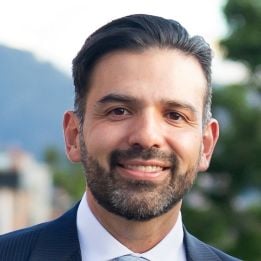
Head of legal and compliance, LATAM | WTW


Fabian Moreno
Head of legal and compliance, LATAM | WTW
Team size: 15+
What are the key projects you have been involved in over the past twelve months?
Over the past twelve months, I have focused on two key strategic priorities across Latin America: leading regional M&A initiatives and driving the implementation of technology-enabled legal transformation projects.
From an M&A perspective, I have been leading and coordinating multiple transactions across the region, acting as a central sponsor for cross-functional teams. My role has involved aligning legal, compliance, commercial and operational workstreams, ensuring that transactions are executed efficiently while maintaining robust risk management standards. This coordination has been particularly critical in a fragmented regulatory landscape, where each jurisdiction requires a tailored approach. As a result, we have successfully advanced several strategic acquisitions in the region, creating opportunities for scalable growth.
In parallel, I have led the regional rollout of new contract management technologies designed to standardise and streamline legal processes across jurisdictions. Acting as the executive sponsor of the initiative, I have coordinated teams across countries to ensure consistent adoption, while adapting the implementation to local regulatory and operational requirements. The outcome has been the successful deployment of a unified framework that enhances efficiency, improves contract governance, and enables greater visibility over legal risk and obligations across the business.
Can you describe an instance where your legal advice directly influenced business strategy or commercial objectives?
A significant part of my role involves leading and shaping the strategy behind M&A opportunities across Latin America, where legal input is not only supportive, but also central to decision-making and execution.
In several transactions, I have taken a leading role in structuring and negotiating deals, managing internal resources, coordinating external counsel and engaging directly with target companies. Beyond the legal execution, my contribution has focused on defining how transactions are strategically positioned, ensuring that the proposed structures are both commercially attractive and viable within the regulatory frameworks of each jurisdiction.
By proactively identifying legal and compliance constraints — and transforming them into structured, executable solutions — I have supported commercial teams in advancing opportunities strengthening our positioning in the region.
What key trends should in-house counsel be monitoring over the coming months?
One of the most significant trends that in-house counsel should be closely monitoring is the rapid development and implementation of artificial intelligence, particularly generative AI, within legal functions.
The evolution of these technologies is exponential rather than linear, and it is already starting to reshape how legal teams operate. From corporate governance tasks to contract drafting and execution, AI is not only enabling automation, but also increasingly supporting conceptual and analytical legal work.
While this transformation will not eliminate the need for human lawyers, it will fundamentally change team structures and efficiency expectations, requiring legal leaders to adapt quickly while maintaining strong governance frameworks.
How do you manage situations where legal advice and commercial objectives conflict?
Managing the tension between legal advice and commercial objectives is one of the defining elements of an effective in-house lawyer. This requires balancing business enablement with risk management, supported by a deep understanding of the organisation’s priorities and operating model. Rather than acting as a blocker, the in-house lawyer must position themselves as a facilitator, identifying solutions that allow the business to move forward while preserving appropriate legal safeguards.
How has the role of general counsel evolved, and what are the most important attributes for the modern in-house lawyer?
The role of the general counsel has evolved from a purely technical legal function to a strategic management role integrated within the business. Modern in-house lawyers must not only understand the law, but also speak the language of the business, interpreting financial indicators, commercial priorities and operational realities to deliver practical and value-driven advice.
Ultimately, the general counsel acts as a business partner, contributing directly to decision-making and supporting sustainable growth.
Head of legal and compliance Latam | WTW
Legal vice president and corporate secretary | Arthur J. Gallagher
Legal vice president and secretary general | Arthur J. Gallagher Colombia
Assistant general counsel (Colombia, Peru and Venezuela) and CRB co-lead (Latin America) | Willis Towers Watson
Fabian Moreno Barbosa, has been the assistant general counsel for Colombia, Peru, and Venezuela at Willis Towers Watson since 2014. Before this he was an attorney at the Colombian Insurance...