Legal counsel | Gulfstream Petroleum Dominicana

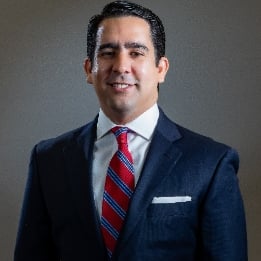
Joan Fernández Osorio
Legal counsel | Gulfstream Petroleum Dominicana
Short biography
For the past 12 years, Joan Fernández Osorio has led legal strategy and regulatory compliance at Gulfstream Petroleum Dominicana, S. de R.L., a leading company in the liquid fuels sector in the Dominican Republic. He has more than 18 years of specialised experience in commercial, corporate and hydrocarbons law, as well as civil and commercial litigation.
His extensive background in the energy sector includes serving as Director of Regulation, Importation and Uses of Hydrocarbons at the Ministry of Energy and Mines of the Dominican Republic. Before moving into the corporate and public sectors, he developed his private practice at leading Dominican law firms, including Castillo & Castillo and Guzmán Ariza.
Joan holds a Bachelor of Laws (LL.B.) from Universidad Católica Nordestana (UCNE) and a Master’s degree in Corporate Law from Universidad Antonio de Nebrija in Madrid, Spain, sponsored by Landwell-PricewaterhouseCoopers. His international training includes advanced specialisation in international oil and gas law, contracts and negotiations in Houston, Texas, supported by institutions including the Institute for Energy Law. He also holds credentials in trusts, fiduciary operations, civil law and real estate law.
What are the most significant cases, projects or transactions that you and your legal team have recently been involved in?
Recently, my legal team and I have been driving several high-impact initiatives that directly safeguard our operations and support our regional growth. Operating in the highly regulated downstream liquid fuels sector in the Caribbean requires us to balance cross-border expansion, sophisticated corporate finance and stringent local regulatory compliance. Having been with the company for some time, I have participated in many of its expansion and strategic refocusing processes, including M&A transactions in the Dominican Republic, Sint Maarten, Jamaica and Haiti. These transactions required navigating distinct Caribbean regulatory landscapes, structuring cross-border financing and managing complex asset transfers within demanding timelines.
A major financial milestone for our team was the structuring and successful legal placement of our corporate bond issuance. This required rigorous corporate governance and extensive structural work. Beyond the issuance itself, it has transformed our routine operations, requiring the legal team to maintain high standards of transparency and manage critical institutional relationships through direct and ongoing engagement with external auditors and bondholder representatives.
At a local level, we continuously navigate a highly fluid regulatory environment, handling significant compliance and reporting matters before our principal national regulators, particularly the Superintendency of the Securities Market (SIMV) and the Ministry of Industry, Commerce and MSMEs (MICM). By maintaining legal alignment with the state’s fuel pricing, subsidy mechanisms and compliance requirements, we have positioned the legal function as an execution engine that mitigates contingencies while helping the business achieve its commercial objectives.
How do you approach managing legal aspects during periods of instability or crisis to ensure the organisation’s resilience?
Managing legal matters during a crisis requires moving from a traditional advisory role to becoming a pragmatic strategic ally. In the Dominican Republic’s downstream fuel sector, geopolitical instability can have an immediate impact on supply chains and local regulation.
To ensure organisational resilience, I focus on four pillars: contractual engineering to provide sufficient flexibility to respond to global trade disruption without unnecessary financial exposure; proactive government relations to maintain alignment with national energy security objectives and evolving subsidy frameworks; financial stakeholder transparency to preserve investor confidence; and agile execution to assess exposures objectively and develop the appropriate legal pathways required to move the business forward.
What do you think are the most important attributes for a modern in-house counsel to possess?
In-house counsel must be a strategic ally to the business. This requires a deep understanding of both the company and its sector, combined with strong commercial acumen, clear communication, pragmatic risk management and high emotional intelligence.
Above all, in-house counsel must remain curious and adaptable in order to truly understand the company’s objectives, operating environment and market position.
We are currently living through a time of geopolitical change, and the world order that we have come to take for granted for many years is being rewritten. Does this affect your company’s risk profile and, if so, what are you doing to mitigate this?
In the Caribbean, and particularly within the Dominican Republic, global geopolitical shocks can translate immediately into local regulatory and national security challenges. Because the country relies on imported refined products, international disruption increases our local risk profile in relation to supply continuity, state-regulated pricing and fiscal compliance.
To mitigate these systemic risks, the legal function operates as a core strategic ally to the business. Leveraging our deep understanding of the local regulatory landscape, we work proactively with the authorities to ensure that our operations remain aligned with national energy security objectives, effectively navigate the state’s fuel subsidy and pricing mechanisms, and maintain full compliance with evolving administrative laws.
By acting as a transparent and agile partner to the state, we help protect the business from global volatility while supporting uninterrupted fuel distribution across the Dominican economy.
Have you had any experiences during your career as a lawyer that stand out as particularly unique or interesting?
Throughout my career, I have had the opportunity to bridge complex dispute resolution, high-stakes corporate strategy and sovereign policymaking. My early career was shaped in the courtroom, handling high-value civil, commercial and real estate litigation. After moving into the corporate arena, I applied that experience to major cross-border M&A transactions across the Caribbean, including in the Dominican Republic, Jamaica, Sint Maarten and Haiti.
My work has also included structuring complex credit facilities with international financial institutions, managing multi-jurisdictional collateral frameworks and navigating corporate restructurings. This experience has given me a 360-degree legal perspective, enabling me to provide objective and sophisticated solutions tailored to the needs of the business.
My corporate finance and regulatory experience ranges from participating in the structuring of our landmark 2018 corporate bond issuance to overseeing ongoing compliance with key regulatory authorities, including the SIMV and MICM. I also manage important institutional relationships through direct engagement with external auditors and bondholder representatives.
This experience has been further enriched by my time in the public sector, where I coordinated the structuring of a landmark preliminary draft law intended to reorganise and regulate the upstream hydrocarbons subsector in the Dominican Republic, which was submitted to the General Counsel to the Presidency. I also contributed to the modernisation of the national legal framework governing hydrocarbons exploration and exploitation, alongside nationwide regulatory oversight.
Having worked on both sides of the table has given me a rare and comprehensive perspective, allowing me to align corporate objectives with complex regulatory and sovereign considerations.