Chief legal and compliance officer | Höegh Evi AS

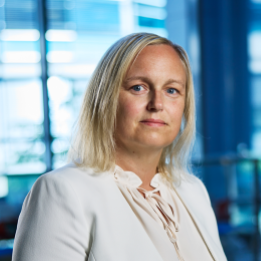
Camilla Nyhus-Møller
Chief legal and compliance officer | Höegh Evi AS
Team size: The legal and compliance division totals 11 people, covering legal, compliance, QA&Risk, security and emergency preparedness and ICFR.
What are the key projects that you have been involved in over the past twelve months?
In May 2025, funds managed by Igneo Infrastructure Partners (Igneo) acquired a 50% ownership stake in Larus Holding Limited, the 100% owner of Höegh Evi, from funds managed by Morgan Stanley Infrastructure Partners (MSIP). The principal investment holding company of the Høegh family retained its 50% ownership interest.
Höegh Evi signed a ten-year time charter agreement with Egyptian Natural Gas Holding Company (EGAS) in May 2025 for the deployment of Hoegh Gandria as a floating storage and regasification unit (FSRU) in Egypt. The FSRU will be deployed in Q4 2026 to the Port of Sumed and will supply up to 1,000 mmscf/day of peak LNG regasification capacity, making it a critical part of Egypt’s diversified and flexible energy infrastructure. On the back of the EGAS contract, the company entered into a contract for the conversion and longevity of the LNG carrier, Hoegh Gandria to a FSRU which includes the installation of a regasification skid, as well as integration of key supporting systems such as cargo handling, utility, offloading, electrical, and automation systems.
As the world continues to face geopolitical, technological and economic uncertainty, how do you manage legal risk while still prioritising commercial objectives?
Given the breadth of my role across legal, compliance, governance and risk, my approach is to manage uncertainty through structure, prioritisation and clear decision frameworks. Rather than attempting to eliminate risk, I focus on ensuring risks are understood, owned and actively managed within an agreed risk appetite.
By integrating legal and compliance considerations into enterprise risk management, governance and strategy processes, I help ensure commercial objectives are pursued with clear visibility of constraints, dependencies and escalation thresholds. This allows the business to move forward with confidence, even in volatile geopolitical, technological and economic conditions, while maintaining discipline, accountability and long-term resilience.
As AI becomes increasingly integrated into legal teams, and the pressure grows to ‘do more with less’, how can GC balance efficiency, quality and human judgement?
As AI becomes more embedded in legal teams, the GC’s role is to ensure technology is used as an enabler, not a substitute, for legal judgement.
Efficiency gains come from deploying AI where it adds most value – for example, we are subscribing to an AI contract software for document review and contract analysis. However, critical decision-making, risk appetite and stakeholder judgement are conducted by the in-house counsel.
We are also in the process of recruiting a legal technology and knowledge specialist to ensure tools are deployed responsibly, embedded into workflows and continuously evaluated for quality and risk.
Ultimately, “doing more with less” is not about replacing human expertise, but about augmenting it. The GC must set clear standards for quality, accountability and ethical use of AI, ensuring that efficiency gains enhance – rather than dilute – the quality and credibility of legal advice.
Beyond your core legal role, are there any causes or initiatives you’re passionate about?
Beyond my core legal role, I am particularly passionate about building effective enterprise risk management as a practical decision‑support tool. Last year, I played a central role in developing a new ERM framework for Höegh Evi. The process focused on establishing a clear and common risk language across the organisation, as well as defining and obtaining board approval for risk acceptance levels and risk statements aligned to our strategy, and introducing meaningful KRIs and clear red lines. This has strengthened management and board discussions by making risk trade‑offs more transparent, supporting informed decision‑making and clarifying ownership and escalation thresholds.
I see ERM as a critical enabler of resilient growth – particularly in a capital‑intensive and highly regulated environment – and I am committed to ensuring it remains a living framework that supports, rather than constrains, the business.
Chief legal & compliance officer | Höegh Evi
Senior vice president (legal and compliance) and general counsel | Höegh LNG AS
Camilla Nyhus-Møller has been at Höegh for almost 10 years. ‘When I started working in the Höegh Group in 2006, Höegh LNG was not established as a separate company. As...

Senior vice president (legal and compliance) and general counsel
Höegh LNG AS
View Powerlist