
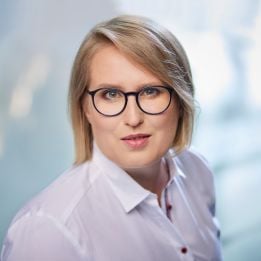
General counsel | R.Power Group


Sabina Blitek
General counsel | R.Power Group
Team size: 15
What are the key projects that you have been involved in over the past twelve months?
Over the past twelve months, I have led a portfolio of transactions worth EUR 1 billion, each critical to R.Power Renewables’ growth and financial strength. The two most significant projects were the €165m Green Bond Issuance and a €250m Equity Capital Increase.
For the Green Bond Issuance, I led the refinancing of existing PLN bonds alongside the Group’s first euro-denominated bond issuances. These multi-jurisdictional transactions were executed entirely in-house, covering structuring, drafting, and direct negotiations with leading banks, investment funds, and international financial institutions. They were highly complex due to stringent investor standards, rigorous ESG and due diligence requirements, and cross-border regulatory compliance. Successfully closing these bonds demonstrated that large-scale capital markets processes can be driven internally, with the in-house legal team playing a leading rather than supporting role. It also confirmed R.Power’s ability to operate at a global institutional level.
For the €250m Equity Capital Increase, I served as the sole legal lead for the final phase of R.Power’s major equity raise with top institutional investors. I ensured that all documentation, governance arrangements, and ownership structures were fully aligned. The complexity of finalising large-scale investment agreements required a strategic, detail-oriented approach and the ability to manage high-stakes processes independently.
In addition to these projects, I oversaw other cross-border transactions, including joint ventures, project financings, and partnership contracts across Poland, Romania, and Portugal, ensuring that all initiatives met both legal and strategic objectives.
What do you think are the most important attributes for a modern in-house counsel to possess?
A great in-house lawyer is not merely a legal adviser, but a trusted partner who combines deep legal expertise with a clear understanding of the business. This combination must be matched by the ability to communicate effectively with executive management, helping them navigate complex decisions and deliver tangible business outcomes. I would not have been able to lead legal teams for the past 20 years without understanding hard business metrics and speaking the language of executive boards.
Equally, to build trust, legal leaders must take responsibility for outcomes, not merely for opinions. This demands the confidence to challenge assumptions, the discipline to focus on what is truly material, the ability to operate in an environment of uncertainty, and, most importantly, the judgment to know when to escalate issues versus when to enable the business to progress.
AI is increasingly being integrated into legal teams to maximise efficiency. How can in-house counsel ensure the successful incorporation of these tools without compromising the human element?
We must be very clear about what AI can be used for and what it cannot. AI should support legal work in areas where it adds the most value – such as research on defined databases, document review, and the summarising of large volumes of information – while legal judgment, accountability, and decision-making must remain firmly with people. With this in mind, legal teams require three things: a clear understanding of AI’s advantages and limitations, training in effective prompting, and the discipline to critically review AI outputs, as AI-generated results should always be treated as a starting point rather than a final answer and assessed through both legal and business judgment.
What is particularly noteworthy is that an AI-driven world creates a genuine opportunity for greater diversity in leadership. As routine tasks are automated, human-centric skills become decisive: empathy, communication, and relationship-building. These qualities are often associated with women, meaning many are already well equipped for the leadership challenges of tomorrow. I am actively involved in mentoring programmes and supporting women in leadership, which is why this topic is especially close to my heart.