
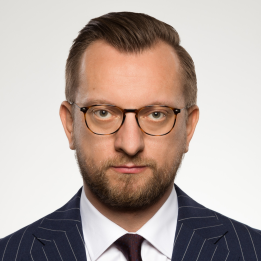
Director - head of legal operations | Union Energy Group/Loyd’s Aviation Group


Wojciech Królak
Director - head of legal operations | Union Energy Group/Loyd’s Aviation Group
Career Biography
Wojciech Królak is a senior in-house lawyer recognised for leading complex cross-border legal strategy and execution in regulated, asset-intensive sectors, particularly energy and aviation. As Director and Head of Legal Operations, he operates at the intersection of law, finance and business decision-making, supporting international groups active in multi-jurisdictional and highly regulated environments.
He has led and coordinated legal workstreams on large-scale strategic investments involving regulated infrastructure and natural resource assets, acting as the central legal interface between shareholders, management, regulators and external advisors. His role has focused on transaction structuring, leading negotiations on key legal and commercial terms, and ensuring that governance frameworks and risk allocation mechanisms support long-term value creation.
A defining feature of his professional profile is legal leadership through coordination, judgement and execution rather than technical drafting alone. He regularly manages multi-jurisdictional advisory teams and aligns legal strategy with commercial objectives, enabling organisations to deliver high-value projects while maintaining disciplined risk control. By positioning the legal function as an execution partner to management, he has contributed to the development of robust shareholder arrangements, governance structures and decision-making processes in complex ownership settings.
Beyond transactional work, he has also played an important role in shaping scalable legal operating models within growing organisations. He has overseen multi-million USD legal budgets and allocated resources on a project- and risk-based basis, with a focus on early-stage structuring, clear prioritisation and disciplined use of external counsel. This approach has helped reduce future legal and regulatory exposure while supporting efficient execution.
Working across Poland, Israel, Malta and other EU and non-EU jurisdictions, Wojciech has developed extensive experience in navigating fragmented regulatory frameworks and coordinating stakeholders with differing legal, cultural and commercial perspectives. This cross-border exposure has reinforced his belief that effective in-house counsel must provide clear, practical and decision-oriented guidance that enables boards and executives to act with confidence in uncertain environments.
He is particularly interested in the evolving role of general counsel as strategic business partners. In his view, modern in-house lawyers must combine technical expertise with commercial judgement, accountability and the ability to articulate complex risks in concise and actionable terms. He also supports the responsible use of technology and AI within legal teams to enhance efficiency, while ensuring that ownership of key decisions and accountability remain firmly human.
Throughout his career, Wojciech has operated in high-stakes contexts where legal, financial and operational considerations converge. His experience as both legal advisor and execution partner has shaped a pragmatic, outcome-focused approach grounded in trust, ownership and long-term value protection.
What are the key trends that in-house counsel should be monitoring in 2026?
One of the most significant trends is the shift of responsibility towards in-house teams in increasingly complex and fragmented regulatory environments. Businesses are operating across multiple jurisdictions, often with overlapping or inconsistent regulatory regimes, and are expected to move quickly despite that uncertainty. This places in-house counsel at the centre of strategic decision-making rather than in a purely advisory role.
Another key trend is the rising expectation that legal functions contribute directly to value creation, not only risk mitigation. Boards and management increasingly look to GCs to help structure transactions, governance and operating models that enable growth while remaining resilient to regulatory and enforcement risk.
Finally, in-house counsel should closely monitor the personal accountability of senior management and legal leaders, particularly in regulated sectors. This reinforces the importance of sound judgement, clear documentation and the ability to articulate risk in a way that supports informed business decisions.
Have you had any experiences during your career as a lawyer that stand out as particularly unique or interesting?
Working at the intersection of law, finance and operations across multiple jurisdictions has been particularly formative. Acting simultaneously as a legal advisor and execution partner to management has taught me the importance of pragmatism, speed and accountability in complex decision-making environments.
What do you think are the most important attributes for a modern in-house counsel to possess?
Beyond technical legal expertise, a modern in-house counsel must have a strong commercial instinct, and a deep understanding of how the business operates. Legal advice only adds value if it is actionable and aligned with commercial reality.
Equally important is the ability to prioritise risk. Not all risks are equal, and part of the GC’s role is to distinguish between theoretical exposure and issues that genuinely matter to the organisation’s objectives. This requires confidence, judgement and the willingness to take responsibility for clear recommendations.
Finally, effective communication is critical. A GC must be able to translate complex legal and regulatory issues into concise, understandable guidance for management and boards, enabling timely and well-informed decisions.
At the same time, a modern GC must also be willing to take ownership of decisions and stand behind them alongside management.
AI is increasingly being integrated into legal teams to maximise efficiency. How can in-house counsel ensure the successful incorporation of these tools without compromising the human element?
AI has become an effective tool for improving efficiency, particularly in areas such as document review, contract analysis and risk spotting. However, its successful use depends on clear ownership and governance within the legal function.
In-house counsel must treat AI as decision support rather than decision-making. While technology can identify patterns and flag issues, responsibility for judgement, context and final advice must remain firmly with the lawyer. This is especially important in complex transactions and regulatory matters where nuance and experience are critical.
Used correctly, AI allows legal teams to spend less time on repetitive tasks and more time on strategic thinking, stakeholder engagement and forward-looking risk management. The human element remains essential, particularly where trust, accountability and judgement are concerned.