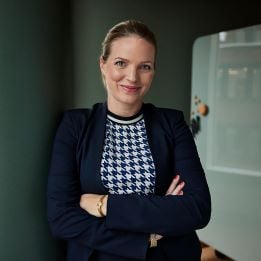
Group general counsel | Sector Alarm Holding AS

Christine Stousland
Group general counsel | Sector Alarm Holding AS
Team size: A lean, senior in‑house legal team, comprising a central group capability of two and local Heads of Legal across Norway, France and Spain
What are the key projects that you have been involved in over the past twelve months?
Since stepping into the Group General Counsel role in Sector Alarm, my focus has been on aligning the legal function with Sector Alarm’s commercial strategy and risk appetite. This includes initiating a group wide legal strategy workshop to identify pressure points and align legal priorities.
A key strategic project during the past twelve months has been Sector Alarm’s acquisition of the Spanish operations of ADT, a milestone transaction supporting the group’s growth ambitions and making Sector Alarm the third largest alarm company in Spain by onboarding more than 100,000 new customers. I’m supporting the ongoing post-closing phase from a group legal perspective, with a particular focus on governance and integration related considerations.
As the in-house role continues to evolve from legal advisor to business partner, what strategies have you found most effective for stakeholder management and aligning legal advice with business strategy?
Effective alignment starts with deliberate calibration between legal priorities and business strategy. Whether establishing a legal function from scratch or stepping into an established Group General Counsel role, I focus early on defining a legal strategy that explicitly derives from the company’s commercial objectives and risk appetite. By doing so, the legal strategy creates a common language and functions as an internal alignment tool that enables fast growth and supports cross-border operations.
From a stakeholder perspective, I’m intentional about framing legal input in the context of decisions. By framing issues as business decisions with legal risk attached, rather than “legal problems”, ownership remains with management. This strengthens accountability and allows the organisation to move faster with confidence.
I care deeply about building environments where people feel supported to make decisions, understand the risks involved, and know when and how to involve legal. Ultimately, the role of the in-house function is not to absorb risk on behalf of the business, but to surface it clearly and early as part of decision‑making so it can be managed well.
What key trends – and challenges – should in-house lawyers be monitoring over the next year?
One of the most significant trends is that AI and legal tech are increasingly capable of supporting legal analysis at scale, allowing parts of the more standardised legal assessments to be distributed beyond the legal function. The differentiator for in-house teams is therefore their ability to increasingly architect the frameworks, guardrails and escalation points, as well as translating legal insight into clear actionable decisions.
Many legal teams are also expected to support faster growth amid increased regulatory complexity, often with limited resources. This makes structure, predictability, shared language and compliance by design critical. This further elevates the role of the general counsel as an integrated business partner.
As a result, legal teams that rely on documents and end-stage escalation will struggle to scale. Those that embed legal insights into business processes will optimise decision quality and speed in complex, fast‑moving environments.
VP Legal | Autostore AS