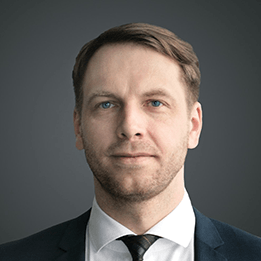

Senior Legal Counsel, Head of Global Practice Areas | Andritz


Alexey Gorlatov
Senior Legal Counsel, Head of Global Practice Areas | Andritz
Team size : 10
We are currently living through a time of geopolitical change, and the world order that we have come to take for granted for many years is being rewritten. Does this affect your company’s risk profile and, if so, what are you doing to mitigate this?
Geopolitical change affects the risk profile of most international businesses. It is no longer an exceptional factor, but a constant part of the commercial environment. Sanctions, export controls, tariffs, supply-chain disruption, payment restrictions and regulatory fragmentation increasingly influence how companies assess markets, counterparties and contracts. This is particularly visible in negotiations. Contracts are becoming more complex, and counterparties are often more sophisticated, cautious, and commercially pressured. As a result, provisions on risk allocation, termination rights, force majeure, sanctions, change in law, price adjustment and dispute resolution are no longer purely legal details; they are central and big business issues. A practical response is to treat legal risk as part of business risk. The legal function should be involved early in commercial decision-making and work closely with management, finance, procurement, compliance, and operations. Its role is increasingly that of a business partner – helping to identify risks early, structure transactions properly and preserve flexibility if circumstances change. In short, geopolitical change increases complexity, but it also makes the legal function more strategic. The objective is not to eliminate risk entirely, but to understand it, allocate it deliberately, price it correctly and ensure that the business remains able to respond quickly to changing circumstances.]
What do you think are the most important attributes for a modern in-house counsel to possess?
A modern in-house counsel needs to combine strong legal expertise with commercial judgment, responsiveness and a client-service mindset. Business teams increasingly expect legal to provide clear, practical, precise and workable solutions, not just identify risks. In-house counsel must therefore be approachable, business-oriented, and capable of building strong internal relationships, while maintaining independence and sound legal judgment.
Based on your experiences in the past year, are there any trends in the legal or business world that you are keeping an eye on that you think other in-house lawyers should be mindful of?
The main trends I would highlight are geopolitical uncertainty, increasing contract complexity, AI and legal technology, regulatory fragmentation, and the evolving role of the legal function. These are all pushing lawyers beyond a traditional advisory role. Lawyers will be expected not only to identify legal risks, but to help the business make decisions, structure solutions, manage uncertainty, and respond quickly to change. The lawyers will need to act less as purely legal advisers and more as business partners, risk managers and problem-solvers.
Senior legal counsel, head of global practice area | ANDRITZ AG
Senior legal counsel | ANDRITZ
Senior legal counsel | ANDRITZ