
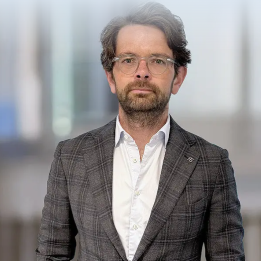
General counsel | Fidelium Partners


Dr Constantin Wegener
General counsel | Fidelium Partners
What are the most significant cases, projects and/or transactions that you and/or your legal team have recently been involved in?
Over the past year, my work has continued to focus on complex M&A transactions, with a particular emphasis on private equity-led acquisitions, carve-outs, and distressed situations. A recurring theme across many mandates has been the increasing structural complexity of transactions, often driven by geopolitical uncertainty, regulatory scrutiny, and challenging financing environments.
On the private equity side during my time at Hengeler Mueller, I have advised several sponsors and portfolio companies on both acquisitions and exits across a broad range of industries, including software, industrials, automotive supply, marketing services and facility management. These transactions frequently involved cross-border elements, requiring close coordination with international counsel and careful alignment of transaction structures across jurisdictions. In a number of cases, carve-outs from large corporate groups played a central role, demanding intensive legal support on separation mechanics, transitional service arrangements, and risk allocation.
Another important area of work has been transactions in distressed or near-distressed settings. These mandates often require balancing transaction certainty with insolvency-law considerations, including structuring solutions that remain robust even under heightened financial stress. In this context, my academic background and practical experience in insolvency and restructuring law have been particularly valuable, especially when advising on trustee solutions, insolvency-proof financing structures or contingency planning in competitive auction processes.
In addition, I spent nine months as a Visiting Lawyer in Canada, where I was involved in large-scale international transactions, including strategic equity investments and acquisitions in highly regulated sectors. These matters provided valuable insight into different deal cultures and regulatory environments and reinforced the importance of flexibility and pragmatism in cross-border transactions.
As General Counsel to Fidelium, I am responsible for all legal matters relating to the Fidelium funds, covering the full investment lifecycle from acquisition and holding to exit. This includes structuring and executing investments, managing ongoing legal and governance matters at fund and portfolio level, and supporting exit processes in close coordination with financial and commercial stakeholders. I report directly to the managing directors and founders of Fidelium, which allows the legal function to be closely integrated into strategic decision-making and ensures that legal considerations are embedded early in the investment process.
AI has been taken seriously as a potentially revolutionary technological change in the legal world for a number of years now. Has it had a meaningful impact in how your legal team works in this time?
AI has started to have a tangible impact on how legal teams work, although its role is currently best understood as an enabler rather than a replacement for legal judgment. In transactional practice, AI-supported tools are increasingly used for tasks such as document review, contract analysis, and the identification of risk patterns in large data sets. This has improved efficiency, particularly in due diligence processes, and allows lawyers to focus more on structuring, negotiation strategy, and client-facing advice.
That said, the use of AI in legal practice requires a cautious and well-governed approach. Issues such as data protection, confidentiality, and professional responsibility are critical, especially in jurisdictions with strict regulatory frameworks. For this reason, AI tools are most effective when deployed within clearly defined boundaries and combined with robust human oversight.
From my perspective, the most meaningful impact of AI lies in its ability to enhance quality and consistency, rather than simply speeding up processes. When used responsibly, it can support better risk assessment and help legal teams allocate their resources more strategically. Looking ahead, I expect AI to become a standard component of legal workflows, while the core value of lawyers will continue to lie in judgment, experience, and the ability to navigate complex commercial realities.