Is Ecuador ready for an influx of foreign investment?

Regardless of the fact that Ecuador’s economy is the eighth largest in Latin America and the Caribbean (among 33 countries), Ecuador has amazing potential of business activities in the mining, energy, tourism and agriculture industries. With large natural mineral reserves (in gold, cooper and iron), amazing conditions for the development of energy projects, especially photovoltaic and hydroelectric energy, incredible tourism locations such as the Galapagos Islands, beautiful highlands, and considered to be one of the most bio-diverse countries in the world, Ecuador is also one of the top exporters worldwide of bananas, shrimp, flowers and cacao.

Due to all these interesting factors and many others like a dollarized economy, the government’s current policy has been focused in promoting attractive conditions for foreign investors and working on improving the benefits that were already granted in the Organic Code of Production, Commerce and Investment (COPCI) published in December 2010, but had little or none effect during the previous government (aligned to Hugo Chavez ideology).

The Law of Productive Development, Attraction of Investment, Employment Generation and Fiscal Stability (Investment Law) enacted in august 2018, offers to investors the possibility of obtaining interesting benefits such as: tax exemptions (income tax and currency remittance tax), reduction of custom tariffs, legal stability and entering into arbitration agreements while entering into Investment Agreements with the State, which has given law firms a new scope of work that involves project finance, tax, regulatory matters and contracts.

Furthermore, Ecuador offers investors a dollarized economy and a much more transparent State which has promoted transparency and the implementation of ISO 37001 anti-bribery among its government institutions and companies. These benefits have caused almost a 130% increase in foreign direct investment in comparison to the former government as per studies of the Central Bank of Ecuador.

However, despite the new foreign investors that came in different industries due the favorable conditions of the Investment Law and the effort of the current government to solve the extremely high debt left by the former government (which in addition to other matters caused a division among the elected political party, some in favor of the previous government and some in favor of the actual government), the economy of Ecuador was affected again by a combination of different factors.  These are the social unrest events that occurred not only in the country but also in the Latin American region around October 2019, followed by the oil crisis (price-drop), the damages in the local oil pipelines due to massive landslides and COVID-19.

COVID-19 impact not only revealed the deficit in the country’s health system but also caused the lockdown of the country and the suspension of most economic activities for a couple of weeks. As a consequence, certain small businesses have faced bankruptcy or many other, have had to reduce their production capacity and employment force, generating many opportunities for law firms in debt restructuring, ADR and labor advice, that had to innovate their services to provide legal assistance while working from home.

In addition, Ecuador has upcoming presidential elections on February 2021, and the political scenario is uncertain due to the fact that most of the high public official (President, Vice President and some ministries) of the former government have been prosecuted in relation to corruption allegations, and there is low probability that they can run for a public position. As such, after 14 years of having the same political party in government, there is a high probability of having a different political party achieving the presidency.

Some of the key aspects take into account while deciding to invest in Ecuador are the following:

Key Indicators for 2020 and forecast

Current Business Environment

Sources: INEC and Central Bank of Ecuador.

Tax Regulation

Bellow a brief description of the main taxes applicable to commercial activities in Ecuador:

a) Income Tax

Income tax taxes the rent obtained by persons and local and foreign companies. Under the Ecuadorian law, income refers to:

Income from Ecuadorian source obtained free of charge of from work or capital.

Income obtained from abroad by persons domiciled in Ecuador or by Ecuadorian companies.

The tax basis is the total taxable income, less returns, discounts, costs and expenses deductible and attributable to such income. In general terms, the rate for companies is of 25%.

b) Value Added Tax

Tax on the value of transfer of ownership or import of goods, services, copyrights, industrial property and related rights. A 12% rate is applied over the price of goods and services. Some exceptions may apply to certain goods and services that will be taxed with a 0% rate.

c) Currency Remittance Tax (ISD)

The Currency Remittance Tax (ISD) taxes transfers in cash, through money orders, bank transfers, shipment, withdrawals or any payment of any kind, of currencies sent abroad, with the exception of an account clearing made with or without the intermediation of financial institutions.

The tax rate of 5% is applied over the value of the currency transfer. This tax is declared and paid by the financial institution by which the financial operation is carried out.

d) Capital Gains Tax or Property Transfer Tax

The tax rate for Capital Gains Tax and Property Transfer Tax ranges from 2% to 10%.

Labor – Profit sharing

15% of the net earnings of a company are distributed to all employees in the payroll. It can also apply to employees of companies that provide the company complementary services such as catering, security, cleaning and courier services. From the 15%, 10% is divided and distributed to all employees. The remaining 5% is distributed in accordance with the employee’s household.

Profit Sharing in mining, oil, and hydroelectric companies: as an exception to the general profit sharing rule, that the 15% of the annual profit must be distributed to all employees, in the case of mining, oil and hydroelectric companies it is only distributed 3% to all employees in the payroll, and 12% is distributed to the state.

Public Private Partnerships

The government has promoted Public Private Partnerships (PPP) which can be established for the provision of goods, building infrastructure, or services. All terms and conditions of PPPs are set out in a contract that must be signed with the public entity.

The PPPs have, among others that might be agreed upon the contractual parties, the following incentives:

a) Legal stability.

b) Income tax Exemption: Income tax exemption for ten years in projects in the prioritized sectors determined by an inter-institutional committee, period which starts from the first fiscal year in which the company generates operating income.

c) Currency Tax Remittance Exemption:  All companies that participate in an PPP will be exonerated from ISD in the following scenarios:

  • In the importation of goods for the execution of the public project, whatever the import regime used.
  • In the acquisition of services for the execution of the public project.
  • The payments made by the company to the financiers of the public project, including capital, interest and commissions, provided that the agreed interest rate does not exceed the reference rate at the date of registration of the credit. The benefit extends to subordinate loans, provided that the borrowing company is not in a situation of undercapitalization in accordance with the general regime.
  • The payments made by the company for distribution of dividends or profits to its beneficiaries, notwithstanding where they have their fiscal domicile.
  • Payments made by any person or company due to the acquisition of shares, rights or participations of the structured company for the execution of a public project in the PPPs modality or for transactions that fall on securities representing obligations issued for the financing of the public project.

d) Reduction of tariffs: Customs tariffs that are related to the PPP projects will also be exonerated

e) International or domestic arbitration agreements

The incentives mentioned above may be enjoyed for the term agreed upon in the contract, with the exception of the income tax exemption, which can only be 10 years.

Investment Contracts

The Investment Law and COPCI benefits are directed to those new investments (either made by foreign or local investors) that meet the criteria of new productive investments in prioritized sectors of the economy that increases production and generates new employment.

The benefits granted by the government will depend on the investment project, its location, its industry, whether is a new company or an existing one, amongst other criteria, as shown bellow:

a) Total or partial income tax reduction from 8 to 15 years.

b) Currency Remittance Tax (“ISD”) exemption for the payment of imported machinery and raw materials, and for the payment of profits to foreign shareholders.

c) Tax stability for up to 15 years of the current applicable income tax rate. This provision does not provide stability for municipal, customs nor VAT Taxes.

d) Temporary exemption of custom tariff.

e) International or domestic arbitration is available for investors.

Initially, the aforementioned benefits apply for those investments made up to August 2020, but the President has recently extended the benefit for 2 years more, until 2022.


See more from Paz Horowitz at: www.pazhorowitz.com

Ivan Loynaz, general counsel, Latin America, 3M

I am from Venezuela and for most of my career I was based there. I moved to Panama five years ago when 3M relocated me to takeover legal responsibilities for countries across Central America and the Caribbean. After two and a half years I relocated to Mexico to become general counsel there. In 2020, I moved back to Panama as general counsel for Latin America, overseeing legal operations in the health care, transportation and electronics sectors.

I started this new role during the pandemic and have overseen the company’s involvement in a range of initiatives during this period. 3M has been very focused on increasing production of respirators. As a company are working together to get things where they need to be, utilising our own distribution channels. It is important to note the company has not increased the price of respirators. In fact, 3M has been fighting against price gouging and many other types of fraud in both the United States and Latin America. There have been fewer cases in Latin American than in the US.

Legally, we have taken a global approach, rather than a local one. Legal departments across the company have aligned their goals for Latin America, USAC (United States and Canada) and Europe.

One of the biggest challenges that I have experienced in recent months has been dealing with the speed of change. Governments have generally relaxed their rules to allow healthcare products to come into countries easier,  while some jurisdictions have made it harder to export products deemed necessary during the pandemic. Dealing with different jurisdictions and trying to standardise the way in which we work has been our biggest goal. It is a challenge when deciding how to balance multiple jurisdictions – you cannot work with 15 countries in 15 different ways. We need to find a midpoint that works across varying countries.

For example, if I am drafting an agreement that I would like to be used as a template for both Mexico and Argentina, I cannot put into that agreement the initial part of the document, as the format will be different for each country. If I insist on having that part of the document done in one single way for Latin America it would simply fail. If I focused on the little things, I would lose sight of the bigger picture.

No matter what jurisdiction we are dealing with, general counsel need to be more business minded  than external counsel. Being part of a company is very different to being part of a law firm. Your state of mind needs to be focused on what the company needs, and on how the company’s goals  can be achieved through different tools. That is where the IT team here at 3M steps in and integrates those tools, sometimes even delivering new tools on demand. When I was in Venezuela I asked the IT team to develop a tool for my internal client agreements. I was tired of people coming to my office to request an agreement with a range of stipulations, without giving me the details that I would need in order to draft the agreement.  The IT team developed technology that would make it easier to extract the relevant information I would need to draft that agreement. However, as things evolved, that particular technology is not efficient enough anymore.

At the moment, there are a number of tools on the market that companies can purchase. They can then adapt those tools to the company’s needs. That is exactly the case for 3M. We have been working with management tools for agreements as well as repository tools to be more efficient. We as a legal department are very much like a sponges. We need to be aware of and absorb a lot, whilst always adapting to the needs of the business. Our goal is to serve the business – there is no question ever about that. We then have to be innovative, and we need to be fast. We aim to help business teams do what they need to do – which in the end is to sell our products.

To that extent, it is really important to adapt to the needs of the business and to take advantage of all the tools we have to make work easier. But I have to admit that the legal department does complain in order to get the technologies that help us become more streamlined. That is the nature of being human, if we did not complain we would not be able to improve things.

I miss being able to go into to work and see people in our Panama office. Looking to the future, I think this moment of time has accelerated things within the industry. We definitely need to move towards becoming more efficient, and to find a balance between being compliant with the law and doing the right thing. I know doing the right thing is a subjective concept, but it is important to try and do what is right at a particular moment when you are faced with a particular situation. As a lawyer, the personal values you have and believe in, are a big part of it.

Of course, you also need support from the business. In a company like 3M, when a lawyer says something is not right, the issue will be heard and observed. Legal departments do not only report to their businesses, but also to a wider legal code. Everybody knows the opinions of lawyers matter – and although lawyers can sometimes get it wrong – companies trust their legal departments. 

Overview: Guatemala

As a macroeconomic preamble, Guatemala is a developing country highly dependent on agricultural products, textile manufacturing, remittances sent by expats and a strong informal economy (which represents 22% of the overall GDP). The country enjoys a stable currency without drastic inflation, even with the COVID-19 crisis, the cumulative inflation rate is at 2.16% and has inflationary rhythm of 2.39%. This strong currency has had a negative impact on exports’ revenue, another extremely relevant economic sector.

Interestingly, on May 2020, Guatemala reported a 2.2% increase in exports compared to May 2019. Guatemala’s main export products are: i) textiles and apparel (10%); ii) cardamom (8.2%); iii) coffee (8.1%); iv) sugar (7.7%); and v) bananas (7.6%). These five products accrue for 41.6% of overall exports. On the import side, on May 2020 Guatemala reported a -9.5% decrease on imports compared to May 2019. This is mainly due to a -35% decrease on the imports of fuel and lubricants and a -17.3% decrease on consumer products. Although exports play a critical role, from 2018 to 2020 Guatemala has maintained a trade deficit of an averaged US$3,93bn. From a trade in services perspective, Guatemala’s balance of payments reflects an overall reversion of the trade deficit with a significant increase in the export of manufacturing services. However, this trade surplus rhythm went from 2013 until 2018 and was interrupted in 2019, when Guatemala reported a trade deficit of US$46.8m.

Despite these not so negative numbers, due to the current COVID-19 economic crisis, the Guatemalan Central Bank has adjusted its economic yearly growth projection from 3.5% to 0.5%-1.5% for 2020. From a microeconomic perspective, both social distancing and transit limitation dispositions rendered by the government have significantly impacted the services sector. For example, projections show a negative impact in hotels and restaurants with an estimated reduction of -24.3%, transportation with -14.7%, basic services (water, electricity and gas) with -9.4% and real estate services with -8.4%. Even though it may seem that the supply chains have not been substantially strained, they reported a turnover decrease of 20%-40% in March 2020. Depending on the length of the crisis, Guatemala could be facing a loss of 97,000 to 177,000 formal jobs.

To mitigate this crisis, the Guatemalan government has increased the national budget on Q19bn quetzales (around US$2.5bn) in order to create public funds for social and economic purposes that will inject liquidity to the economy. 80% of the Q19bn was financed by the emission of treasury bonds and the remaining 20% was covered via institutional loans. These measures have increased the fiscal deficit by 5.7% in comparison with 2019. Surely, this will have an impact on the macroeconomic indicators of the country. Furthermore, the government has also suspended: i) certain tax obligations reducing collection by 3.3% (which will intensify this fiscal deficit); ii) the payment of Bono 14, a yearly mandatory bonus that employers pay to employees. Such provisions, along with the social distancing and transit limitations guidelines, have impacted the conducting of business of our clients; influencing their business projections in a short- and long-term perspective. They turn to their trusted legal advisors and appreciate a holistic approach in their everyday challenges.

Within this context, the Guatemalan legal market is going through a very pressing and critical time. COVID-19 has, not only disrupted the way legal services are rendered, but also drastically shaped our clients’ current needs. The new reality has forced law firms to migrate to a full home office model, challenging the in-office stereotype enshrined in the legal profession.

As many law firms have moved to a mandatory home office, it is important to closely monitor the working culture of their employees and substantially rely on their technological platforms to enable a smooth transition. Before the COVID-19 outbreak, the home office standard had a limited and informal presence within the law practice. Many law firms allowed lawyers to work half a day from home, but it was not formally stated as an internal policy. At EY, employees have always enjoyed a mandatory policy requiring them to work from home at least once a week. This has nourished the home office culture and facilitated the migration to a full home office model overnight without compromising efficiency.

Our clients have constantly relied on our services in order to help them better understand the impact changing COVID regulations could have on their daily operations. We have created multidisciplinary service packages where EY’s legal division works closely with other service lines within our multidisciplinary teams, advising our clients to tackle most of their COVID necessities from a legal, financial and tax perspective. Within the legal element of this full package, we have detected a strong need for advice in the labor, contractual, tax and regulatory areas.

The M&A market has also been impacted by the current situation. The buy side M&A practice has observed dynamism triggered by big companies. Certain groups are using this crisis as an opportunity to expand their operations by acquiring smaller companies in distress for a better price. This has generated several opportunities for our transactional practice.

The COVID-19 crisis has brought uncertainty. It is an ongoing crisis with unpredictable effects continuously unfolding without a clear projection, affecting all sectors of the economy – and the legal market is no exception. However, with change as the only constant, organizations are forced to keep up with this roller coaster by rapidly evolving their internal administration and the manner in which they are addressing their clients’ needs. Survival depends on resiliency and the ability to adapt.


See more from EY at: www.ey.com

2020 Compliance Trends in Latin America

Fraudsters, money launderers, and corrupt government officials in Latin America (LATAM) have been running rampant, capitalizing on the coronavirus emergency. COVID-19 is posing unprecedented challenges to compliance professionals in LATAM, both in-house and external, for preventing, detecting, and reacting appropriately to compliance risks, especially in a remote working environment replete with financial strains, and massive surges in alerts caused by changes in the behavior of clients, employees and third parties.

Against this unprecedented backdrop, we present the following summary of recent compliance trends for organizations doing business in LATAM.

Additional corruption risks

With governments in the region allocating significant resources via expedited public procurement processes, the risk of corruption has dramatically increased in LATAM. Further, as pressures grow on sales representatives, consultants, and distributors to keep businesses afloat, individuals are tempted to bribe government officials. Not surprisingly, law enforcement agencies in Mexico, Guatemala, Honduras, Panama, Colombia, Ecuador, Bolivia, Argentina and Brazil are conducting criminal investigations against a number of senior officials for participating in schemes to misappropriate emergency COVID-19 funds, or for engaging in the fraudulent purchase of ventilators, masks and other medical supplies.

Critically, multinationals face heightened exposure to corruption allegations, because such enterprises can potentially, in the course of regular business operations, inadvertently assist, sponsor, or provide financial, material or technological support for forms of corruption such as the misappropriation of public funds, collusion, opaque contracts, and overpricing. The risk is even higher when organizations interact with government officials, especially in situations involving government procurement and inspections, customs clearance, licensing and permitting and donations.

Ramifications for multinationals operating in LATAM of being involved in, or associated with, corrupt practices is significant. For example, they can be the target of US enforcement actions, including criminal investigations under the Foreign Corrupt Practices Act (FCPA) for suspected involvement with bribery of foreign officials, and/or under the US Money Laundering Control Act for engaging in monetary transactions in corruption proceeds. Additionally, foreign companies believed to be involved in corruption can have their assets blocked under the Global Magnitsky Human Rights Accountability Act.

In fact, the US Government has continued to aggressively fight corruption in LATAM this year through criminal and civil penalties, in addition to economic sanctions. Notably, the Department of Justice (DOJ) has criminally charged individuals and corporations for FCPA violations in connection with the bribery of foreign officials in or from countries such as Uruguay, Brazil, Panama and Venezuela.

The US Government also recently released new compliance guidance to enhance its FCPA-related enforcement efforts globally. On 1 June 2020, the DOJ released its revised Guidance on Evaluation of Corporate Compliance Programs to further explain its assessments of the design, implementation, and effective operation of corporate compliance programs in criminal cases. And, a month later, the DOJ and the Securities and Exchange Commission (SEC) released a new edition of their FCPA Resource Guide, which advises on prosecutorial guidelines in FCPA matters.

Also, the US Government has expanded its economic sanctions related to countries that are believed to be under corrupt regimes, such as Venezuela. Specifically, the US Government has sanctioned several individuals, entities, and vessels for operating in designated sectors of the Venezuelan economy, or for their attempts to evade US sanctions related to Venezuela.

Coronavirus-Related Fraud

Law enforcement agencies from Panama to Argentina are investigating criminals impersonating government agencies, international organizations, and healthcare facilities to solicit donations, steal personal information, or distribute malware (imposter scams); fraudsters misrepresenting that the products or services of publicly traded companies can prevent, detect, or cure the coronavirus (investment scams); companies selling unapproved or misbranded products that make false claims pertaining to COVID-19 or fraudulently marketing COVID-19-related supplies (product scams); individuals and entities stockpiling items in high demand to sell them at extremely high prices online and in person (price gouging); and insiders conducting transactions based on, or tipping others with, material non-public information about the negative impacts of COVID-19 on the financial performance of shares (insider trading). Business email, telework, and social media scams, ransomware attacks, and phishing email schemes have also proliferated in regions such as Puerto Rico, Guatemala and Mexico.

Organizations should take great care to familiarize themselves with emerging trends associated with coronavirus-related fraud identified by regional law enforcement agencies, in order to promptly detect and report criminal activity. In addition, businesses applying for relief programs offered by governments in LATAM should track and understand the eligibility requirements under local statutes, to prevent future civil and/or criminal liability for sanctioning benefits fraud.

Increase in Money Laundering (ML) And Financing of Terrorism (FT)

On April 8, 2020, the Financial Action Task Force of Latin America (GAFILAT) issued its ‘Statement on COVID-19 and its associated Money Laundering ML and FT risks.’ In it, GAFILAT cautioned that controls aimed at preventing and combating ML and FT in the region have been compromised by the pandemic, due to a decrease in compliance staff at reporting entities. GAFILAT also warned that criminal organizations are stepping up recruitment to support ML-related activities, and that pawn shop services, lenders, as well as informal financing are being used for ML and FT in the region now more than ever.

In fact, a number of law enforcement agencies in LATAM are witnessing an increase in the recruitment of people, sometimes under the pretext of legitimate employment, to receive deposits of illegal money into personal bank accounts; as well as an increase in illicit financial flows, including trade misinvoicing, tax evasion and the criminal smuggling of cash, gold, diamonds, and illicit goods across borders.

There is also a growing concern among Governments in LATAM of criminals using cryptocurrency in the midst of the pandemic to hide the illicit origin of funds stemming from blackmail, extortions, imposter and investment scams, and charities fraud.

Recommendations

While most government agencies in the region have granted some measure of regulatory relief to organizations upon considering the current circumstances, there is no ‘pandemic defense’ for violating applicable laws. Organizations should make every effort to meet their compliance obligations, such as filing suspicious activity reports and conducting comprehensive, risk-based, and integrated customer and third-party due diligence.

Given the additional risks caused by COVID-19 in LATAM, organizations should also update their risk profile to determine where vulnerabilities exist and enhance their controls, including customer and third-party due diligence procedures, around those vulnerabilities. For example, organizations should design and implement digital identity systems under the on-point guidance issued by the Financial Action Task Force (FATF) on 6 March 2020. In it, the FATF explains several factors for assessing whether a digital identity system is sufficiently reliable and independent to conduct customer due diligence.

Lastly, organizations should make the best of technological resources to provide employees, customers, and third parties with training programs, together with mentoring and capacity building support, so all stakeholders are familiar with the red flags of fraud, corruption, and money laundering, and can take timely and appropriate remedial action.


See more from Diaz Reus at: diazreus.com

Overview: Honduras

The following article contains an overview on Honduras and the impact that COVID-19 has had in different regions country-wide.

Honduras has a population of approximately nine million, and, like most countries, is struggling in many areas due to the pandemic. Honduras has one of the highest rates of COVID-19 infections in the Central American region.

The Honduran government has approved a set of measures that benefit the many affected industries, for example by granting limited economic relief to employees in the tourism and ground transportation sectors.

Regarding tax matters, an extension was granted for the deadline for filing the Annual Transfer Pricing Information Affidavit for the fiscal year 2019, which must be filed no later than 31 July 2020.

All calendar days are declared as non-working days for the period in which the declaration of emergency originated by the COVID-19, except those days that are necessary in order to comply with the obligations.

The deadlines for filing returns and paying sales tax for the months affected by the emergency decreed by the COVID-19 are extended to all taxpayers who have not carried out operations within the same period of the emergency. These will now be filed no later than ten working days after the end of the state of emergency.

Taxpayers who keep all their employees within the period from the declaration of the state of emergency arising from COVID-19 until December 2020, in respect the payment of wages and labor rights and who have not suspended or terminated their employment contracts, will be granted an additional special deduction from their gross income. Such deduction is equivalent to 10% calculated on the payment of wages and salaries in the months during which the state of emergency is decreed, which may be accounted for as a deductible expense for income tax purposes in the 2020 fiscal period. This benefit will not apply in cases where the employer terminates or suspends employment contracts.

On the labor law practices, COVID-19 has changed the normal operations from the government and private entities. As in other regions, ‘the new normal’ is the work from home solution, known as ‘Home Office’. Even though Honduras has no specific laws for Home Office, unlike many other countries, the Honduran Government issued an emergency decree which authorizes Home Office as a possibility to deliver work. This not only applies to private companies, but also to public employees. Honduran Law defines Home Office as the activity that is developed outside the facilities of the employer, using the information and communication technologies for the development of the work. Employees of any public or private entity can perform their work totally or partially at a distance from their workplace.

The obligations of employers and employees remain the same according to the Honduran Labor Code.

The return to work in Honduras has been very slow. An economic and labor reactivation has been established for specific periods of time of 45, 60 and up to 75 days divided into three regions distributed according to the amount of contagion by COVID-19. However, this may vary depending on the amount of contagion in such areas. Every Sunday since mid-March 2020, the Honduran government has issued curfews for one or two weeks, allowing only specific companies to operate normally with the now customary protocols.

Soon, Honduras will – on a provisional basis – apply a model that allows a percentage of employees to work from home and others to continue working from the office to protect the general population and promote savings in the operating expenses of employees, such as office supplies and utilities.

We also expect an increasing number of labor disputes in the Labor Administrative Offices due to the loss of jobs, which will likely generate direct intervention by the Supreme Court. Also, an increasing number of civil procedures is expected in relation to contractual breaches, especially in the real estate sector.

Even though this will be the biggest recession in Honduran history and it will definitely have strong effects on private entities, this will be an opportunity for the country and for foreign investors to navigate into more modern and improved industries and technologies such as telecommunications, digital marketplaces, cybersecurity, programming and technology, education, medical services, product distribution, convenience stores/supermarkets and a more modern agro-business sector. With local or foreign companies investing in these areas, Honduras will generate more job opportunities, and government incentives are expected to this effect.

Work related to debt restructuring has also increased in Honduras due to the resulting economic implications of the current situation. We expect a substantial number of companies to file insolvency and liquidation procedures. We have been advising clients in strategies that can support business continuity at all levels, on an integrated basis, with our other service lines covering all aspects of a business operation.

EY Law has not stopped working amid the devastating impact of the pandemic in Honduras. Our firm has applied Home Office for many years in this country and our timely implementation of the best technology has been a key issue to the success of our business and our clients in this difficult time.


See more from EY at: www.ey.com

Data Analysis 2: Legal Team Multitool

The responses to The Legal 500 and GC magazine’s GC Powerlist: Latin America Survey illustrate the far-reaching and continuously expanding role that in-house counsel are playing in their businesses across the region. General counsel are a multitool, able to step in and assist their company as needed. But this also means that the differences between in-house roles are becoming more distinct: the portfolio of one general counsel might look very different from another, even in the same jurisdiction.

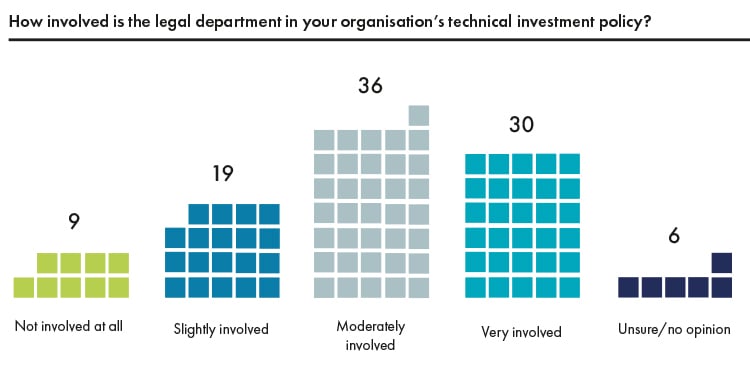
For example, as a part of the survey, participants were asked about the role they play in their organization’s technology investment policy. When asked how involved they were, nearly as many characterized themselves as ‘very involved’ as they did ‘slightly involved/not involved at all’ (30% and 29%, respectively).

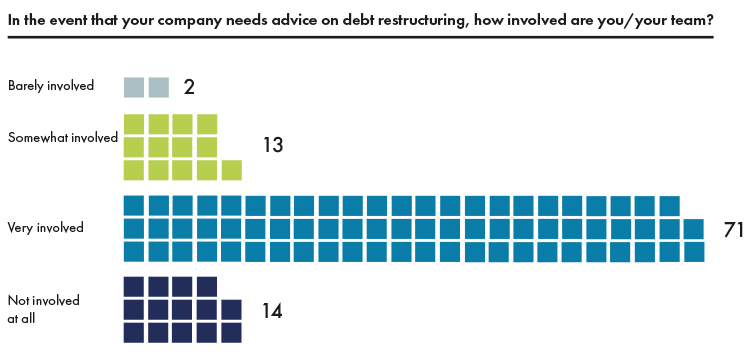
Similarly, though the majority reported being ‘very involved’ in the event that the company needs advice on debt restructuring (72%), the second-most common answer was that the legal team is never consulted in these scenarios (14%).

‘Yes, I am proud to say that my team is very responsible with their work and with the company,’ gushes Alejandro Fernandez, head of legal at Cotemar in Mexico.

‘But how they are showing commitment is amazing. They just do not comply with their daily activities, but they interact with other areas to provide support – even if there is not related to legal performance.’

The versatility of in-house counsel has come to the fore over the course of 2020, but a widely held view among the Latin American in-house counsel interviewed for this survey is that the challenges of this year have merely given the opportunity for lawyers to demonstrate a level of adaptability and utility that was always there.

‘It has just confirmed that we are committed and always business oriented, and very creative in addressing difficult times, such this one,’ says Catalina Gavivria, legal vice president at  SBS Seguros in Colombia.

‘We are always asking about business results and we know that if we deliver our work quickly, it will facilitate business.’

When asked what he’d learned about his team over the past year, Jorge Hirmas, general counsel at Orica in Chile, pointed to ‘resilience, the capacity to adapt and quickly adopt change and perform under unprecedented strenuous and stressful circumstances’. The words ‘adaptability’ and ‘resilience’ came up a lot over the course of the research conducted for this report.

‘Resilience, empowerment, independence, high accountability’, were the words offered by Pablo Urrego at Diageo.

‘Creativity is a part of our job’, says Alfonso Videche, regional legal director for Colgate-Palmolive.

Overview: Chile

Sanitary and economic crises are challenging Chile’s modernization. Great leadership to guide Chile in combining the right experiences from the past and adapting the country to new demands and reality will be needed to overcome social and economic difficulties Chile is currently facing.

Chile is generally regarded as South America’s most stable and prosperous country, renowned for competitiveness, political stability, economic freedom, and low perception of corruption. Its market-oriented economy, based on a neo-liberal model implemented in the 70’s, is characterized by a high level of foreign trade, open market policy and sound financial institutions and policy. Chile is member of the OECD, being the only South American member (together with Brazil) with a GDP worth USD$282.3bn, and a GNI of USD$15,010, similar to countries like Poland or Croatia. It has the second-lowest tax burden in the OECD and the government maintains a tight rein on fiscal spending, ensuring the highest credit rating among the major economies of Latin America. It is an active member of the Pacific Alliance, the principal regional multilateral trade platforms, and has bilateral free trade agreements with basically all of the major economies in the world.

Being primarily a mining-based economy, Chile enjoyed for several years high economic growth figures of about 5%. Growth rates were, pre-COVID-19 , between a more modest 2% and 4% and similar rates are expected for 2021.

Chilean economic policies favor foreign investments. FDI increased by 63% from USD$7bn to USD$11bn in 2019, sustained by investment in utilities, mining and services. FDI stocks reached USD$268bn, a rise of more than USD$100bn if compared to 2010. Investments are mainly oriented towards mining, finance and assurance, transportation, energy and manufacturing.

The coronavirus crisis and simmering discontent over inequality in a neo-liberal economic model have forced the conservative government under President Sebastian Pinera to adopt measures that both allow for political reforms and stimulate the economy. It announced a constitutional referendum which will be held in October, which may lead to a new model that minimizes social disparities and equalizes the distribution of wealth, and is in the process of implementing a fiscal stimulus package worth USD$11.8bn (4.7% of GDP) to increase productivity and innovation in key sectors.

The stimulus package covers, among other things, increased investment in infrastructure, implementing protective measures to protect workers against a loss of income, providing support through tax measures and the creation of social funds and state backed credits. In parallel, the parliament just adopted a controversial reform, not backed by the government, allowing citizens to have 10% of their pensions savings paid out as emergency coronavirus aid and is discussing legislation prohibiting utilities companies to cut basic services (water, gas, electricity and internet) in case of non-payment by their clients. The Central Bank of Chile, for its part, reduced the fiscal policy interest rate to 0.5% and announced an increase of its bond purchase program of USD$4bn as well as measures loosening regulatory credit requirements.

An injection of over USD$8bn is projected into water and other infrastructure, including short-term projects worth USD$150m starting in 2020. The projects include road maintenance, the building of irrigation systems, drinking water facilities, hospitals, ports, airports, and inland water management systems. Most of these projects will be carried out through private or public concessions and the Ministry of Public Works has already initiated the first tenders in the public health care sector worth USD$2.5bn.

The temporary tax measures, loosened credit requirements and government reliefs include, amongst others: 0% stamp tax rate for credit, financial and refinancing transactions (until October 2020); expenses incurred in Covid-19 related measures will be deductible for income tax purposes; deferral of VAT payable with 0% interest; deferral of annual income tax payment for small and medium sized companies; early return on income tax; deferral of payment of real estate tax; deferral of mortgage backed loans; flexibilization of loan maturities for small and medium-sized companies; increase of the credit capacity of the National Bank to mainly support citizens and micro businesses; creation of a social fund for micro businesses; state support to finance credits for micro businesses; and subsidies and socials fund for citizens without formal employment and unemployment insurance.

In addition, and in order to generate additional resources to the State, opposition deputies of the opposition presented a draft constitutional reform that would allow to establish a capital tax, a project currently under discussion in Congress and which has received strong criticism from experts, taking into account the lack of clarity of the tax to be established, lack of clarity in the determination of the associated tax base and the effects that taxes of this kind have generated in legislation, and that are associated with wealth and capital flight.

Employment and security related measures adopted or underway include: temporary unemployment insurance; the possibility for an employer and employee to agree on a suspension of the labor relationship or reduction of the work hours with a proportional reduction of the salary, cases in which the affected employees access to the benefits of their unemployment insurance; suspension of working contracts in case of a mandate by the competent authority with access to the same benefits; safety obligations to assure the health and wellbeing of the employees. New regulation on ‘teleworking’ (Law N° 21.220) was adopted regulating remote work and work by technological means, establishing rights and duties for workers and employers. The adopted measures have been a relief for employers and employees, as they intend to prevent the termination of the labor contracts and the increase of unemployment, and numerous companies has applied those measures. However, projections show that the companies will not be able to reintegrate all the suspended employees, and will have to dismiss them, in which case their unemployment insurances will be depleted, as they already make use of them during the suspensions.     

On the other hand, aid to large corporations has been difficult. Latam Airlines Group, Latin America’s largest air carrier, sought bankruptcy court protection in New York after the COVID-19 pandemic grounded flights across the region. The government has been reluctant to come to the rescue, very much like other governments in the region, although discussions are ongoing. These discussions seem to stall government support to other large corporations as well.

The implementation of these measures and the direct effects of the economic slowdown on businesses are providing legal practices with a vast stream of advisory work. Additional work comes from significant legislation or legal modifications. Most noteworthy, on a fiscal level, is the adoption in February of law N° 21.210, modernizing the tax legislation. It is aimed to grant certainty to taxpayers regarding audit processes, the possibility of conducting out-of-court transactions in respect of ongoing litigation, and the digitization of processes, among other things. Moreover, it introduced a new tax on digital services provided by suppliers residing abroad, so that depending on the tax quality of the local beneficiary of the service, these will be affected by either VAT (at a rate of 19%) or withholding tax. At the income tax level, a number of amendments are being made, the most relevant being the following: corporate tax of 27% for large companies and 25% for small and medium-sized companies under a simplified income determination system;  the is the possibility for small companies of opting for a ‘pass-through’ system, so that the rents generated by the company are taxed directly at the level of its owners. Other modifications relate to changes to the concept of accepted expenditure for tax purposes; incorporation of legal definitions for the determination of the possible establishment of a permanent establishment in Chile; the establishment of a new entity to support and guide taxpayers; and incorporation of a new tax or contribution applicable at the regional level for certain investment projects.

Other recent or upcoming modifications include a recent update of banking regulations, modernization of the criminal code, and strengthening of anti-trust and anti-corruption regulation, amongst others. In parallel, there is a growing emphasis on compliance, corporate governance, data protection and data privacy, stimulating companies and the business community to adopt higher standards of corporate governance and business ethics. 


See more from Schwencke & Cia at: www.schwenckecia.com

Overview: Nicaragua

According to official figures, Nicaragua has maintained a growth rate of 4.7% and 4.5% in 2016 and 2017 respectively. However, due to the social and political unrest that the country has experienced since April 2018, the economy has slowed down. According to the Central Bank of Nicaragua, for 2018 the economy contracted by 5.016%.

Despite this, Nicaragua offers significant tax incentives in many industries, including import duty exemptions, property tax incentives and income tax relief. The country has a well-established free trade zone regime with significant foreign investments in textiles, car harnesses, medical equipment, call centers and back-office services. The construction sector has also attracted significant investments, driven by large infrastructure and housing projects, as well as by the telecoms sector, resulting in increased coverage of mobile telephony and broadband.

In reference to the current crisis derived from the arrival of COVID-19, the State of Nicaragua has not issued pronouncements or decreed the application of labor measures. For this reason, the employment sector has been implementing the tools or measures established by the Labor Code for events of force majeure and that affect the survival of workplaces. The main measures are:

  1. Collective suspension of employment contracts.
  2. Individual suspension by mutual agreement for a specified period.
  3. Cancellation of employment contracts as a result of the company’s request for definitive cease.
  4. Partial hiring to continue operations with a minimum of workers.
  5. Bilateral vacation enjoyment agreement between employer and worker.
  6. Reduction of shifts. The employer may decide on a shorter working day without a salary reduction.

Additionally, telecommuting is largely being applied despite the fact that it is not regulated by current labor legislation. Telecommuting can be implemented taking into consideration the same minimum rules and rights and guarantees for the benefit of workers established in local laws.

When it comes to the post-pandemic job market opportunities, it is very difficult to be able to predetermine Nicaragua’s short-term future. Many companies have been reducing operations. Despite this, the Government of Nicaragua has not decreed any special regulation, nor has it been made known if there is a plan to alleviate the situation in the short or medium term.

There are companies that, having access to information technologies, have been able to adapt and face new challenges. E-commerce platforms are in high growth due to their legal possibilities to operate in the local market.

In the financial sphere, the board of directors of the Superintendency of Banks and other Financial Institutions (SIBOIF), issued a statement in June establishing temporary conditions that financial Institutions can grant to debtors of all types of credits in all sectors of the economy.

The temporary conditions range from:

  • The deferral of payments.
  • Extending the original payment term.
  • Granting grace periods of up to 6 months for principal and interest.
  • Conducting an assessment of an individual case based on the institution’s internal policies.

This is subject to certain classification criteria of the portfolio or debt. All requests for temporary conditions have to be made before 31 December 2020.

Additionally, the crisis has forced the business sector to adopt e-commerce modalities and measures, which are not particularly regulated in local legislation. However, the legal basis of e-commerce is found in the political constitution on the principles of the right to protection and respect for privacy and freedom of business, that serve as a basis for contractual parties to freely agree on their contracts, provided that they do not contravene express law, morality or good customs.

In this sense, despite the fact that Nicaragua does not have legislation related to e-commerce, anyone who wishes to undertake contracting and activities related to e-commerce will have this possibility with public limitations, such as those related to consumer rights and data privacy.

The rights of consumers are regulated in Law No. 842 ‘Law for the Protection of the Rights of Consumers and Users’ and its regulations, contained in Executive Decree No. 36-2013. The protection of personal data is regulated in Law No. 787 ‘Law on Protection of Personal Data’ and its regulations, contained in Executive Decree No. 36-2012.

In the current circumstances, from the contractual standpoint, it is favorable to incorporate and apply the ‘rebus sic stantibus’ principle within the clause of the contracts in force and those that will be formalized in the future, since the crisis has had a direct impact on economic stability and compliance of contractual obligations. This leads to reviews of the repercussions and effects that the pandemic may cause to each of the contractual parties, with the objective of avoiding breach of contracts and finding healthy alternatives to face contractual obligations, particularly in service and lease contracts.

At EY LAW Nicaragua, we are currently advising all those companies and investors to adjust to changes in the current times and providing our support in advising and accompanying them in all legal and regulatory processes related to the above aspects.


See more from EY at: www.ey.com

The Magnitsky Act: what every general counsel needs to know

Though not exactly a household name, Sergei Magnitsky has come to symbolize the American and Western efforts to combat foreign corruption and money laundering across the globe. Understanding these recent efforts is critical for general counsel operating in international markets.

Sergei Magnitsky was a Russian tax accountant who worked closely with one of Russia’s largest foreign investment firms. Magnitsky eventually uncovered a highly complex $230m fraud, whereby Russian officials used forged documents to claim ownership in the foreign fund and then sued the Russian government for millions in ‘overpaid taxes’, upon which the Russian courts speedily agreed and ‘repaid’. Magnitsky sued the Russian state and paid dearly: he was arrested at home in front of his children, imprisoned, contracted gall stones and pancreatitis, and was eventually beaten to death. What followed was an aggressive series of anti-corruption measures by the United States, the first of which included the Sergei Magnitsky Rule of Law Accountability Act of 2012. Commonly referred to as the Magnitsky Act, the law imposed economic sanctions on Russian officials thought to be responsible for his assassination.

So why is this so important for general counsel?  First, the scope. The original iteration of the Magnitsky Act froze Western assets of specific Russian oligarchs and officials, including finances and real estate, and also barred entry into the United States. But the Magnitsky Act has since evolved far beyond the borders of Russia. On 23 December 2016, the United States passed the Global Magnitsky Human Rights Accountability Act (Global Magnitsky Act), which authorizes the president to impose economic sanctions on human rights abusers and corrupt government officials anywhere in the world.

Second, the Magnitsky Act and its global successor are about money, which is enforced on the international stage through economic sanctions. Economic sanctions are used by the United States to accomplish foreign policy and national security goals. The administration and enforcement of these sanctions are delegated to the Office of Foreign Assets Control (OFAC), a financial intelligence agency that operates under the US Department of the Treasury. Basically, economic sanctions are imposed on countries, governments or individuals that are hostile to US interests. The Cuban embargo and the Iran nuclear-related sanctions are probably the most famous examples of these sanctions. OFAC regulates activity within the Global Magnitsky Act and Magnitsky Act under 31 C.F.R. Parts 583 and 584, respectively.

General Counsel must therefore maintain a basic understanding as to how these laws operate in practice. An individual or entity sanctioned under the Magnitsky Act or the Global Magnitsky Act is summarily included in the Specially Designated Nationals and Blocked Persons (SDN) List, a ‘blacklist’ maintained by OFAC. This occurs after an administrative investigatory process where the subject individual or entity has very limited opportunities, if any, to intervene in order to avoid being sanctioned.

Once an individual or entity is blacklisted by OFAC, all of its assets in the United States, or in possession or control of US persons, are blocked and cannot be dealt with in any way. A Magnitsky sanction is the equivalent of a blanket prohibition to engage in any transactions with the sanctioned individual or entity. These sanctions can be seen already, for example, in Latin America. In 2018, the United States used these sanctions to target government officials in Latin America, most recently against Nicaraguan officials of the Ortega regime (including Ortega’s wife, Vice President and First Lady Rosario Murillo) accused of committing serious human rights violations during the recent anti-government protests where hundreds of Nicaraguans where killed. And in 2017, the parent company for famed jeweler Cartier reached a $334,800 civil settlement with the United States after it shipped jewelry to Shuen Wai Holding Limited, an entity in Hong Kong that had been added to the SDN list in 2008. In 2018, OFAC added 17 Saudis to the SDN list following the killing of Washington Post journalist Jamal Khashoggi.

“Companies are strictly liable for violating these sanctions. ‘We did not know’ no matter how sincere, is not a defense.”

In light of these enforcement frameworks, here are some of the things that general counsel for companies involved in international business need to be aware of:

Companies engaged in international transactions must exercise great care to refrain from doing business with any individual or entity subject to Magnitsky sanctions. To complicate things further, OFAC has said that, pursuant to its so-called ‘50 Percent Rule’, the sanctions are also applicable to any entities directly or indirectly owned 50% or more in the aggregate by a sanctioned individual or entity. Even if the blacklisted individual or entity does not have an ownership interest in another entity, OFAC has warned that the mere fact that a sanctioned person is representing a non-sanctioned entity (albeit in a non-personal capacity) may lead to a violation.

Companies are strictly liable for violating these sanctions. ‘We did not know’ no matter how sincere, is not a defense. The penalties could be very harsh, including significant fines and imprisonment. Civil penalties of $295,141 or twice the amount of the transaction could be imposed under the Magnitsky Act. The Global Magnitsky Act proscribes penalties of up to 20 years in prison and a $1m fine. The Magnitsky sanctions make for risky business in many areas of the world.

Particular industries could be more susceptible to being identified under the Global Magnitsky Act. One general rule of thumb for identifying at-risk industries is FCPA compliance. Industries susceptible to Global Magnitsky Act violations often mirror those FCPA violations, such as energy, oil and gas, pharmaceuticals, and telecommunications.

Countries with a history of public corruption and human rights abuses warrant heightened scrutiny.

Strong compliance measures ensure adequate prevention and a swift reaction when a violation occurs. Like FCPA compliance, GCs should oversee a risk-based approach tailored to the business operations. And strong compliance begins with comprehensive screening.

Use experienced third-parties. Commercially available screening tools can aid effective screening. Some entities, particularly those owned or represented by a sanctioned individual or entity, can be harder to trace, because their names may not be included in OFAC’s SDN List.

These laws leave little room for error (and zero excuses). Significant investments in a robust compliance program that can conduct the most comprehensive due diligence available, while timely and expensive, will often pale in comparison to the price of violations that could have been avoided. 


See more from Polsinelli at: www.polsinelli.com

Martha Elena Ruiz, general counsel, Telefónica Colombia

I am a lawyer with a master’s degree in Economic Law and have been working in the telecommunications sector for over 22 years. During these years I have witnessed innumerable modifications and changes in the telecommunications sector, and, at the same time, I have had the privilege of leading Telefónica’s legal team in Colombia from 2004 until today. Telefónica is a Spanish multinational with operations across Latin America in places such as Colombia, Venezuela, Peru, Ecuador,  Brazil, Argentina, Chile and Uruguay.

When it comes to the impact of COVID-19 in Telefónica´s legal team, I have to say that has not been as shocking as you might think at first glance. Indeed, before the COVID-19 outbreak, Telefonica had already implemented mechanisms to reconcile personal and professional life enabling tools such as teleworking one day a week. The COVID-19 pandemic has allowed us to expand such tools and to continue with the day-to-day business in a comprehensive teleworking environment.

Despite finance playing a role, legal also played a massive role with providing support and advice during this time. The finance and legal teams worked together to obtain the required approvals. We did a merger as well. We experienced a lot of challenges during this period. The legal team has done a great job. We have been very cohesive and have been working together, showing a high level of commitment, producing very high quality work.

To monitor the effectiveness of our employees we have set up weekly meetings. Every Monday we have a meeting and divide up the responsibilities we have for that week. At the end of the week we review everything and check in on our work developments and duties. I think communication is the main thing at this time. Not only with our immediate reports, but also checking in with our whole team. Meetings also help us keep in touch on a personal level. It gives everybody the space to explain what they are doing and how concerned they are on a personal level. We try and do some activities to check in on the emotional wellbeing of the team.

However, when doing huge amounts of work, the fact is you cannot be at every meeting all the time, so, you have to relinquish control and empower employees. You have to give them space. We want everybody to be part of the operations of the company. For example, we have adopted different procedures to make us more flexible with reviewing contracts, signing agreements, negotiating, and have adjusted procedures to obtain approvals inside the company. As a result, we became more agile and effective as a team without losing quality. We have improved the way we work from long distance.

I have engaged my team in activities that focus on personal wellbeing. I have tried to strike a balance between focusing on work, without losing focus on life as it is, we are mothers, wives and so on. So, it is important to promote a balanced approach where everything is not just about work. I believe this has emotionally helped our team.

At the beginning of lockdown, we had to do very long hours, but at some point, it became evident that we could not continue that way. At the very beginning we were all committed to supporting all company needs to adjust the operational continuity. Eventually, we realized it was not possible to sustain those working hours. We started to set boundaries and set work times, it was important to respect weekends and lunchtimes.

It is important to acknowledge everything has now gone virtual. As a telecommunication company, we have access to technology to support our work: technological tools for contracts, signing documents, litigation proceedings, virtual hearings. When it comes to legal tech we are not hesitant, we want to keep working and delivering high standards and are committed to moving in the way the company needs.

Specifically for us, Microsoft Teams has been very useful. It is so easy to use, this application allowed us to do our meetings, review documents and share presentations in a simple way. In addition, we have also introduced a contract software called Webdox. This software helps us keep track of all the negotiations and approvals inside the company. It helps us identify the legal areas that we are involved in. Our work as lawyers has a lot to do with negotiations and meetings. We can keep track of the different areas of the company – these are the clients we serve. We have implemented this software to streamline business operations, so we can deliver contracts and services to different parts of the business faster.

When looking at alternate dispute resolution, mediation is always preferred, if that is not possible, we always prefer arbitration over litigation. During this quarantine period, all litigation proceedings were suspended, but arbitration continued virtually, as well as mediation. During this period we reviewed all our litigation and we tried to mediate some of our litigation cases. As a result of this process, we were able to find mediation solutions to some of our litigation cases. As of 1 July, courts opened again.

Basically, all of our contracts have an arbitration clause. In Colombia we have confidence in arbitration and the way justice is provided. Arbitrators tend to be specialised in a particular area and can have more knowledge in a specific field. In contrast, litigation in Colombia can take years. When using arbitration, we are basically fast-tracking cases to get an end result.

Overall, in-house legal teams need to be more business minded and present across all business’ operations. They need to be working hand in hand with different areas of the company. They have to be aware of the legal issues and, also understand the practical business implications of legal decisions. In the future, we have to be more present in the groundwork, be more agile and flexible. We have to be open to redefining the way we work and the way we approach our internal clients.

Nowadays, it is not just about having legal knowledge, it is also about how to approach people and how to achieve goals as a team. It is extremely important to become more business minded – you have to know your company in order to serve them.