Focus on HRC Equidad MX

This year marks the 20-year anniversary of HRC’s Corporate Equality Index (CEI), a national benchmarking tool for corporate LGBTQIA+ inclusion in the US. But Latin American countries are fast catching up with their neighbour in the drive for recognition of inclusive professional environments for LGBTQIA+ employees and, in 2016, a Mexican version was launched.

Run by LGBTQIA+ inclusion consultancy ADIL, the HRC Equidad MX: Global Workplace Equality Program promotes LGBTQIA+ equality and inclusion in the Mexican corporate landscape through an annual workplace survey, like its US counterpart. Each year, participating businesses in Mexico offer up their policies and practices for scrutiny, hoping for recognition on a list of ‘Mejores Lugares Para Trabajar LGBTQIA+’ or ‘Best Places to Work for LGBTQIA+ Equality’.

Mexico has a suite of laws prohibiting discrimination against LGBTQIA+ people in areas such as marriage, adoption and more, although these are often state-based and coverage across the country is incomplete. The Out Leadership Business Climate Score gives the country a rating of 7.5 out of 10, marking it ‘low risk’ in three out of four risk categories. However, according to that same index, ‘Pervasive anti-LGBTQIA+ violence and homophobia in Mexico and the patchwork landscape of legislation may create challenges for companies seeking to relocate LGBTQIA+ personnel to Mexico.’

Francisco Robledo Sánchez is a Mexican consultant and strategist in LGBTQIA+ labor inclusion, and founder of ADIL. He explains that culture, practices and the law do not always match, and that it remains important to campaign on LGBTQIA+ rights in the Mexican corporate space.

‘Mexico is a very conservative and Catholic country, where a lot of companies are family companies that have grown into large corporations, or companies that come from different countries with offices here, that don’t have D&I on their radar at all,’ he says.

‘Mexico, is very, very behind on sexual education and diversity and inclusiveness – basic information that’s not taught anywhere in our curriculum and at any stage of public or private education. So, the corporate world has been a great place for re-educating adults in the workplace, so they can positively impact their families and their social circles.’

But the tide is turning, according to Robledo: ‘The interest is genuine, the social pressure is big, there are a lot of ingredients in this conversation, and I can see that people are more comfortable to talk.’

Capitalising on that increased appetite for conversation about LGBTQIA+ inclusion, Equidad MX is on a mission to build workplaces where anyone can be themselves at work, and to celebrate where companies are doing this well.

Eight years ago, Robledo first met with Deena Fidas, director of HRC’s US Workplace Equality Program at that time (the current US director is Keisha Williams, a lawyer, law professor and former in-house counsel). Fidas wanted to help US-headquartered companies expand LGBTQIA+ inclusion in their Mexican operations to provide the same experience for staff working internationally, while also supporting Mexican companies to comply with the supply chain DE&I requirements of US entities. ADIL was selected to run the program, which launched in 2016 and released its first report in 2018.

By 2016, the CEI had been running for 14 years, making it an excellent template for Equidad MX.

‘We reviewed it question by question, and we asked ourselves: “what is a good fit for Mexico right now to ask for as minimum requirements?” We had a couple of roundtables discussing what we should be asking locally. We thought that, for the first five years, we should ask for the very basics,’ Robledo explains.

The team settled on three criteria, or core pillars, of LGBTQIA+ inclusion, which companies seeking to appear in the Equidad MX list need to demonstrate. The first of these is adoption of non-discrimination policies, necessitating a written commitment to encourage eventual standardisation among companies – and nuance is a must. For example, the Mexican constitution bans discrimination due to ‘sexual preferences’, Robledo explains.

‘We knew that companies would only put what the constitution says. But more involved companies would actually know that we should abide by these three big dimensions of sexual diversity and gender and diversity. So first, it was: “let’s ask them to put these terms in writing, particularly sexual orientation and gender identity, and then gender expression as an option for more involved companies.” That’s a basic commitment and we can grow from there,’ Robledo explains.

Alejandra Bogantes, legal manager for Costa Rica and El Salvador, and Bob López, deputy director of culture, diversity and inclusion, Walmart México and Central America

Bob López (BL): This is the fifth year that we have received the certification, certifying that we are a company committed to the LGBTQIA+ community, we respect the LGBTQIA+ community, that we have in place those policies, procedures with regards to talent acquisition, talent development, non-discrimination policies and so on.

Last year, for example, we rolled out our trans associates guidelines, so that here in Walmart we can be ourselves at any time, and we can explore the potential that we may have within the company.

To give an example, at Walmart, you can choose a name on your badge – you either define yourself as a female or male associate. Regardless of your birth certificate, you can choose that name on your email address or on your badge, and we respect that. Here in the region, it’s very complicated for the trans community to officially change official government documentation. But in Walmart, we are not requesting that. If you want to change your name or your email address, we can do it for you, and we respect that.

Alejandra Bogantes (AB): The legal department helps in all new initiatives, for example with the trans gender issue, because the company needs to make policies to make people feel good and so the legal department will help in terms of how we can comply with the law, working with HR.

BL: The HRC Equidad MX report is a real certification process. You need to submit a lot of information to confirm that you are making affirmative actions for the LGBT community, that you have in place policies, trainings and so on, to preserve and enforce a safe workplace for the LGBT community.

And at the end, they do an audit to confirm that you are doing this for your associates, and they give you back a report with feedback, with recommendations on how you can improve your current processes, and that way you can start working on your action plan for the next year. So, it’s adding value to the D&I strategy. It’s been a great journey, because we have been learning a lot from other companies, sharing our experiences in regard to the LGBT community.

The second pillar for candidate companies is the creation of employee resource groups (ERGs) or diversity and inclusion councils. In another example of Equidad MX’s desire to systematize LGBTQIA+ inclusion policies, the idea was to see companies build on and solidify the work done thus far by champions.

‘We found that very, very, very few companies have a diversity and inclusion area or a full-time person responsible for these matters. Some would have a diversity council. So, this part was more of a challenge because we were requesting companies to formalise their commitment by founding a council or building an ERG, or the basis of an affinity group. Because we had a lot of champions. So this was a way of saying, “ok, we have it in writing, now which group of people are going to make it real, are going to transform it into programs and procedures?” – we have to visualize that group of people,’ says Robledo.

The third pillar is engagement in public activities to support LGBTQIA+ inclusion, which means that companies must evidence at least three public activities – and these must take place throughout the year, not only during Pride.

The thread running through the criteria, and the ethos behind Equidad MX, is not just to reward the corporate ecosystem as it relates to workplace LGBTQIA+ equality and inclusion, but to move it forward. The pillars, Robledo explains, are designed to meet companies where they are now – but also to challenge them to move on.

‘It’s just a basis. One of the other missions is to empower companies to tell us where to grow, how to grow, and what’s needed locally, so we can set that as a standard and make this grow together.’

But in moving the conversation around inclusion forward, Robledo has, at times, found the legal profession to be less helpful than he believes it could be. He explains that although there is a federal law banning discrimination based on sexual orientation, it was Mexico City as a state that broke this down into sexual orientation, gender identity, sexual expression and sexual preferences, addressing the specifics of discrimination around characteristics like speech and dress for the first time. But while the federal constitution refers only to ‘sexual preferences’, many companies comply only to that degree.

‘Still today we find a lot of lawyers that still don’t want to make that change, because they say that if the law says “sexual preferences”, then that’s it. And then we say that if we don’t break it down in these terms then the company is not actually being that advanced or that forward. It takes a lot of lobbying for us to make them see how they should keep up with what society and what international laws are saying and not just local laws. It’s a tough group. Sometimes we just have to pull out the Mexico City Constitution (if they are based in Mexico City) and tell them: you’re not abiding by this law and just ignoring it and going to the other law which is incomplete,’ he explains.

‘We have to break down these terms so they can use them in a procedure of a lower scale within the company or just with internal communication. So, they may have still have just “sexual preferences” but then people in the D&I area or champions will find a way to put it in writing in a document of different rank within the company.’

Robledo argues that despite protection under legislation in Mexico, LGBTQIA+ people wishing to bring workplace discrimination claims often find themselves unprotected.

‘The federal law and the local Mexican law don’t have teeth. There’s lots that ends up only becoming recommendations,’ he says.

And, he adds, the lengthy, demanding and resource-intensive nature of the process for pursuing a claim is a disincentive for bringing proceedings in the first place.

‘People are not suing for discrimination in Mexico, so then many lawyers are very comfortable in their positions – “It’s not an issue because we are not losing money, on the reputational side there’s only very few companies that have been exposed to discrimination issues”, and so it’s not a priority for them. The global sense is: “Ok, prove to me you were discriminated against”. But the laws that we have are not that strong, so it can actually be a nicer process for me if I receive the discrimination.’

As long as the laws remain relatively toothless, Robledo believes, addressing workplace discrimination against LGBTQIA+ groups will not be a priority for in-house teams, and policies addressing the issue will remain recommendations. However, engagement among the legal profession is looking up: despite the 2021 Index featuring no law firms at all, the newly released 2022 report includes five.

Speaking with his consultant hat on, Robledo has found that, in many cases, the motivation behind improving LGBTQIA+ inclusion can be an obstacle towards achieving it.

‘We have a few very large Mexican companies that have started to do the D&I work because they have international pressure from customers and clients in other countries, but not coming from a genuine interest. As a consultant, when I ask them why they want to start doing this, almost 80% come from a business perspective: my customers, the stock market in the US is asking us for some sort of documentation, some business or money-based perspective on why they want to do it,’ he says.

Across the global corporate community, the business case for DE&I is often a major argument made for increasing workplace inclusion. But Robledo contends that can be a weak basis, leading to an underestimation of how long it can take to achieve, for example, Equidad MX certification.

There are two types of companies, he says – those with an intrinsic commitment, and those whose commitment is driven by marketing opportunities. But, buoyed by the power of social media, the public is demanding to know what commitments lie behind the Pride flag. The Index itself, says Robledo, can perhaps help such companies develop a more authentic commitment, by serving as a toolkit as well as a commendation:

‘Pride was their only option to show that they were committed, but on the marketing side. Those marketing perspective companies actually now have a reason. Six years ago, we started working with them to get them to this point.’

Since its inception, Equidad MX has seen year-on-year growth. In 2018, 32 companies received the accolade. In 2019, the list had grown to 69, 120 in 2020, 212 in 2021, and the most recent 2022 edition saw 242 companies listed, out of 262 survey applications made. Robledo is pleased, despite having had a goal of 300 applications for the 2022 edition, which may have been stymied by the pandemic. But growth may be slowing, he fears.

‘It’s coming to a maturity point where we’re not growing that much anymore. We now have 262 [applicant] companies and maybe 60% of them were doing it well in another country and they just had to put it in place in Mexico. Maybe another 15% were forced by their global business partners, global customers or clients that were pressuring for them to grow LGBTQIA+ inclusion. And the last group really just want to do the right thing by working on it – maybe they started three or four years ago and finally now in our fifth year they are ready to jump into the report,’ he says.

‘For the rest of the companies, their starting point is lower than 80% of the companies we found five years ago. So the group is going to slow down in the next three, four or five years.’

The focus for the report now is to strengthen the tools that the team is trying to develop, moving the conversation on in Mexico, and lobbying to have impact beyond the corporate sphere and linking the results with legislative and policy changes. The next report will evolve the list of criteria to look at how LGBTQIA+ people are included in employee benefits, as well as training offered by organizations. In addition, the team is looking to branch out beyond Mexico City, where many participating companies are based.

The HRC continues to broaden its reach across Latin America, having launched a similar initiative in Chile two years ago and, recently, in Brazil and Argentina. The team is also looking at Colombia and Costa Rica, where there has been interest.

‘I’ve been looking for partners in each country so they can implement and be the local focal point,’ says Robledo.

‘Maybe down the road we will have a LatAm version of the survey, where we can talk about some general requirements and some local requirements as well.’


Claudia González Montt, general counsel and external affairs, SMU S.A.

Because I am a woman, it’s very important to me that, in an organization, women have equal treatment and equal opportunities to anyone else. Diversity and inclusion means being recognized for my talent, ability, my individual characteristics and it’s important that, based on those, I can compete and develop with equal opportunity.

The importance of inclusion

But having a diverse team in an organization is not enough to get all the benefits that diversity brings. There must be an inclusive and open environment that guarantees this equal treatment and opportunity. I heard in a training session that diversity is when they invite you to the party, but inclusion is when they invite you to dance. If you don’t work on inclusion, you won’t have the environment that you need to develop your career as a woman or as a minority. You need a safe place where you can express your ideas, your different viewpoint. In my experience at different companies, women can help to develop the business because we have different perspectives than men.

For many years, I have participated in D&I initiatives, for example leading D&I committees, developing minority support programs, developing diversity management models, and participating in mentoring and sponsorship programs.

Work-life balance

I love mentoring, especially when the mentee is a woman starting out in her working life, because you can share your experience, and help other women to open up the workplace and develop their professional career; give some advice about how to balance personal life and work. I’m married, I have children and for me this part is very important, because I need to have a very good personal life in order to give a very good work performance. I need this balance in my life. Through mentoring, I can give young women tips or advice to help to balance personal life and work and about the importance of co-responsibility in caring for children.

That’s a big challenge because, traditionally in Chile, men work and women stay at home. It’s part of our culture. Unfortunately, the pandemic has impacted women more than men in terms of employment, and also due to the increase in childcare. Co-responsibility is a new concept for us and we need to work on that, to involve more men in work at home.

Only 14% of board members of IPSA companies (the top 30 companies with the largest stock market presence in Chile) are women. However, there has been an advance because, ten years ago, this precedent was close to 4%. In the legal field, things are not very different. Although today there are more women lawyers working at law firms, at the partner or general counsel level, there are very few. We are proud that SMU is one of the two IPSA companies in the country led by women. Our chair and vice president of the board are women, and we have three female board members.

Culture

In our company, D&I is a priority. It’s included in the company strategy plan, it’s one of our pillars, and the company has a management model based on our code of ethics. We have a cultural code called ‘CERCA’, which means Closeness, Excellence, Respect, Collaboration and Agility. Our culture is very important, because it tells us how we do business, and through actions and activity in the company, we seek to influence employees, their family, our clients, suppliers and the community. We have different programs in the company to support different groups, for example women and people with disabilities.

The legal team

The legal team promotes and lives the values of the company in terms of diversity and inclusion. I think we are an example for other teams. 59% of the legal team and 67% of the legal top management are women. My team has actively supported the creation of policies, procedures, and action plans related to D&I, protection of human rights and sustainability for the whole company. We have supported this process with the people team and have prepared training in these kinds of matters. The company has many activities, and my team supports all of them in their creation and organization, not only as participants.

The team has participated in a sustainability volunteers’ program. We have promoted female talent by giving them visibility, for example three women from our team represent the company in trade associations.

During 2020 and 2021, the team participated in a development program implemented for the first time in the company, which includes mentoring and sponsorship activity. We had the opportunity to put forward two women and one man as mentees, and I mentored two women.

I think as an in-house legal team we can contribute a lot. For example, we have experience of working with diverse teams from other areas, we have colleagues not only of different genders or groups, but also from different professions. This allows better collaborative work and knowledge exchange, and we share all that experience and good practice with everyone and, of course, with our external lawyers. I think we can help our outside counsel to promote these matters.

We are a client of many law firms and we contribute by giving visibility to talented women lawyers and in hiring law firms led by women. For example, in the last year we hired a law firm led by female partners for an important company matter, and we had an excellent result and developed an excellent relationship with them.

It’s very important for me, for my team, and for the company, that those who work for us share our special culture. When we hire a new law firm, as a woman, I always like to know how many female partners or minority group members the law firm has, and I share with them the importance of having women in the team.

In my opinion, in-house life is more diverse than private practice, because we are part of the company and we have relationships with other areas, other professions. SMU has many initiatives related to flexible work, different schedules to help everyone, not only women, and different thinking in everyone to try to have the same diversity in the company as in the society. My company is a retail company, we serve clients in society, and we need to have more diversity in our teams to better serve our clients.

Alexandra Blanco, general counsel, Pro Mujer

In Bolivia, unequal access to justice undermines the possibility of equality in society. As a university student, I volunteered with a human rights organization that worked in a women’s prison here in Bolivia. Most of the women that I worked with were survivors of gender violence, and it quickly became clear that many women were in jail simply because they did not have the money to afford a lawyer, not because they were likely responsible for a crime. Most of these women did not know their rights, so we worked with them to explain their human rights, help them with their legal cases, and share information on what their futures might look like.

It was obvious to me that the system had failed these women and that they needed a way to escape the vicious cycle of poverty and violence. For me, the answer was simple: help women support their families and themselves so that they could leave violence behind and start a new life.

This chapter of my life defined me. I knew that I wanted to continue to fight for women’s rights and women’s empowerment. At Pro Mujer, we spend every day working to make these objectives a reality.

Closing gender gaps

The gender gaps in the financial sector are alarming. Globally, only 6% of investment capital goes to companies led by women, and 70% of women do not have access to capital to start a business. In Latin America, women’s access to funding is even bleaker. Covid-19 has further exacerbated the situation – the progress made over the last 10 years in terms of achieving equality in the labor market has been erased, and rates of gender-based violence have exploded. In Bolivia, the figures are sobering: every day, a woman is killed by gender violence, and only one in three cases is ever reported.

Gender equality contributes to poverty reduction and boosts the economy. According to McKinsey, closing the gender gap would result in an automatic increase in global GDP of 11%, and GDP in Latin America would increase by 14% if women were encouraged to participate in the economy and received the support they need to do so.

Data show that if you give a woman access to loans, they tend to use the money to support their family and be more productive than men. In 2021 alone, Pro Mujer disbursed US$269 million in loans to women who were unable to access traditional financial services. Pro Mujer uses a holistic approach to positively impact women’s lives. We go beyond just financial inclusion and access to microfinance loans, offering access to health services, digital inclusion initiatives, and skill-building opportunities.

In 2021, we provided 400,000 health services, including 3,000 free mammograms in Mexico, preventive health services for breast cancer and cervical cancer, access to a chatbot for diabetes prevention, and access to contraceptives.

Pro Mujer’s community health workers also play a critical role in our health and well-being initiatives, as they are able to reach women in rural areas where hospitals and doctors are scarce. Each community health worker is trained to detect risk factors in their communities and refer women to a health clinic, if necessary.

Over the past few years, Pro Mujer has also ramped up its focus on digital inclusion. Today, 67% of women have access to the internet. We strongly believe that digital tools will allow us to offer more financing and training opportunities to more women.

In addition, we are working together with US Vice President Kamala Harris as a member of the Partnership for Central America and have committed to increasing our impact in the Northern Triangle, reaching more than three million people with our services. To meet this commitment, we will be opening an office in Guatemala.

Gender lens investing

Pro Mujer is committed to strengthening the gender lens investing ecosystem in Latin America by creating investment strategies, sharing best practices with investors that want to create impactful social change, and offering technical assistance to private companies to help them get gender smart.

In 2019, Pro Mujer partnered with Deetken Impact to launch the Ilu Women’s Empowerment Fund. The Fund invests in a diversified portfolio of high-impact businesses that support women in leadership and governance, offer products and services that meet the needs of women and girls, develop gender-sensitive value chains, and support workplace equity.

In 2021, the Ilu Women’s Empowerment Fund was awarded funding from USAID to develop the ILU Women’s Empowerment Program. This program seeks to increase gender equality in Latin America and the Caribbean through three main components: incremental capital, technical assistance and knowledge sharing, and advocacy.

Within the framework of this program, we launched the Ilu Toolbox, an open-source platform featuring more than 30 resources to help companies address gender gaps and implement strategies to attract gender lens investing.

Identifying the appropriate legal mechanisms

In the past, the role of general counsel was more to put out fires. These days, the general counsel is a key business partner that should be involved in an organization’s business decisions from the very beginning of its operations. Pro Mujer is always working to expand its impact footprint and empower more women. Our role as a legal team is to identify the appropriate legal mechanisms so that Pro Mujer can expand its footprint through alliances and support more women. Latin America is very politically volatile, and we must navigate a lot of legal challenges in order to continue our work.

At Pro Mujer, the legal team must go beyond the role of legal advisor to make sure that the organization is able to continue to impact and empower women. The most rewarding part of the job is going out into the field and hearing the success stories. Knowing that we have had an impact on the lives of our employees and clients is truly gratifying. We have supported women who are survivors of gender-based violence and have empowered them to start a new life. One specific success story that has stayed with me is that of a woman who has been a part of Pro Mujer for more than two decades. Twenty-four years ago, she started to sell boots in the streets of El Alto; now she owns a factory.

The role of in-house lawyers is different today than it was 20, 30 years ago. Now we are the dealmakers of the organization, and we must become thought leaders for our organizations – we are not in the back office anymore.

Not just any policies: The right policies

As members of the legal profession, we must think about the impact we can have and the critical importance of supporting women. In Latin America, many women do not have access to the courts or to fair laws, and the region is very behind in everything to do with dealing with gender-based violence. There is a lot of space to improve the laws, but it is also necessary to ensure equal access to the court system – because you can have perfect laws, but if women cannot access the justice system, those laws are useless. I think there are a lot of opportunities for lawyers to be proactive, to make our voices heard, and to identify how we can help improve women’s lives.

Something that concerns me is the fact that a lot of people do not speak about sexual harassment. When I started my career, many years back, it was something that you had to live with. I sadly have personal stories about sexual harassment; as a woman, it was just something you were expected to deal with when you navigated in a men’s corporate world. Today, times have changed, and although sexual harassment is no longer acceptable, there is still a long way to go.

As members of the legal team, we are involved in creating company policies, and these policies must include gender inclusion and diversity. I strongly believe that gender inclusion must be mandatory in every company’s internal policy—gender inclusion should not be optional. It is our role as inside counsel to make sure that the policies not only exist, but also that the right policies are in place and are effective.

Anna Martini Pereira, partner, Willkie Farr & Gallagher

Having a diverse team brings different points of view to the table where a specific solution or point is raised because of the unique perspective of an individual based on their life experience and identity. I have been in situations where someone raised a point that was within my blind spot, and without which the group would not have reached its ultimate decision. I also believe that diverse teams have the ability to be more creative and innovative in their way of thinking leading to better decision making overall.



A diverse team also tends to share more and therefore tends to be more involved and more engaged. Better engagement results in teams with strong talent retention. Beyond being good for performance, it also results in a better work environment, better culture, happier employees and gives you more access to a better talent pool – it’s a good cycle to be in.

Another key aspect to the importance of diversity is when it comes to leadership positions. When younger diverse talent sees people who reflect their own diversity in leadership, they see people that they can identify with and feel more represented and willing to stay for longer in an organization. For example, if you are a woman and see other women in leadership positions, I think there is a sense that you can trust that your own perspectives will be better represented because similar life experiences create an empathy.

Beyond gender, I think the importance of representation goes for all traditionally underrepresented groups. If you have people in leadership positions with different identities, backgrounds, etc., it creates a greater sense of trust that anyone that works hard can succeed, regardless of their background. In addition, this trust become cyclical because once you succeed you want to stay and help lift up those who are coming up behind you. All of this creates a better environment, group of talent and overall performance, as studies have shown.

When it comes to how we serve our clients, having diverse teams is also incredibly important because studies show that diverse teams consistently outperform teams that lack diversity. It is also critical that we are able to demonstrate value alignment with our clients when it comes to fostering an inclusive culture. Many clients are demonstrating that diversity is a top priority. Therefore, law firms that in the best case scenario are seen as extensions of that in-house team, must be able to further reinforce that.

María José Van Morlegan, director of legal and regulatory affairs, Edenor

To me, diversity and inclusion means the possibility for anyone to have the opportunity to participate, or to make an improvement in, their career on an equal basis with anyone else.

I belong to a percentage of the population that could do that – I am at director level after a long career of 25 years – but the conditions that we had to accept at the start of our careers are quite different to those we are trying to achieve nowadays. For example, if I had to go to an interview 20 years ago, I was compelled to wear a skirt: I remember that in my first interview as a junior associate. And nowadays, when I hire someone, I don’t care if that person has put on their résumé that they’re a man, or a woman or whatever.

Follow the rules

I think that certain practices regarding diversity have to be implemented with rules so that change can work. While we’re still talking about the idea, nothing will change. And I think that for my team to comply with this goal, and with my beliefs, I need to directly set some rules considering diversity.

Last year, Argentina passed legislation compelling public sector companies to give 1% of positions to transgender people. If you’re a private company and you achieve that 1%, you have certain tax benefits.

But last year, the Public Registry of the City of Buenos Aires (PR) tried to compel organizations to give at least 50% of board seats to women, but that regulation was attacked by certain private associations and the resolution was struck down.

There is certain view held within the corporate landscape that says, ‘ok, we can have a good corporate governance program, and let me do my job, let me decide who I want and when I want certain changes to my board or management level or key officers – but do not impose that through a law. I don’t want to reject a man just because a law says I have to comply with giving 50% of seats to women’. That’s the discussion that has been set for bills regarding quotas today in Argentina, and we are expecting to see what can be done.

In summary, we are not in the top countries for prioritizing diversity in Latin America. We are trying to improve this, but the private sector is not convinced.

Using that seat at the table

I’m a member of the Argentine Chapter of Women Corporate Directors (WCD). This is an international association, with chapters around the world, where women that have certain board seats in listed companies, have meetings and offer job opportunities to other women at any point of the corporate ladder. For instance, if a company in England needs someone bilingual who has expertise in the energy sector, WCD shares information around the world, and the search starts between us to find résumés.

In addition to that, since I am a member of the board of the Buenos Aires Stock Exchange, and a trustee of Caja de Valores S.A., I participate in certain meetings with the government and try to participate in the development of legislation concerning all of this stuff.

I arrived at Edenor in July 2021, so I have only been here for six months, and one of my goals was to work on our new corporate governance code, including specifically a chapter on diversity. Likewise, we are working on a sustainable bond to be launched probably in 2022, and one of the measures of the sustainable bond will be diversity.

Previously, Edenor didn’t have any key officers as women, and now, out of ten at the table, there are three women. Any vacant role at the company has to be opened with at least three candidates and at least one should be a woman.

The most difficult part of this is with engineers. We have an industry where it is so difficult to find electrical engineers, and it’s even more difficult to find electrical engineers who are women. So we are working with certain universities to provide seminars, trying to seek women that could be interested in exploring the energy sector. We have a program that we call ‘Women in Edenor’, and in that program we try to focus on including more women in the company at the different levels we seek. My team is comprised of 100 people and 65% are women. For any new lawyer or student that would like to work with us, I follow the three résumé rules, and that one of these should be a woman.

I think that in-house lawyers can play a significant role in driving diversity and inclusion, because when you work at a listed company, you have a lot of opportunities, through complying, for example, with the rules of the SEC, or the London Stock Exchange, which helps you to have a significant role in diversity decisions throughout the company.

A little ignition: empowering women lawyers for leadership success

‘The number of women lawyers continues to increase. Now, almost half of all the students in law schools in Mexico are women. But there are no women in the high positions,’ says Tere Paillés, partner at SMPS Legal.

It’s a sentiment echoed throughout this report: in Lati America, it remains that case that women are underrepresented among the top echelons of the legal profession – in both branches.
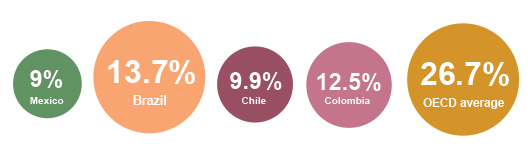
It mirrors a wider corporate environment in which the female share of board seats in the largest publicly listed companies falls far below the male share. Of the OECD Latin American countries listed (plus Brazil), Mexican women had the smallest share of board seats at 9%, while Brazilian women had the highest at 13.7%, with Chile and Colombia at 9.9% and 12.5% respectively – well below the OECD average of 26.7% (itself hardly an indicator of parity).

‘It is important to emphasise that, today, Brazilian women have a higher level of education than men, with more access to universities, but this is not reflected in their careers within organizations. Those who are in the labor market earn up to 34% less than men in the same position, and are still a minority in leadership positions,’ says Leila Melo, general counsel at Itaú Unibanco in Brazil.

‘I see that the legal and corporate universes have a lot in common regarding the challenges for gender equality,’ she says.

The women interviewed in this report reel off the causes of gender inequality in the legal and corporate workplace – unequal distribution of domestic tasks, a culture of ‘machismo’, unconscious bias. Even harassment was cited as a feature of the professional workplace, at times.

But some Latin American women decided to make their own luck: to forge opportunities, bolster their networks, and empower themselves into a force to be reckoned with – top lawyers but also agents of change.

Like Jurídico de Saias, or ‘Lawyers in Skirts’, a group of female Brazilian in-house counsel formed in 2009. Originally part of an in-house counsel committee of the American Chamber of Commerce for Brazil (Amcham), the group evolved into an assembly for the exchange of ideas and experiences under the initial leadership of Josie Jardim, now assistant general counsel of Amazon in Brazil.

Erica Barbagalo, head of law, patent and compliance Brazil and LatAm BP for Crop Science at Bayer, was one of the founding members.

‘We realized at the time that the majority of companies’ legal leadership – general counsels – are male and there are few women,’ she says. ‘We found that the leadership of legal in-house was so alone, because we are just lawyers at the company. You don’t have peers to exchange ideas within the company when it comes to legal aspects.’

OECD Latin American countries by women’s share of board seats

Over time, the group came to focus on the professional development of female corporate counsel and the creation of female leaders in law. For the more than 3,000 women who subscribe to the Jurídico de Saias app, that means access to information-sharing, job opportunities, mentoring programs, training and events. One such event is ‘De Saias Para Saias’ (‘From Skirts To Skirts’), a monthly live session on Instagram lead by senior speakers. Recent topics have included ‘thinking less like a lawyer’, and ‘the lawyer as business partner’.

‘It’s a collective, it’s a group, it’s not a legal entity, it’s not an NGO or association or anything, it’s just a group of people that benefit from this support for fostering women’s careers within legal,’ Barbagalo explains.

‘It’s not our target to be enormous, or to have thousands of subscribers, but to be effective and make a difference in the lives of women in-house counsel.’

In Mexico, the story of Abogadas MX began eight years ago, explains Paillés, who was recently elected president. Former president and founder Valeria Chapa (then general counsel for Latin America at Honeywell) returned from a Leadership Council for Legal Diversity (LCLD) fellowship program in the US, and questioned why there was nothing similar in Mexico. So, Abogadas MX was born.

‘We had very big dreams, we wanted to change everything,’ Paillés recalls.

The group started with a pilot mentoring program, where 20 senior lawyers mentored 20 younger lawyers. From there it launched an annual workshop with guest speakers – ‘we bring in people who make some sort of change in the minds of our members,’ says Paillés – which has been a virtual conference since 2020, enabling speakers to reach women outside Mexico City, in areas where equality and inclusion are scarcer.

From its beginnings as a group of 30 women lawyers, Abogadas MX is now an NGO with 700 members.

‘We have been very successful in gathering interesting people and working towards not necessarily information about law or technical information, but about soft skills that are required for women lawyers to succeed in these big law firms or international law firms or corporations,’ Paillés explains.

The organization is passionate, ambitious and structured. Four years ago, Antonia Rodriguez Miramon was hired as executive director, working with a council of senior female lawyers both in-house and in private practice, and a president.

‘We firmly believe that speaking about inclusion, diversity and leadership within the women’s sector directly translates into the development of our country,’ she says.

Through initiatives like the workshops, she adds, the organization provides a place ‘to be part of important topics to do with human development, professional development – not only legal things, but things that can nourish you as a person and help you grow.’

The work is built around four pillars: ‘support model’, where the organization provides courses, workshops, talks and networking opportunities for personal and professional development, including soft skills to hone leadership and networking skills; ‘impact on the environment’, which includes diversity and gender perspective masterclasses for law school students, and scholarship opportunities; a mentoring program; and the annual leadership and professional development workshop.

Advocacy is a key part of the Abogadas MX offering and, together with 38 law firms in the country, it has developed the ‘Mexican Standards of Diversity and Inclusion’. This takes the seven UN’s Women’s Empowerment Principles as a basis for a framework of principles to be applied to the legal profession in Mexico, and adds two more, regarding workplace sexual harassment, and gender and pro bono work.

‘We focus on being a community of women, or men allies, that know the importance of supporting gender and diversity in every place of their personal and professional lives,’ says Rodriguez Miramon.

For Barbagalo, the benefit of groups like Jurídico de Saias is precisely that sense of community. She describes her own experience of feeling alone and unsupported when returning from maternity leave and, for her, Jurídico de Saias fills a need that is especially powerful among outnumbered senior corporate counsel.

‘It’s to feel that you belong, to see that you have others like you, and to have support. Sometimes you don’t even know you have a problem if you don’t talk to others, and then you see, “Ok, there are more like me.” It is especially that you feel supported, that you have a place for equals to help you,’ she explains.

‘Being a young lawyer and having that kind of support from a group definitely would have helped me. When I got back from maternity leave, or in situations when I didn’t feel supported, I wouldn’t know there were more women like me. I wouldn’t know that I could be myself and could talk, and I could go to that group and say, “Am I crazy?” and feel ok to do that. It’s very common that people come and say, “That happened to me, is that ok, what should I have done, how should I react?” If you don’t have one formal group to do that, you don’t feel like you can look for this information, or you don’t feel confident in sharing, because it’s feels “gossipy”. But if there is an environment of openness and sharing, you see that what happens to you happens to others, and you can learn from that, and evolve, and feel empowered.’

At Women in Leadership in Latin America (WILL), that conversation takes place on a regional and even international level. Formed not only for lawyers – though managing vice president Leila Melo is one – WILL is a São Paulo-based non-profit with advisory boards in Bogotá, Miami, New York, Washington and London. Since 2013, it has supported and promoted the career development of women in Latin America, encouraged Latin America-based companies to implement programs for women in business, and promoted the exchange of best practices between national and international organizations.

Melo describes initiatives such as the annual Women in Leadership Survey – a free personal and professional development course for cisgender and transgender university students to encourage female leadership in finance, called the Dn’A Women – and the Empower Black Women to Senior Leadership mentoring program.

A wide network of women at all stages of their careers can function as a discussion forum to take stock and also move the conversation on – considering the spectrum of perspectives from generation Z, raised to expect, not request, equality, and of more seasoned women who are still fighting for it. In both Jurídico de Saias and Abogadas MX, that forum is cross-generational and both organizations have found making an intergenerational link to be fundamental in achieving sustainable empowerment for women.

‘We are very happy to see younger women looking for change, and the extent that they understand that change starts with us. Even though we need to have organizations, and men, and everybody else, involved in changing their bias, there is a little ignition, I would say, that is taking place within a lot of younger women, who want things to change,’ says Paillés.

‘We need to include younger women to see what they want and where they want to go, and how they are seeing these changes within their own organizations. You see it a lot with social media, and women doing things very differently than was done 20 or 30 years ago. Women on the board of directors of the organization are a little bit older and went through different things. I think we need that link, because the firms and the companies are controlled by older people, so we need to get that mix in place,’ says Paillés.

Adds Rodriguez Miramon: ‘We are living in an era with a lot of changes, and it’s really interesting how not only women but also men are interested in improving their way of working, the way they feel, their paternity leaves – and that finally is like a perfect match in getting our mission across faster and to talk about what we see as societal development.’

With the entry of new groups into the conversation, Barbagalo has found that a greater, and more evolved focus on inclusion and diversity is emerging, together with more understanding of intersectionality, in areas such as gender and race, but also in terms of considering all professionals as individuals with unique needs.

‘Different ways of working have a lot to do with diversity and inclusion because what works for you doesn’t necessarily work for me,’ she says.

For her, inclusion is an all-purpose tool, to be used beyond traditionally underrepresented groups, to improve the workplace as a whole. She puts this in the context of the pandemic:
‘I’m dying to go back to the office because I get distracted at home. Other people would prefer to be at home because they have a different routine. So how do we deal with that? We exercise our muscles of inclusion. I don’t look at this as a gender problem, or a race problem, or whatever problem. I just look at the different perspectives, a different person than I am, a different reality than I have.’

At WILL, Melo is conscious of the need to guarantee the rights of all vulnerable groups, not just women, and sees equality in terms of political action, health, security and education as well as the labor market.

‘When we look at the representation of women or black people in our society, or when we study the indicators of violence against the LGBTQIA+ population, or the access of people with disabilities to inclusive education and the labor market, the data show that we still face a serious situation of vulnerability and inequality,’ she says.

She believes it behoves private organizations to promote the inclusion and development of underrepresented groups in the corporate environment – and the lawyers within those organizations can play a key role.

‘Knowledge of legislation and legal issues contributes in an important way in proposing affirmative actions in the corporate environment and in private social investment, promoting advocacy for the creation of public policies that contribute to the guarantee of rights and the consolidation of a more inclusive society,’ says Melo.

Lawyers are well-represented on the board of WILL for this reason, she explains, and function as another voice in an organization which creates space for exchange between different agents of society.

In another effort to broaden the conversation, WILL has sought to involve men, with initiatives like its ‘Inviting Men to the Debate’ panel event, where leaders from national and multinational companies exchange views and experiences, and the ‘Homens da Nossa Época’ (‘Men of Our Time’), a series of interviews with male executives, who share and discuss their experiences about what it means to be a man in their time, along with conversation about diversity and inclusion.

‘For gender equality in the corporate environment, I see that organizations like WILL have been playing an important role in mediating this agenda at companies and engaging in dialogue with men, who still occupy most of the leadership positions, so that they can also understand that gender equality is also their responsibility,’ says Melo.

Abogadas MX has taken the step of admitting men as board members, mentors, workshop participants and allies – and has discovered that their presence brings the opportunity for a synergistic learning experience.

‘Maybe men don’t understand how important it is for certain skills to be there in order to succeed [in the workplace], and they think it’s a challenge where you have to run to do the best work. And it’s not that you don’t need to do the best work, it’s just that you need some additional things within your persona,’ says Paillés.

‘When they come out of these workshops, young [male] associates from law firms are amazed, because they really get touched by our analyses and it’s broadening their minds. Even the older men, when they go into this 450-woman meeting and they are a minority, just by being there they see how women feel when you go into a meeting and there’s only one of you.’

As the reach of Abogadas MX grows, so has its influence as a pressure and conscious-raising force in the industry, its leaders believe.

‘We started in a niche of high-end law firms and companies, and I think that we have become some sort of itch in every place that we’ve touched, and they know that they’ve got to change,’ says Paillés.

‘We believe that women at that level are getting stronger at requesting that their rights are met and that they are given what they deserve, and that they need to be in the same competition as men – because it’s not a matter of just “giving me things because I’m a woman”, but that we need to be at the same level. In that niche of law firms and companies I think we have made enough noise for there to be a small change.’

But there is much work to be done. The organization is working to extend its influence beyond elite law firms and corporations, to reach legally qualified women such as notaries public, or growing its program of classes at public universities, broadening its socio-economic reach into corners where bias might lurk.

‘It’s really important for us to start talking about mobility in terms of social mobility and in terms of opening our network,’ says Rodriguez Miramon.

The organization is also expanding beyond Mexico City, building on its chapters in Monterrey and Puebla.

‘It’s a matter of conscience, and we need to open up and touch more people so that the conscience of everyone starts moving. It’s a matter of making clicks within the minds of more and more people,’ says Paillés.

Systemic cultural change needs broader action than solely that of underrepresented groups. But women themselves are creating momentum to raise their own tide, lifting not only their own professional presence, but that of generations to come.

Carolina Forero Isaza, North Cluster Board Attorney and LATAM Vaccines Lead, Janssen Pharmaceutical Companies of Johnson & Johnson

I love the way the DEI team at Johnson and Johnson puts it: you belong. I love it because it’s about feeling comfortable to bring your true self to work.

It’s indispensable to have everybody’s point of view – if you have customers, patients and stakeholders all over the world, it’s important to have a wide variety of people inside the Company.
But, in addition to that, I think when you’re comfortable being yourself, you’re more creative. You feel better about raising your hand and shouting out your ideas and about participating. I also think when you’re comfortable being yourself, you’re better engaged.

Getting the culture right

We always think about our law department culture as one of camaraderie. We get invited to speak, with colleagues from other countries, about the future of our law department and how to make it better, and we’re always focused on making sure that, even as our department has grown over the years, we keep that camaraderie culture. I think we’re succeeding in that process, and I think that’s a very good grounding for DEI.

We have periodic training on different topics, for example, on unconscious bias, on building trust, and on many subjects related to DEI.

We also have Employee Resource Groups – we have groups that champion women, we have the ‘open and out’ group, which is a group that supports the LGBTQIA+ community, and we recently launched a group in Colombia that is supportive of indigenous communities.

We have been learning from the US team, which has been very active in examining racial inequality and social injustice; we’ve had book-clubs, we’ve had movie discussions, we’ve had experts come to talk to us.

Something that we had recently, that I thought was incredible, were some talks by experts on menopause, which is something that is part of being a woman, but we sometimes take it for granted. We are taught about giving birth, about being a mother, and about many things, but not about something that is so inherent to our lives as menopause. That, I think, is how inclusive our law department is.

Living DEI day-to-day

In the law department at Johnson & Johnson, one of the members of the leadership team of our general counsel is always responsible for DEI, and at the regional levels we also have leaders of DEI initiatives and DEI committees. We have some programs and initiatives that are global, and others that are regional. DEI is part of our strategic planning in the law department, and people report on our DEI efforts regularly.

We have some global objectives that we have to complete within the year – so there is some training we have to complete, we have to make sure that our goals include DEI goals, and in our conversations with our leaders, we report on how we met or did not meet those goals. But we also have a DEI committee at the regional level and, at the LatAm law department, we have our own strategic planning that we have to present to the global council. We report to them at least every quarter, and tell them how we’re doing, what we’ve finished, what we didn’t, and whether we completed our plan or not.

I think our law department leaders have made the law department really live DEI; it’s not something to check the box, but it’s really in our way of thinking.

Appreciating difference

I had a chance to lead the law department DEI group for Latin America a couple of years ago. We wanted to make sure that we respected everybody’s holidays, so we made a calendar to make sure that no regional meetings were ever scheduled during special holidays for different people in the group.

We tend to all speak Spanish in the meetings and leave our colleagues in Brazil on the side, so we tried to work on that by balancing the meetings – having some parts in Portuguese and some parts in Spanish. We even shared some glossaries of words in both languages, so we could all feel more comfortable.

We had an initiative called ‘beyond the label’, where with each LatAm law department newsletter, we got to know one of our colleagues – so, for example, someone might be the IP lawyer, but they are also interested in wildlife conservation and had a chance to live in Africa in an elephant nursery. We’ve had things like that, to connect at another
level.

It might not be rocket science, but these are things that keep us on our toes and thinking about how we’re different.

The importance of listening

On a personal level, I think being constantly reminded of the importance of listening is key in DEI. Lawyers are used to talking a lot and, in a way, we may not be so good at listening. I think the best way to make sure that everybody feels welcome, and that we hear everyone’s voice, is if we learn to listen.

I think legal strategies benefit greatly from other points of view, so I always discuss the important strategies with the business, with our marketing director, with our general manager, and I think that’s also inclusion. And that comes together with leaving aside the legal language – I like to think of myself like a translator, translating legal language into business language.

Amanda Lee Cotrim Lopez, senior legal director LATAM, ADP

Latin America is a melting point for ancestries, ethnicities and races, making it one of the most diverse regions in the world. It is also a region where minorities face significant barriers to employment. For example, recent studies show that around 90% of board seats are occupied by men. If women are not represented on boards of those huge companies that are listed, it’s hard to claim a true commitment to diversity.

ADP’s executive team in Latin America has a 40% women representation. This is well above the market average in the region. ADP was recently recognized by Great Place to Work (GPTW) as a top employer for women in Chile and Peru.

We were able to reach to this point because of the tone at the top. ADP has taken several affirmative actions to make sure diversity and inclusion is part of our DNA. In ADP, diversity and inclusion is not an HR only issue. The leadership team strongly supports D&I actions.

ADP has a global diversity and inclusion office, with dedicated associates. The D&I office works closely with HR and leaders of business units. The leadership is highly engaged and involved in diversity and inclusion globally. In Latin America, each senior leader sponsors a Business Resource Group (BRG). Since I joined ADP, I have sponsored iWIN’s activities in Latin America.

ADP’s iWIN

iWIN (International Women’s Inclusive Network) is ADP’s BRG with a focus on gender equality. iWIN currently has around 7,000 members across 16 countries around the globe. That is a big chunk of ADP’s 60,000 employees.

iWIN’s activities are conducted by a global board comprised of 25 ADP associates and by local chapters distributed in different regions and countries. iWIN organises events to create awareness, education and training – on unconscious bias, for instance. Our main goal is to make ADP a more diverse and inclusive place, not only in the workplace, but we also think about how we can impact the business and the communities close to us.

Doing the right thing

At ADP, the legal team plays an important role in terms of providing the business a perspective on what is the right thing to do. One of ADP’s main value is ‘integrity is everything’. Integrity is about doing the right thing all the time. In this sense, diversity and inclusion is the right thing to do.

When the legal team organizes the compliance week and trainings in Latin America, we educate our associates on anti-bribery and other relevant compliance aspects, but we also take the opportunity to discuss conduct, respect and inclusion. We create opportunities to discuss with associates about being inclusive and respectful with their colleagues at work, with family members, and when using social media.

Keeping an open eye

Corporate legal departments play an important role in promoting diversity and inclusion in the legal market in Latin America. We can influence the private practice market as clients and exchange experiences through our network groups.

When diversity and inclusion is part of your agenda, you will constantly call attention to inequalities, share practices to improve D&I awareness. It is important that in-house counsel keep an eye on what law firms are doing in terms of diversity and inclusion: if they have their own policies and if they are taking real actions towards their associates.

In Latin America, we have our eyes open to prioritizing discussions about minorities, either on the compliance training, hiring process, or when choosing a service provider.

Isabel Araujo, Partner, Willkie Farr & Gallagher

First, we should make mindful decisions about who we hire and resist the urge to favor people who look like us, went to the same schools as us or grew up in the same towns as us. Then, once you have a diverse legal team, be mindful that everyone’s experiences are different, and just because something has worked well for you, does not mean it will work well for me. Unsolicited commentary about the way one person handled a situation could be received differently than may have been intended so we should be aware of the impact of our words. Allow lawyers to develop their own styles and manage their projects as they see fit as long as the common goal to fulfill a client’s needs is being met.

Part of the benefit of working at a law firm is that a client has access to lawyers who have expertise in different subject matter, and transactions are not handled by only one lawyer or a group of lawyers with the same knowledge. The value a diverse legal team provides for a client is perspective and broad experience, which translates into a client being able to hear different sides to an argument or consider a strategy that had not been presented before. Having different voices in the room, in just the same way that having lawyers from across different practice areas in the same room, ensures that more ideas are being heard, with the ultimate goal to settle on the best one of the bunch.

A few examples include: (1) I think a best practice is that when a matter is being staffed, a senior lawyer should call each person on the team and tell them why he or she would make a good addition to the team. This adds instant loyalty and a sense of purpose for the lawyer. Compare that to an impersonal email alerting a group of lawyers about the new project. (2) At the start of the project, along with reminding everyone about the client’s needs, the most senior person should articulate his or her expectation that everyone on the team will actively contribute to the matter. Then follow-up. If you notice that the same people are the only ones speaking, specifically ask the others to weigh in and frame it so they know you are interested in their ideas. (3) Utilizing 360º feedback is also a simple but effective technique that allows people to feel heard (and of course, implementing changes based on that to the extent appropriate).

Ana Silvia Dias Haynes, General counsel for Brazil and Latin America, Essilor Group

Latin America is a diverse region, with over 660 million people of various ethnic groups and ancestries: Amerindians, white, mestizos, African descendants, Europeans, among others. It is essential to all companies and their workforces to continuously reinforce the need for diversity and inclusion in their work environments and, most importantly, in the Latin American boards and senior management positions, which data indicates are more than 90% occupied by men, mostly from a similar ethnic group. Diverse groups have raised their voices to increase awareness and fight for their rights and needs in the last 20 years.

However, with the ‘new’ diverse groups, such as LGBTQIA+ groups, you see very different positions. In larger cities, such as São Paulo (Brazil), Mexico City (Mexico), Buenos Aires (Argentina), Santiago (Chile), Bogotá (Colombia) and Lima (Peru), you have more respect and more protection of such rights. However, if you go less than 100 kilometres into the interior of these countries, that situation changes significantly, and people are much more provincial and less open. While governments have passed laws accepting various rights for these groups that were long awaited (such as same sex marriage), and principal media channels have supported many of those changes, there is still a big divide amongst those in society that live in the large city centres and the populations of more remote interior areas.

Historically, legal professionals were quite reserved about the topic of diversity and inclusion. In the last five years, this has changed very positively. Law firms are openly promoting diversity and a free environment. This change was supported by the new generation of lawyers, who wanted to see those values and principles embraced and actually lived in the work environment, whether in-house or in a law firm. Law firms had to rethink their standards of what they were looking for in a lawyer. Most law firms, now more than ever, know the true value of having lawyers and paralegals with different backgrounds, and even different qualifications and experiences, that bring new ideas to the legal solutions and advice provided to their clients.

Bringing diversity to life

At my workplace, I can proudly say we promote diversity through many different actions. One, most importantly, is to respect diverse people and their rights. Another is to talk about it openly and have training sessions to raise awareness and consciousness of how important it is for any company to bring diverse teams to work together collaboratively, respecting each other, and promoting innovation. Day-to-day, these actions translate into a very positive work environment, where people learn from each other, bring new experiences and ideas without fear. People have the freedom to succeed and change. I truly believe that promoting diversity is a tool to reach greater performance in terms of solutions and products, and ultimately makes people happier.
We have many internal programs supporting diversity and inclusion, such as having more women in management positions at all levels. We believe we are at the beginning of a journey, but we are, every day, bringing that to life.

Removing the filter

Five years ago, we first recognized that we needed to do more in terms of having a diverse legal team in Latin America. We were pretty much all from the same background, very
similar in terms of life choices and, although we were, at the time, divided equally between men and women.

As a team, we thought: what could we do better to be more diverse, and to support diversity and inclusion? First, we had a training session with one of the internal ambassadors, and he opened our eyes to simple actions that we could do as part of our daily routine, and when recruiting people, which would have great impact in promoting this value.
We can proudly say we are a much more diverse and united team. We have embedded diversity in our actions within our team and beyond, when selecting our external advisers and new people for our team, for example.

We look at each other as professionals who work hard together to deliver visual health products and services, focused on our mission. And we don’t judge.

Influencing others

I believe that, as lawyers, we have a huge role to play in diversity and inclusion, because we interact with multiple teams, partners, customers, external advisers and their respective communities. We are their trusted advisers; we are responsible for ‘opening their eyes’ to this important value. We also interact with government authorities and organizations. If we understand the influence we exercise during those interactions and use those to support diversity and inclusion in the respective workforces, together with our other colleagues (such as the leaders of organizations and HR, to name a few), we can be a motor for change in Latin America and other regions.

Many people are still blind about the benefits of such change and know nothing about the consequences of not respecting such values. We have historically embraced cultural and ethnic diversity, we are people moved with different and unique passions for life, which makes us who we are as Latin Americans. Why not take our diversity values to another level?

The result will surely be having a happier and more inclusive work environment, where people enjoy their work and learn from each other, putting aside any pre-conceived ideas or prejudice that can prevent us from performing well collaboratively.

As of 1st April Ana has been appointed GC for Asia Pacific and India.