Interview with… Deniz Sisa, Chief Legal & Compliance Officer, KoçSistem

Tell us about your career choice and journey. What was it that made you want to become a lawyer?

It’s a bit strange. People usually decide to be a lawyer by seeing or experiencing one in the family. For me there was no one. I was telling everyone around me when I was a child that I had decided to become a lawyer. I remember walking around in the kindergarten among kids and telling them that I was born to bring justice to the world. Weird! I wonder which cartoon or movie created this mindset.  It seems like I stuck to the plan though. 

After graduation I started my career with one of the most reputable law firms. I learned lots of things, but I think the most important outcome for me was being able to decide which area I didn’t want to practice.  

In my point of view the most important thing for a person is to be aware of what he/she doesn’t want in her life. I never created a path for my future based on what I want. Because as a human being we want everything.  

At the start of your career, you worked as a private practice lawyer for six years prior to moving in-house. What has been your experience as a woman working in both of these very different environments?

People might think that it should be almost the same, as you are ultimately a lawyer and you are practicing what you were educated for. 

It’s completely different. Two different worlds. In private practice what is expected from you is to make things right and work in accordance with laws and regulations. You are the lawyer who fixes the problems for the clients. You usually step in once the problem is already there. 

As an In-house you are naturally a part of the client. Well, even it’s not a client anymore: it is your family. You should be there during the building process; you draw the path with them, and you are not someone that fixes or solves the problems but the one who prevents those problems from occurring.  

The main difference between a private practice lawyer and an in-house is there the moment you step in. It wouldn’t be wrong to say that in-house lawyers are the reason for revenue loss for private practice lawyers. 

My experience of being a woman working in both environments could be defined more or less the same. I don’t think the environment is the key here. It’s all about culture. There is a famous saying which I really agree with – the geography you are born into is your destiny. I was born in Turkey but lived in different countries. I have experienced the way people act towards women in many countries. I think I am lucky. Things are easier for a woman living in Turkey than before and I hope that continues to improve every day. 

In your 17 years as an in-house lawyer, what barriers have you encountered during your career growth and as a leading female GC in the Turkish legal market?

Well, there are lots of them. I don’t even know where to start but I think I should talk about the one that has never changed in all those years.  

Even though I always mention this, the most important thing as a GC is being allies with the rest of the team, getting involved, understanding the needs and the nature of the business. People usually think that the only mission of the GC is to say NO! GC’s are there to make things difficult etc etc.. 

I have always tried to show that this was wrong, that I was there to make things work. People who worked with me and my team for a few years felt very comfortable about us getting involved in everything. But once there is a change in the management team, we go back to square one, and become the enemy again.  

What accomplishments are you most proud of?

I can say that the best thing I created during my career is my amazing team. I always feel very proud to see their improvement during all those years.  

As a regular inductee to The Legal 500’s GC Powerlist Turkey, you continue to receive deserved recognition as a leading in-house lawyer across the national and international stage. What has been the key to your success after all these years?  

Thank you for the question. Even being asked made me feel so proud and happy. I think the right answer is the trust I built during all those years. 

With both law firms and their clients valuing diversity, how do we get more women into leadership roles?

I always give the same example to this question as it makes it easy to visualize reality: consider your house, your family, and your parents. Who does the most challenging work at home? Who manages all of crises? Who has the immediate responsibility? 

Excluding some exceptions, the answer to these questions is most likely “The Mother”.

As you all can see it’s the woman who leads, who controls and to whom the control is given by the men. Home is the most important place for everybody’s life. It’s the core of our lives. So tell me why you give all the leadership and control to women at home and not at work? 

Do you see any challenges for women within the legal industry in Turkey? And what would they be?

I don’t think there are challenges specifically for women. Diversity became an important issue, and companies and law firms value it. The challenges are the same for everyone. In the early years of my career things were simpler, there were some basic requirements. In these days each day you should do something to improve yourself. 

How do you manage a work-life balance?

It’s a big challenge. It always has been for an obsessive and workaholic like me. I took some courses regarding management skills etc. In almost every course the most important thing mentioned was delegation. I realized that learning to delegate was also learning to trust. That is the key for being a good team.  

Thanks to my team, I now have a very good work-life balance.  

Which women have inspired you the most? 

Ursula K. Le Guin.

What has been your greatest achievement, in a professional and personal capacity? 

I think being nominated for The Legal 500’s GC Powerlist Turkey since 2019 and seeing my name on their prestigious website is one of my greatest achievements.  It’s not about being published, but to be recognized as a leading in-house lawyer across the national and international stage means many things. It means I did some good things, that they are noticed, and that they have value. 

What is the one piece of advice that you would give to a young woman at the start of her law career and has aspirations to become a leading lawyer one day?

As I mentioned above, Ursula K. Le Guin inspires me a lot. Once she said, “ All of us have to learn how to invent our lives, make them up, imagine them. We need to be taught these skills; we need guides to show us how. If we don’t, our lives get made up for us by other people”. 

So, my advice would be don’t be scared. You don’t have to be like one of the successful lawyers around you. Success can have different a meaning for each person. Be you and always speak loud if you believe in what you are doing. 

Interview with Ceren Çakır, Founding Partner, ECC Law

What was it that made you want to become a lawyer? 

You know those types of people who are always ready to speak out of turn, be lawyer of someone without being asked. I was one of them since my childhood. I could never stand to unfairness. As I grew up, my perspective stayed the same and although there are not any lawyers in my family, it all went naturally. Today, I understand that this was the point I had to reach, and here I am.  

Prior to starting ECC Law in January 2021 you also worked as an attorney at two leading firms. What barriers have you encountered during your career growth and as a female lawyer in the Turkish legal market? 

In the business world, some professions sound more masculine. Being a lawyer may hint as such. Maybe this is the reason why lawyer who is a female is described as a “female lawyer”. I do not sympathize with such descriptions. I am against this discrimination from the bottom. Instinctual and natural capabilities of the women being organized, strategist, comprehensive, more welcoming to innovation and solidarity may be the difference of a lawyer who is female creates in her works. I strongly believe that the difference should be read over the business results and not discrimination.  

I was lucky to get to work with fantastic lawyers who were strong women and we achieved great successes together. Also, I had the chance to work with men who believed that a woman could change the world by using her skills that she had naturally and used this power by appointing women – including my-self – in their law firms in leadership roles. Unfortunately, not all men have the same perspective. Even though they may look very modern from the outside, deeply they sympathise with the historical background of the issue and do not have the courage to share their power. This is the main barrier that a lawyer who is female may encounter during her career and not only in Turkey but in all over the world. 

What are your reflections on diversity and inclusion in the Turkish legal profession? 

Diversity brings strength and inclusion matters.  

Gender, race, age, national origin, ethnicity, sexual orientation, physical ability, cultural identity diversity adds values not only to a social environment but also in a workplace or to business. Turkey and naturally Turkish legal profession have already diverse actors. 

At ECC, we value the human as beings, and we value their work not their diversities. We have employers, business partners and clients from a wide range of diverse gender, age, national origin, ethnicity, sexual orientation, and cultural identity. 

Do you believe it should be the law firms or their clients that are the main driving force of change? 

I believe both should keep the sides of the bargain for the change to be realized. The law firms should adapt their systems, their team in line with the technical innovations, new trends to assist their clients better legally. Businesswise, the clients are the main driving force of change since they should know their business the best. However, the law firms should also learn and adapt the changes in the relevant industry. Because law and the business minds are inevitably inseparable. A lawyer should always consider the sectoral factors and the commercial needs of its clients.  

ECC Law organizes projects to help young lawyers gain domestic and international experience and professional development with an emphasis on corporate and social responsibility. Can you give us an insight into this process and the successes achieved so far? 

At ECC, we give the most importance to the young practitioners and students to gain and develop their skills in practice alongside the theoretical knowledge. We aim for them to have the experience without being in crises, trial-and-error learning it in the hard way. 

Individually, I am so pleased to be able to have already achieved this by creating and organizing the Young ISTAC Future Arbitration Counsel Moot when I was in the board of Young ISTAC (Istanbul Arbitration Center) and chaired the “Future Arbitration Counsel” Moot Committee between 2015-2019. The moot reaches more than 500 Turkish students coming from all over Turkey and Northern Cyprus each year and allow young practitioners to gain experience since they also participate as arbitrators in the competition. The Moot is still annually organized and as ECC, we support it by participating as arbitrators. 

Also, I served as the ICC YAF representative for Turkey during my mandate between 2019-2021. I have organized 4 physical events and 13 webinars and reached more than 2.500 practitioners for them to develop their knowledge and experience in the field of international arbitration. These events were also noteworthy in the sense of networking for the young practitioners when the world was hit by the pandemic.  

At ECC, we build and develop both mentorship programs and internship programs for creating opportunities to gain experience for the students and young lawyers.  

I am so pleased that the word is spread and the young practitioners individually or in groups come to ECC to ask advice regarding their career or ask for a seminar to develop their knowledge and experience in particular fields of law. 

I am also being invited to several universities as guest speaker to give courses on dispute resolution, domestic and international arbitration, and maritime law to share practical experience in the fields. 

In addition to the future recruitment drive your firm has with diverse lawyers, does ECC Law get involved in other diversity-related activities? 

I’m thrilled to lounge. Because this is the goal of ECC as part of its corporate social responsibility. As to the ECC’s distinctive sign, we have shifted our focus from Istanbul and major cities of Turkey. We focus to each 7 regions of Turkey and disadvantageous students. Under the mentorship and internship program “7 regions 7 Arbitration Lawyers” we have built to welcome senior high school and law students who are female and who consider being an arbitration lawyer in our offices or by engaging them remotely to gain experience by working with us. Also, they will be mentored and be followed up in their path of building their career. 

With clients valuing diversity in their external law firms, how do we get more women into leadership roles in law firms? 

Together with the courage of both sides. This distinction has an historical background, but I believe it can be overcome when considered on human scale. Women will be willingly appeal for the role and the men will show the courage to share its power. 

Do you see any challenges for women within the legal industry in Turkey? And what would they be? 

In addition to what has been said in the previous questions, the historical background, that the profession may sound masculine, and that men may not have the courage to share their power; some organizational and regulative steps may be taken to ease the lives of a lawyer who is female. Women are human, but they have many additional responsibilities as daughters, sisters, mothers, and wives. Organizing all their responsibilities may of course be challenging. 

There are already some steps taken by the Bars, such as placing lactation rooms for nursing mothers at the court houses. However, the system may be upgraded to a nursery room where older children could also use. Also, the law firms may be obliged to provide with the same conveniences in their offices. 

I should note that according to the data provided by the Union Bar Association, as of 21 December 2020, there are 143.330 lawyers registered to the bars overall in Turkey and 45,72 % of them are women. I trust that by acting in solidarity, many can be achieved to create a change. 

Which women have inspired you the most?  

All women who created a change. The system, the world, even who changed their inner circle. Big or not, every woman in the history or around me who led to a change inspired me gradually. 

Because the world is changing every day. Not just now with the pandemic. Change has been the inevitable since the beginning of time. And the ones who have the courage for the change are the ones who make a difference.  

I would like to share an example. You could not be interviewing me today if it was not for Attorney Süreyya Ağaoğlu.  

She is the first lawyer who was female in Turkey. She was registered to Ankara Bar in 1927 and became a lawyer in 1928. She knew French and English, and she initiated Istanbul Bar Association to be registered to International Bar Association in 1946. It should be noted that she was the only female board member of this union until 1960. She acted as an attorney at law during her entire life. I commemorate her with great respect and gratitude. 

In your career so far what achievement are you most proud of? 

ECC is the most exciting decision and achievement I am proud of in my career, which I have pursued with great enthusiasm and pleasure.  

Also, I am very proud of the moments where I grasp promptly on the new subjects. I was once appointed on a transactional matter that I did not have a clue or experience in the field before. It was challenging for me, and I was so proud of myself when I completed it successfully without any assistance. It made me even more proud when I got my second appointment immediately after the first one. 

Individual successes are important and marvellous, but also when I have made my team believe in me and that thanks to the team effort, raising the cup together was a magnificent moment.  

How do you manage your current work / life balance? 

I do not prioritize one to another. I do not think that they are separable especially when you are a lawyer. Your client can become part of your life, or your schoolmate can become your client.  

I have discovered that the work and life balance come naturally if I give enough time to myself. I am speaking of silent time only for my-self. Also, I try to plan my day before hand, but I always leave enough space for the unexpected work or family matters. This allows me to be flexible on the unexpected. 

I have diverse activities I enjoy performing such as sailing, snowboarding, reading, playing chess, dancing, and socializing with friends and family. Especially sports allow me to be more balanced and consistent in work and life. 

When you look back at your career and the knowledge you’ve gained, what advice would you give to female students who are about to enter the legal industry? 

First, I advise them to act like a professional human without thinking about gender diversity. Second, to believe and to equip their selves with the sufficient knowledge to achieve what they seek for. If they want to work internationally, then I advise them to learn at least 3 foreign languages. Turkish is my native language and I know English and French at professional level. But I regret not to knowing at least one another foreign language at professional level. Also, I believe it is essential to find a particular field and be an expert in that field. Attending conferences/webinars, moot court competitions and summer interns at law firms may help them to determine that very field and start gaining professional experience. Lastly, I advise them not to skip life while busy with the studies and equip themselves with intellectual intelligence which will assist enriching their life as well as the work. I should also add to have the courage to face and fight any challenges that they may encounter.  

The target is not easy to be achieved, but to lift the barriers and create a change, we must willingly and consistently appeal for it. 

View interactive PDF version

Interview with Deniz Okuyucu, Partner at Gökçe Attorney Partnership

Tell us about your career choice and journey. And what made you decide to get into corporate and commercial law? 

In my childhood, I was affected and impressed by my relatives running their own business and I found myself interested in businesses and companies. I went to law school with this business mindset, and therefore, corporate and commercial law became a passion for me. When I graduated from university, I oriented my career in this field and worked in corporate and commercial departments of leading law firms.  However, solely graduating from the university was not enough for me. I always aim to develop myself and create something new which was not discussed or addressed before in this field. Thereby, I pursued my LL.M. studies and currently continuing my Ph.D. studies in the same field. 

What are your reflections on the diversity and inclusion culture in the legal profession in Turkey? 

Over the recent years, people in every part of Turkey have made their voice louder on their differences and tried to take place in the society with their uniqueness and incomparableness. Thereby, many issues, that were deemed not to being discussed and sometimes deemed as a “taboo” prior, such as LGBTQ+, gender equality, and refugees have begun to be discussed. This way of living created a necessity for a more responsible business world.   

As law firms face this transaction in which maximum care regarding diversity, inclusion, and wellbeing are expected, legal culture in Turkey has inevitably changed in favor of equity and fairness. As I see, law firms adopt diversity and inclusion policies to create a positive workforce environment and to address clients from every walk of life. In this way, for instance, the rate of increase in the number of women lawyers began to be higher than that of men. However, this is a very basic step, and it is not needed to be mentioned at all. I think that there are still more needs to be met to represent all kinds of groups, especially in leadership positions. 

How is Gökçe Attorney Partnership progressing with its diversity agenda? 

At Gökçe, members of our team are recognized with their unique backgrounds, cultures, and perspectives. We are aware that our team’s creativity and passion is our greatest asset and hold the key for success. From day one, we had the goal of creating a culture of inclusion and ensuring equal treatment in the workplace where our team can bring their whole selves to work.  

We are committed to hiring, development, and advancement of diverse lawyers. For the recruitment, we always look for people who are open to interiorizing knowledge and creativity rather than their school types, religion, or ethnicity. If you also take a glance at the gender diversity at Gökçe, the number of women who hold major leadership positions in our firm has increased over the years signally. These are all due to our dream being to create a business space in which our team members feel belong and where they have the opportunity to improve their legal knowledge professionally. In this way, every member of our team contributes to our work in their unique way, and this helps the exchange of ideas to be strong and the outcome to be unique. 

How do you define the culture at Gökçe Attorney Partnership? 

Collective ideas: Our firm’s culture is rooted in the free expression of different opinions. We always had an open-door policy where we encourage our team members to be themselves, to advance in their own way, and to enhance themselves.  

From day one, we had an appetite for development and innovation. Thus, our client base has become shaped towards innovative and technology companies with open-minded vision. I think, their openness to innovation and differences are the best examples that reflect our firm culture. Besides, to take a concrete and permanent place in the innovation sector, we have to be away from any kind of bias and embrace all the backgrounds, cultures, and perspectives. 

As Gökçe, we also value social responsibility. We encourage our members to be more effective in every part of society. In recent years, we had several aid efforts towards rural schools, set up social responsibility committees. 

You are currently taking a PhD at Istanbul University and working on a thesis entitled “Corporate Social Responsibility of Joint Stock Companies”. In your view, how has CSR evolved in Turkey and how should all companies approach to being more socially responsible? 

Corporate Social Responsibility is one of the most controversial topics. In my thesis, I analyze CSR in detail, particularly in the sense of company law. I think that the CSR agenda in both Turkey and in the world should be handled on a more serious level and should be removed from the umbrella of charity and positioned as a legal mandate rather than a voluntary initiative. By doing so, companies may become truly socially responsible in a meaningful way, apart from charity campaigns and PR activities.  

The development of CSR in Turkey is still at an early stage. Companies are trying to lay down certain principles, especially under the leadership of multinational companies, but I think it is still insufficient. Likewise, academic of its legal aspects are almost non-existent. 

How do you see the new generation of women lawyers? 

Based on my observations, the new generation of women lawyers have broken down the barriers and become more prominent. They vault to leadership positions since they have the ambition. They are also self-confident and not shying away from taking tough decisions. The reason behind all of these can be explained by the recently increased awareness level of women’s rights in Turkey. As Gökçe, we just desire to rocket the opportunities that women should have in a law firm. 

If you weren’t a lawyer, what would you be? 

I would stay in the social science field and probably get into politics. I would use this as an opportunity to raise awareness on the environment, animal rights, and human rights.  

Which women have inspired you the most?  

In different parts of my life, I have had inspired by various strong women, however, of course, my mother is the real motivation and courage. And, nowadays, I follow and am inspired by Alexandria Ocasio-Cortez. I think by her support to different groups of people, she is paving the way for new generations. I appreciate her attitude in politics.  

What motivates you? 

I’m really driven by outcomes that create added value for society. Because, in this way, I feel like I have an earned place in society. In my belief, this is one of the ways of contributing something new and permanent. 

I also get motived by the idea of raising new generations of lawyers and hopefully being a role model to them. That’s why, in our firm, healthy communication dominates our relationships rather than hierarchic order as well.

What have been your personal highlights during your time as a female lawyer in Turkey?  

I had witnessed my women colleagues face a different kind of difficulties. But I was fortunate enough not to been exposed to any discrimination or difficulty due to being a female lawyer, apart from the problems experienced by lawyers in general. 

How do you manage your current work / life balance?  

I think I’m one of the lucky ones who love what they do for a living. When you love and have passion for your job, the time you spent in your job becomes valuable. Also, we have good chemistry here at Gökçe, so working doesn’t feel like a chore. If you have a workplace that does not restrain your desires, you cannot differentiate your business life from your private life because you only have one life that you enjoy. That’s why I can also make time for my hobbies such as sports, literature. I think with proper planning, maintaining a successful balance between work and life is possible. 

When you look back at your career and the knowledge you’ve gained, what advice would you give to female students who are about to enter the legal industry? 

I want to stress that we aim to provide equal grounds for both women and men. That’s why I wouldn’t have any different advice than the one I would give to male lawyers. The first piece of advice that I can give is not to prevent themselves by creating barriers against their ambitions and intentions. So that, they could have the imagination to draw their dreams in a framework and fill it with their accomplishments. Moreover, the most essential thing, they have to recognize to be sensible towards social and moral issues in every stage of their professional life. Also, to respect the ethical rules and adopt the objectives of being a lawyer.  

Interview with… Lawrence S. Elbaum and Patrick Gadson, Co-Chairs of Vinson & Elkins’ Shareholder Activism Practice

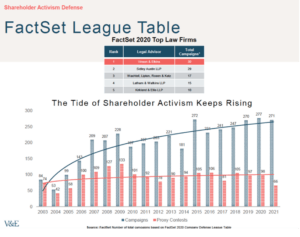
Vinson & Elkins’ Shareholder Activism Practice has consistently performed well in the activism defense league tables and rankings. It has ranked number #1 by FactSet for company and board representation based on the number of campaigns defended from 2016 – 2020;  #1 for public company defense by Activist Insight in 2016 – 2020; #1 in Bloomberg’s inaugural league table for company defense in 2019, and most importantly, it is Tier 1 rated in The Legal 500’s Shareholder Activism rankings. We sat down with Lawrence Elbaum and Patrick Gadson, based in New York City, who co-chair the practice, to see what has made their team achieve such success.

What are the capabilities that have made V&E a destination practice in the area of shareholder activism work?

Lawrence: It really boils down to our experience. Today, our activism team at Vinson & Elkins is one of the most experienced and most knowledgeable company and board defense practices in this highly specialized area. We’ve seen just about everything, having defended over 150 activism campaigns during the past 6 years, so we know what to expect and how to handle it.  We are also blessed to count among our team nearly 30 M&A, securities, governance and litigation attorneys to provide clients with omnipresent advocacy and support during these critical times that can feel like a corporate crisis.

Because of this, we can react quickly and with precision. We regularly defend companies against high-profile activists such as Starboard Value, Carl Icahn, Elliott Management, Engaged Capital, Jana Partners, Corvex Management, and Legion Partners. In situations like these, being at the ready is incredibly important. A board member calls you because they’ve just learned that an activist investor has made their enterprise a target. It’s important to them to know you’re prepared to represent them, and that they can leverage your expertise and experiences to navigate what oftentimes turn into extremely hostile and public contests for corporate control.

Patrick: This past year is just an example of that. We were engaged by MiMedx in the defense of the proxy fight of Prescience Point, eHealth, Inc. in the defense of the proxy fight of Starboard Value and the activism campaign of Hudson Executive, and  First United Corporation in the defense of the proxy fight by Driver Management.

Experience drives insight. We’re now nearly done with the 2021 proxy season, and our activism defense practice has seen more activity than ever before, across all industries, from healthcare to banking. That’s a lot of insight. Unlike most firms, we have a multi-practice approach and capability, which affords us the ability to take these situations through entire complicated lifecycles, even if that includes litigation. Leveraging the talent of V&E’s preeminent Delaware law practice, as well as our strong ESG and corporate governance practices, allows us unparalleled representation capabilities.

Are there qualities that your lawyers have (or that you look for when hiring) that make the practice unique?

Patrick: I believe we are the only defense practice whose leadership includes someone who made his bones working for activists before transitioning to corporate defense. That gives us an “insiders” insight and understanding that our peers just don’t have. It’s one thing to believe you know what the other side is thinking, it’s entirely a different thing to have had to spend countless hours doing that thinking. In addition to that, the two of us co-lead a group of what is arguably the most experienced associates in the space. Each of us is completely client-obsessed. We lose sleep so our clients do not have to.

Is there anything that makes the practice’s approach unique?

Lawrence: We start every engagement by asking our clients what victory means for them, and then we begin the process of tailoring bespoke solutions to zealously help them achieve their goals. As we leverage experience from more than 150 defense engagements from the better half of the past decade, we also give our clients unvarnished and ego-free assessments about their chances of success.

Patrick: We always highlight alternative and often overlooked strategies that we believe result in more sustainable victories, involving the long-term peace between activists and companies. Because of our approach, those lawyers in the group have to be comfortable thinking creatively regarding today’s set of circumstances and tomorrow’s scenarios. We want our client’s companies to have optimal runway to focus on maximizing value for shareholders.

What have you done to train the next generation of lawyers (in your practice or throughout the firm) during the pandemic?

Patrick: We require our associates to understand the full range of matters with which we deal. We ensure that those who work with us, even at the associate level, have real-world exposure with clients, adversaries, opposing counsel, investment banks and activism industry-specific advisors. Shareholder activism defense is a multifaceted practice, and you need to train lawyers to look at it through multiple apertures.

About ESG

We’ve been reading that climate change and other ESG related issues are add fuel to the activist fire. Can you explain why that is the case and the impact of ESG on board governance?

Lawrence: Banks and investors are setting huge climate change and ESG-related capital goals, meaning some public companies may go from hearing very little from their investors and capital providers to hearing from everybody. ESG-activism is becoming a full-blown concern at the same time that companies and the market in general are still figuring out what it all means and what these commitments will require. Public companies may get caught in the misalignment if they are not prepared.

What can boards do to ensure that they are prepared and ready to handle these threats?

Patrick: Increasingly, investors have voting policies that address ESG matters. Boards need to treat voting policies and statements very seriously. While public companies often pay some attention to the voting recommendation policies of various entities like those active in the US, such as ISS and Glass Lewis, they do not always stay abreast of the changes taking place. We advise our clients to conduct robust ESG voting due diligence every year, including a benchmarking of their current company policies against those of ISS, Glass Lewis and institutional stockholders, even in the absence of a formal ESG stockholder proposal.

Lawrence: Board composition will become even more of a battleground during activist campaigns, so while they may not think they need a climate change expert on the board in times of calm, they will most likely wish for one in times of crisis. While there are a number of other steps that should be taken, there is more to be read on the topic at https://www.velaw.com/insights/money-meet-mouth-why-the-esg-war-is-just-beginning-and-what-to-do-about-it/

Do boards need to have a member who is an ESG specialist or are there other steps that they might take in place of that move?

Patrick: You may not need one particular specialist, but you do need to ensure that the board has the capability to understand those concerns and stay in front of all issues. Your legal personnel, your auditors, your marketing and HR departments should all be a part of that effort. They should all be involved in preparing policy and in executing appropriate plans.

About Board Protections in General

We’ve seen boards lose control of M&A scenarios, and as a result lose significant board seats. Are there actions that boards should be taking today to address this problem and avoid this in the future?

Lawrence: Yes, there are three considerations that companies often miss before announcing an M&A transaction, most often in all stock deals or deals involving both stock and cash. The three that immediately come to mind are:

1. As part of regular, “peace time” engagement with shareholders, engage in dialogue with them about the types of M&A, if any, they would like to see the company pursue and also about their views on M&A, in general. It is important to understand your shareholders’ – your owners’ – investment theses and to set their expectations as well.

2. Companies have one chance most often to explain the deal rationale and bona fides to shareholders. Companies are well-advised to begin work on these items as early as possible, prior to the agreement of a deal and to rehearse their presentations. It can be very difficult to rehabilitate even the greatest transaction that is not initially communicated properly to investors and the market.

3. Companies should not rush into a deal because they are dealing with public or private activism. Boards should be focused on getting the best deal with the best terms for shareholders, while being completely agnostic about how a consummated deal might affect their directorships.

Which area of ESG are activists focused on currently?

Patrick: That’s industry and company specific, but we advise companies keep their attention on the entire area. If a company is underperforming, then the next screen is for weakness in ESG factors. Maybe it’s the “E”, maybe it’s the “S”. Which letter isn’t as important as a company already being vulnerable because of operating and market performance. But at the end of the day, it’s still about performance. If you underperform, the ESG gods will not save you.

Focus on… Balcioglu Selçuk Ardıyok Keki Attorney Partnership (BASEAK)

Balcioglu Selçuk Ardıyok Keki Attorney Partnership (BASEAK) is an Istanbul-based full-service law firm. Drawing on experience gained at Turkish and global law firms, BASEAK’s lawyers are well equipped to provide creative and diligent transaction legal advisory and litigation services.

BASEAK has gained an outstanding reputation and a valued clientele by tailoring effective legal solutions to a broad spectrum of clients of all sizes, including international and global entities.

Since 2007, the Firm has provided legal solutions and access to top-tier legal talent with experience in 17 sectors and 20 practice areas, including corporate, M&A, banking and finance, major projects, tax, capital markets, competition and antitrust, employment, litigation and arbitration, regulatory and public law, and intellectual property. Clients benefit from a team of 85-plus lawyers and professionals who are committed to offering practical and pragmatic advice as well as value–driven business solutions.

Key clients

Hummingbird Ventures

Tiryaki AGRO

Coca Cola

Amazon

Yemek Sepeti

Akbank

Yapi Kredi

Koç Holding

Bilkent Holding

Fujitsu

EnerjiSA

EBRD

Karadeniz Holding

Interview with… Galip M. Selçuk, Balcioglu Selçuk Ardıyok Keki Attorney Partnership

Galip M. Selçuk is the Managing Partner and the Head of the Corporate and M&A practice. He has over 20 years’ experience representing Turkish and multinational corporations in high-profile cross-border transactions in a variety of industry sectors. Galip also regularly advises private equity firms on M&A transactions in the local market. In addition to his focus on corporate and commercial law, Galip also advises clients on intellectual property, employment, and data privacy laws.

A graduate of Ankara University Faculty of Law, Galip is a registered trademark and patent attorney. He is a member of the Istanbul Bar Association and is fluent in both Turkish and English. Legal directories rank and recommend Galip for corporate and M&A transactions, restructuring and insolvency and intellectual property.

Given Turkey’s unique geographical and geopolitical placement, which market is likely to be a more common source of overseas work moving forward- The European Union, Russia, or China?

Turkey is a strategic country, both in terms of its geopolitical location and its strong demographics. Its proximity to key markets in Europe and the Middle East, and its affordable and qualified labor force have always been persuasive factors for foreign investors to invest in Turkey.

The European Union, as the largest trade partner of Turkey, has historically had a big impact on the Turkish economy. The majority of the foreign investment in Turkish companies has come from Europe over the recent decades. Considering the COVID-19 outbreak, there may also be a shift by European investors from China to Turkey in order to shorten supply lines. However, Europe will no doubt remain a strong partner for Turkey in the future.

China, on the other hand, may consider Turkey as a manufacturing hub for reaching European markets, especially after the COVID-19 outbreak. Macroeconomic and geopolitical factors make Turkey an ideal manufacturing hub for a variety of industries. Turkey is the number one textile exporter to Europe thanks to its short delivery times, high design capability and trade agreements with the European Union. Chinese manufacturing firms may wish to enter the Turkish market through acquisitions and strategic business partnerships.

A number of international firms are active in Turkey, alongside longer-standing domestic firms. What impact have these cross-border partnerships had on the legal market?

The presence of international firms and cross-border partnerships, as well as anticipated foreign investment inflows in the future will provide law firms with many opportunities to exploit, because these investors are often unfamiliar with Turkish law and will inevitably need Turkish expertise in this arena to comply with regulations. The necessity for expertise in domestic laws and regulations as well as conveying the same in international legal standards becomes even clearer with cross-border partnerships, favoring law firms with an international dimension, one way or another. It should also be noted here that the Turkish government encourages international investors to bring their capital into Turkey and is continuing its efforts to ease regulations to attract more foreign investment at a time when the Turkish lira is at an all-time low.

With our cross-border experience on the legal market, we aim to demonstrate to our clients that BASEAK, with its highly experienced team of lawyers, agile resourcing and award-winning technology, is the law firm best suited to meet our clients’ business needs.

Does having an international presence offer an advantage in attracting clients from overseas, e.g. US-headquartered companies?

Work from US, UK or EU based companies is a major source of activity for BASEAK, particularly in the technology sector. Equally, the European Union is Turkey’s biggest trading partner, and (especially Germany) continues to be a main source of cross-border work. Working with international standards, and understanding global best practice and how international organisations like to work, are significant selling-points for us with our clients.

The share of Chinese investors in the Turkish M&A market is also growing rapidly, and a number of international companies already active in Turkey have recently acquired a bigger stake from their Turkish shareholders.

Just the opposite is also true. When assisting our Turkish clients with their expansions to other jurisdictions or investments in foreign markets, it is critical to find the right experience and talent in those markets to cooperate with to serve the clients.

What sets your firm apart from others in Turkey?

Constant focus on the quality of our work product and comprehensive client service with business approach is our motto. We usually establish long relationships with our clients, and continuously invest into the relationship by keeping updated information about their investments, co-workers, businesses and markets. We use our broad reach to serve our clients and can handle complicated projects in multiple jurisdictions by bringing the right talent and experience to the table. We have the capacity to adapt to high-quality cross-border services and systems, and infrastructure.

Energy and natural resources work form a crucial part of the Turkish legal market. Additionally, the announcement of major infrastructure projects to mark the nation’s centenary also continue apace. Are these keeping firms busy across the board or only a few with the necessary capabilities, and what other practice areas do you anticipate booming over the next few years?

For the major Turkish law firms, particularly those like BASEAK, Energy, Transportation & Infrastructure (‘ETI’) is a crucial practice area.

This sector is going through a major period of change due to the impact of COVID-19. As this process continues, the lessons drawn from it will filter into existing ETI projects’ contractual arrangements and operational methodologies; and for the new project pipeline there will be an opportunity to reshape existing approaches in a way best suited for the years to come, uncertain as they may be.

Two areas providing significant volumes of work for us currently are:

  •  changes in scope and service for existing projects; and
  • restructuring / refinancing of certain projects and indeed project portfolios.

For example, for new Turkish roads projects recently out to tender, we saw some for a fixed term, with the toll being bid, rather than the project duration being bid, as was the previous solution – a direct impact of COVID-19.

What about the impact COVID-19 has had on end-user demand in live projects? A positive feature of many Turkish projects compared to the general international market is the use of demand guarantees by the government, which sponsors and lenders can benefit from. Changes in the level at which the demand guarantee takes effect would be key, and such changes might be needed in the short, medium and long term. For example, roads and healthcare may see hitherto normal or even increased demand going forward, as the initial COVID-19 impact lessens. Healthcare will continue to be a major area in Turkish projects.

In terms of the market in general, projects in procurement continue to move forward. We’ve seen limited delays in new projects. General transactional market activity has remained strong for us, e.g. we continue to work on a number of existing projects, which include an acquisition of several project companies with a broad renewables portfolio and we just closed a large wind farm project here. We’re also busy supporting Turkish companies winning projects internationally.

And in terms of mega projects, we’ve had the third Bosphorus bridge project and the new Istanbul Airport, so perhaps now, new big projects will bring renewed momentum. Certainly new roads and renewables project will feature here. The involvement of international players in major Turkish projects ̶ from China, South Korea, Germany, to some extent France, alongside strong Turkish sponsors – may seem slightly limited right now, but perhaps this is not that different from most sophisticated emerging markets internationally today.

On the pure energy side, focusing on renewables, there are multiple reasons to grow that sector in Turkey, to take advantage of falling prices, to reduce the need for expensive energy imports, and to make increased effort on the sustainability agenda.

Another upcoming development is the launch of tenders for mini solar YEKAs (with an aggregate capacity of 1 GW), as well as details coming out about the new YEKDEM support mechanism for projects commissioned after 2020, both positive developments, even in the current unprecedented circumstances.

The pandemic has coincided with intense construction activity on renewable projects in Turkey.

Therefore supply chain interruptions and labour shortages have a significant adverse effect on projects at this stage. This is all the more so for wind projects, which mostly depend on European suppliers (e.g.

Vestas and Siemens, both are also clients, are among the leading turbine suppliers to Turkey). Although in most cases suppliers and contractors have not yet formally invoked force majeure type contractual mechanisms suspending performance, we are aware that they continue to seek extensions or revised work schedules. This is also a concern for the lenders to these projects and may lead to renegotiation of financing terms and to debt restructuring arrangements.

Medium to long term, we have confidence in the renewables sector in Turkey, albeit ‘weathering the storm’ in the short term is the focus for many at this point.

The situation has had a limited effect on the existing mandates of our teams. We anticipate an increased requirement from clients in respect of EPC and O&M contract variations / renegotiation, contractual disputes (re e.g. material adverse change, delay events, extensions of time, force majeure) and relevant legal advice. New requirements in respect of refinancing, debt restructuring and distressed M&A are also expected to increase here.

Given Turkey’s broad energy and infrastructure markets, do you anticipate an increase in targeted investment from overseas in the form of private equity and infrastructure funds?

We do. Private equity and infra funds have been a game changer in the ETI sector during 2020 and we expect them to continue to bring deep liquidity across international markets in ETI. Their focus has been more upon the Western European markets to date, but as they seek to broaden their portfolios, we expect them to increase their Turkish exposure and look to secure the higher returns available in the Turkish market compared with Western Europe’s more mature economies.

Turkey broadly aligns with EU regulations and laws in areas such as competition and data protection. Which areas see notable diversion, and how does this impact the way firms operate in said areas?

Although the suggestion that Turkey broadly aligns with EU regulations and laws in areas such as competition and data protection certainly holds true for the letter of the law, the enforcement actions and the interpretation of the law may diverge from the EU approach.

Therefore, it is crucial for legal practitioners to keep themselves up to date with recent enforcement trends in both Turkey and EU, whether or not the legislation is aligned with EU regulations. As a full service law firm operating in e.g. competition law and data protection law, we follow the enforcement trends in the EU and identify the differences in interpretation and enforcement of similar legal concepts. This helps us tremendously in understanding the needs and expectations of our international clients and tailoring a bespoke legal solution for each of them.

The Turkish economy has been stagnant in recent years, with the Turkish lira struggling against major global currencies. Will the M&A market be able to adapt to this, or will transactional activity continue to be rarer and reliant on the mid-market?

2021 is expected to be a promising year for Turkey regarding the volume of M&A transactions. However, the negative effects of the COVID-19 outbreak cannot be ignored. Despite the fact that the global

economic environment is likely to remain uncertain, the Turkish market offers strategic opportunities to many investors and Turkish M&A activity is expected to improve in a rebalancing and recovery environment.

Following the decline in the volume of mergers and acquisitions in Turkey due to the COVID-19 outbreak, an upward trend is expected regarding strategic acquisitions, particularly in manufacturing, infrastructure, technology, energy and the food sector in 2021. One possibility is that foreign investors may consider Turkey as a feasible alternative to China, in sectors such as manufacturing in particular. This potential shift would considerably increase M&A activities in Turkey as a result. In addition, the global shift towards green energy will continue to make Turkey attractive for investors, since Turkey is rich in renewable energy sources.

2020 was ultimately a quiet year in M&A, even though, it ended up one of the busiest years or our M&A team. Nevertheless there were some remarkable transactions. These include: Peak Games’ acquisition by Zynga Games for $1.8bn; Sanovel’s 30% stake sale to Yamm Investments, an investor consortium of Metric Capital Partners and Afendis Capital, for $200mn; Turkish Wealth Fund’s acquisition of 24% of the share capital of Turkcell for $530mn; and Qatar Investment Authority’s acquisition of 10% of the share capital of the Istanbul Stock Exchange.

Despite the challenges of conducting cross-border deals, there has been continued foreign interest in Turkey, including the largest deal so far this year, the acquisition of Peak Gaming by US-based Zynga for $1.8bn in June. The Peak Gaming deal helped drive a significant rise in the value of the technology sector, signalling that there are great opportunities in the market. On balance, we expect a relatively strong M&A market in 2021 in Turkey. Company valuations are attractively priced and the Turkish market continues to be one of the significant markets in the world.

How has the COVID-19 pandemic affected the type firms are seeing, and how are firms adapting?

A number of industries have been granted certain force majeure type protections by the government because of the pandemic. Chief amongst these are the construction, tourism, agriculture, automotive, logistics and food & beverages industries. The healthcare industry is – not surprisingly in Turkey, given the recent massive expansion of hospital provision here through PPP – more resilient. Other resilient businesses here include online shopping and gaming.

The COVID-19 pandemic has shown us that all people and businesses have been impacted and society will not be returning to “normal” anytime soon. We embraced this new dynamic as less of a disruption and more a state of constant and accelerated change. To that end, our firm remains more committed than ever to supporting our clients and communities.

We know our clients will have been confronted with—and risen to—the huge challenges presented by COVID-19, and our firm is ready to support them going forward.

A special growth sector we envisage is digital network infrastructure. COVID-19 has massively accelerated business and consumer digital adoption. There will be increased digital transformation and a drive to minimise countries’ digital divides in general, although we don’t single out Turkey in this respect, and indeed its IT infrastructure has been robust in the crisis, without material downtime. That will have a significant infrastructural requirement attached to it ̶ whether that be new or increased capacity and reach of networks, or a step change in data centre projects and similar facilities – all of which we are well prepared to advise clients on as they embrace this new dynamic.

Interview: Antitrust and competition law with Vinson & Elkins’ Craig Seebald

Who needs to be worried about antitrust and competition law?


We are keeping a close look on several industries and areas of increased enforcement. Here are four areas that we think are in play. First and foremost, high tech and healthcare will continue to top the list of antitrust enforcement priorities. We also see enforcement in public procurement as a priority. The Department of Justice (DOJ) has assembled a Strike Force to investigate collusion in public procurement, and there are many active investigations in this sector. We also see continuing enforcement in the labor market with investigations of “no poach” cases. Finally, the area I find most interesting is energy. In the last decade, the energy sector has thrived in the U.S. The U.S. is now exporting natural gas to the world. President Biden, however, ran on a platform of promoting clean energy. In terms of how this plays out in antitrust enforcement, I expect a major focus of antitrust oversight will be watching for any perceived efforts to thwart competition from renewable energy.

U.S. jurisdiction for antitrust offenses is broad. It is not boundless, but it is broad. As we live in a global economy, anticompetitive conduct originating in other countries can be prosecuted in the United States, if it has a foreseeable effect on U.S. commerce. So it is important to understand enforcement trends in the United States even if you never conduct business on U.S. soil.

Why is it now more of a concern in the US, is it simply that you have a new president?

A new president certainly changes the agenda for the country’s enforcement of antitrust laws. President Biden and his attorney general have made increased antitrust enforcement a priority. But it goes beyond just a change in the president. I love history, and I think about this in a historical context. The Sherman Act, our primary antitrust law, was enacted at a time of great populism in our country. There was a belief that large trusts and large companies were hurting American workers and the economy. In 2021, we are seeing a resurgence in populism in the U.S. from Democrats and Republicans with both sides converging on an agenda of increased antitrust enforcement. This is a significant change, as for the last 40 years, the political right has argued for business-friendly enforcement of antitrust laws. But now we are seeing movement away from this position. For example, Senator Hawley (R-MO) who is viewed as one of the leading voices on the right introduced a bill in the Senate this month in which he proposes sweeping antitrust reforms including banning mergers and acquisitions by companies with a market cap higher than $100 billion. This would be a radical change in our enforcement policies and priorities if enacted. Beyond the political changes, as a lawyer who defends companies and individuals in cartel matters, a constant concern about U.S. enforcement is that the laws can be prosecuted criminally. Even with the change in administrations, the one statistic that has held steady is the average prison sentence for an antitrust defendant, which has remained at 24 months.

Tell us about the U.S. Task Force?

In late 2019, the DOJ’s Antitrust Division (the “Division”), announced the new Procurement Collusion Strike Force. The Strike Force’s mission is to protect American taxpayers from the harm caused when competitors in an industry collude and conspire to rig bids, fix prices, or allocate markets for goods and services funded by tax dollars. Underlying this new initiative is, in part, the fact that a lot of money is at stake. The DOJ points out that U.S. government agencies spend more than $550 billion on procurement every year. The Strike Force’s efforts are not limited to enforcement of conduct involving federal procurement. They are also targeting wrong-doing at the state and local levels. We understand antitrust prosecutors reportedly have more than 100 open competition-related investigations, with more than one-third of those cases relating to public procurement or otherwise involving the federal government as a victim of antitrust crimes.

While you would think that these enforcement efforts would only be a U.S. domestic concern, that is not the case. The Strike Force has major impact outside of the U.S. as one of the priorities of the Strike Force is to investigate potential wrong-doing involving U.S. government procurements in other countries. By far the largest feather in the Division’s cap to date is the more than $350 million in criminal fines and civil penalties reaped from five oil refinery and transportation and logistics companies that pled guilty to rigging bids and fixing prices for contracts to supply fuel to U.S. military bases throughout South Korea.

At Vinson & Elkins, we are very fortunate that one of the original members of the Task Force, Zach Terwilliger who was a U.S. Attorney and senior level DOJ prosecutor, has recently joined us as a partner in our Washington, D.C. office.

Are there certain countries that need to be concerned?

With the global economy, any company doing business in the U.S. is subject to our antitrust laws. The DOJ publishes a list of the largest Sherman Act violations resulting in criminal fines and penalties. If you look at the top 10 companies on the list, only two are American-based companies. The remaining eight spots are held by companies based in the United Kingdom (2 companies), Japan (2), Taiwan (1), South Korean (1), Switzerland (1) and France (1). This list is very revealing because it demonstrates the international reach of the Sherman Act.

I note that there are no Chinese companies on the list. In fact, no Chinese company is on the list of the 250 top fines paid for Sherman Act violations. Despite this, we are seeing increased enforcement both by the U.S. government and especially by plaintiffs in civil cases against Chinese companies.

What do companies in the U.S. and around the world need to do to prepare?

The most obvious answer is for companies to have a world class compliance program. This is the best way a company can prepare for a U.S. government more focused on antitrust enforcement. We recently added a new partner to our San Francisco office, Mike Ward, who is a former federal prosecutor. Mike was a Chief Compliance Officer at a major Silicon Valley tech company and his practice is focused on helping companies develop strong compliance programs. From my discussions over the years with Antitrust regulators, there are a variety of factors they consider when evaluating the effectiveness of a compliance program. The most important one is “tone from the top.” It is critical to have CEOs not only talk about compliance, but also believe and embrace that compliance is critical to a company. You can have a great paper compliance program, but if senior leadership does not buy into the program, it is not worth very much.

The other thing I would say is that companies should look at their document retention policies. If they are not under investigation or in litigation, it is important to make sure employees are complying with document retention policies. I have been in cases where companies and employees keep documents for decades.

Besides the big tech cases, what are the biggest types of antitrust cases to watch for right now?

I started off discussing my love for history and how the Sherman Act was the result of the populist movement against the trusts of the 19th century. One of the biggest trusts at the time was the railroads. More than a century later, one of the biggest cases in the country is a large case against the railroads. After years of consolidation, there are only four major railroads in the U.S. About 300 large shippers (including huge companies like Toyota, Constellation Energy, Anheuser-Busch, and Dow Chemical) are alleging that the railroads illegally conspired to impose fuel surcharges on the shippers. V&E is representing a large group of shippers in this litigation. The railroad recently lost a motion in which they tried to argue that their conduct was immune from the antitrust laws. The court will decide summary judgment motions on liability this year, and hopefully these cases will go to trial soon after that.

Keeping with the historic theme, over 30 years ago, my partner Harry Reasoner won a $1 billion jury verdict against a railroad for conspiring to prevent competition from a coal slurry pipeline. At the time, it was the largest Sherman Act verdict ever. We hope that our past success will carry over to the new round of cases against the railroads.

Craig Seebald is a partner in the Antitrust Group of Vinson & Elkins LLP and over a 30-year career has defended numerous companies in antitrust investigations. He is the managing partner of the firm’s Washington, D.C. office, and co-head of the firm’s Complex Commercial Litigation practice.

Women in The Legal 500 Deutschland – addressing the lack of gender diversity within the German legal sector

The Legal 500 Deutschland editor Anna Bauböck puts gender diversity statistics in the latest Deutschland guide under scrutiny

The Legal 500 Deutschland guide published in mid-January, shortly after The Legal 500 editors Georgina Stanley and Ben Wheway took an in-depth look at gender diversity within the latest London rankings. Over the past years, for the UK and Deutschland research, we have explicitly been encouraging firms to include women in their submission forms, while simultaneously urging our researchers to look out for talented women who should be recognised in our rankings. With the London rankings showing significant progress in this regard, I sat down to calculate the numbers in the 2021 Deutschland guide.

Overall figures
The overall figures were disappointing, reflecting the larger structural issues within the German legal market, as many others: Out of a total of 437 lawyers achieving a listing as Leading Individual in the latest guide, only 63 are women. In percentage terms, this equates to women making up only 13% of Germany’s most recognised private practice legal experts.

Our second category for individuals lists the lawyers on their way to achieving Leading Individual status – Next Generation Partners, who generally have five years or fewer at partner level. In the 2021 Deutschland edition we rank 134 Next Generation Partners, of which 34 are women. While 25% is a step up from the 13% in our Leading Individuals category, it could be better and in part reflects the still shockingly low number of women being promoted to partners in firms across Germany.


A bigger jump is visible once we examine our Rising Star category, which was first introduced in 2020 to recognise associate-level lawyers who frequently appear on significant matters and have made major contributions to practices. Albeit a relatively new addition to the guide, with 47% female representation in our Rising Stars category, the gender divide here is almost equal: We list 32 women and 36 men.

The closer parity here reflects the growing diversity of the German legal profession in recent years. Studies by the Soldan Institut in its Statistical Yearbook of the Legal Profession show that, since 2017, more women than men have successfully finished law degrees in Germany, and at large firms across the country the percentage of female versus male junior associates is almost equal.

In that sense, we have come a long way since the very first woman, Maria Otto, was admitted to the German bar in 1922. Yet when it comes to partner promotions, these figures remain dramatically lower.

Rather than becoming partners at law firms, many women choose to go in-house or pursue a judiciary career, (although here too men continue to dominate at the top).

Addressing the reasons behind this would require a separate analysis and article, but inadequate flexibility around family planning and working hours is certainly a key factor.

Company childcare services, flexible working hours and appropriate payment and support for women are essential but still not sufficiently implemented. On top of the work/life balance and gender pay gap issues there is also the glass ceiling effect, with women largely not yet part of the upper echelon of the profession.

According to 2020 statistics released by the German Federal Bar Association (Bundesrechtsanwaltskammer, BRAK), while the proportion of women in the legal profession in Germany has been rising steadily over the past decades and is now at 35.56% (versus only 4.52% in 1970)more than half (55.72%) of in-house lawyers are women. Looking at those with dual qualifications in private practice and in-house law, women make up 44.28%, however, when it comes to lawyers working at law firms women make up only 34%, a number that has climbed only marginally in the last two years.

Looking at some firms
So let’s take a look at some individual firms in our latest rankings. Are there particular firms that fared better than others in terms of the number of ranked women in The Legal 500 Deutschland guide?

Hogan Lovells and Noerr both have the highest number of female ranked lawyers in the guide, with nine ranked women each.

Of course, without looking at this figure in the context of the firms’ total number of ranked individuals, this number doesn’t reveal a lot, and only by doing so the disparity become clear.

With 34 ranked individuals in total, Hogan Lovells has in fact achieved the overall highest number of ranked lawyers in the 2021 edition, with the nine women therefore equating to a female representation of only 26%.

The split between the categories is exactly even with three female Leading Individuals, three female Next Generation Partners and three female Rising Stars.

Noerr has overall also done very well and achieved a total of 27 ranked individuals, which means its percentage of ranked women is slightly higher than Hogan Lovells’ at 33%. Four out of the nine ranked women are Leading Individuals, two are Next Generation Partners and three are Rising Stars.

Going beyond our own rankings, let’s put these figures into the broader context of the overall proportion of women at those two firms. According to 2020 data by azur, JUVE’s career portal for young lawyers, and 2018 data by German legal magazine LTO respectively, 36.7% of lawyers at Noerr are women, with this figure stnding at only 13% at partner level. With 41.9% Hogan Lovells has a higher percentage of women than most large firms in Germany, but this number drops to 17% at partner level.

Based on the same data, at CMS, Germany’s largest firm by head-count, 35.1% are women, 14% at partner level. In our current The Legal 500 Deutschland guide, nine out of 29 ranked individuals at CMS are women, which is a female representation of 21%.

In short, all these figures show not only that the number of women compared to men at firms is low, but also that there is still a significant discrepancy between the number of women at the firms and the number of women appearing in our rankings. This is an indication of the additional work our research team need to undertake, together with law firms, in order to boost female representation within our individual rankings

Looking at some practice areas

There is also some disparity between practice areas, with studies by JUVE, among others, showing higher proportions of female practitioners in some practices versus others. This too can be observed in our Deutschland rankings. There are still several practice areas with not a single woman within our ranked individuals. These are our Financial Services Regulatory, Tax, Insolvency and Insurance Litigation ranking tables, as well as our Compliance and Venture Capital sections.

Time for some better news: One particular practice area stands out positively from the rest. In our Foreign Trade Law table (first introduced as separate ranking category in our 2020 edition), three out of five Leading Individuals are women, both listed Next Generation Partners are women, and one out of the two Rising Stars is a woman. With a ratio of six out of nine listed lawyers, women dominate this relatively new ranking table.

Our Arbitration rankings are worth a mention too: In total, nine out of the 19 listed lawyers are women, having achieved an almost even ratio across the three categories: six out of 14 Leading Individuals, two out of three Next Generation Partners and one out of two Rising Stars. This aligns with studies which have shown that Dispute Resolution practices have one of the highest quotas of female partners compared with other practice areas.

A promising category for a future closing of the gender divide may also be our Environment and Planning table, due to its strong female representation at Next Generation Partner and Rising Star level. Two out of five Next Generation Partners are women, and so are all three listed Rising Stars. However, with no women included in the 13 Leading Individuals there is still a huge deficit to overcome.

The crux of the matter

At the crux of the problem is the lack of women being promoted to partner in Germany. Among JUVE’s top 50 firms in Germany, the percentage of women promoted to equity partner in 2019 stood at 20%. In 2019, German legal magazine LTO looked at the ten largest firms in Germany and reported a total of fifty equity partner promotions, of which only six were women. The previous year it was ten women among 37 new partners. In 2020 no new report was released by LTO but instead an article titled, “Nothing is happening”, which discusses the stagnating numbers. There was nothing new to report, because numbers are not improving.

In fact, most recently, the Covid-19 outbreak has raised fears that gender equality goals might take another blow, including in the legal sector. Research already suggests that the pandemic is widening the gender gap with women taking on the bulk of childcare and home-schooling tasks.

Studies by JUVE have shown that British firms in Germany have managed to improve the percentage of women promoted to partner level, which reflects the more widespread discussions around diversity and more prominent push to close the gender gap in the UK. Global and German firms lag behind.

It’s time to seriously drive this conversation in Germany too and, following in my UK editor colleagues’ footsteps, I would like to recognise that The Legal 500 Deutschland needs to be a part of this. As the new guidelines for the upcoming The Legal 500 Deutschland 2022 edition have just been announced, I also echo my colleagues’ sentiment that we need firms’ help to change the lack of female representation in our The Legal 500 rankings.

We will continue to take notice of women to be included in our tables; we will monitor female representation on a yearly basis; and we will ensure that our Rising Stars and Next Generation Partners indeed move through the rankings, while adhering to our merit-based research.

At the same time, we need you to enhance women’s visibility within your firms and to tell us about the women in your teams within your submissions. We need you need to recognise and promote talent; and we need you to make sure women have the same opportunities as men in terms of their legal careers at your firm.

By working together we can ensure we better reflect the increasing diversity within law firms in Germany and, in so doing, demonstrate to a younger generation that, like those in our rankings, they too can break through the glass ceiling.

COVID-19 exacerbates California housing shortage for renters

COVID-19 exacerbates California housing shortage for renters

It is no secret that California continues to face a significant housing shortage, particularly for low-income renters.  The problem has troubled the state for years, and will continue to do so as California renters navigate through the onslaught of challenges brought by the Covid-19 pandemic.

“Pre-Covid,” over 1.3 million renters statewide had incomes at or below federal poverty guidelines.[1]  At the same time, there were only 304,197 affordable rental units available in California.[2]  The majority of California renters (more than 3 million households) pay more than 30% of their income toward rent.[3]  Over one-third of renters (more than 1.5 million households) pay a staggering 50% or more of their income toward rent.[4]  Women of color are more likely than other groups to be rent-burdened.[5]  With such high housing costs, many families live paycheck to paycheck with very little to spare.  Seemingly small changes in income—a few missed shifts—could mean missing next month’s rent.

The Impact of Covid-19

The Covid-19 pandemic and its associated economic fallout have exacerbated this already difficult situation.  The National Low Income Housing Coalition estimates that over 1.6 million California renters will need a total of over $21 billion in emergency rental assistance between May 2020 and June 2021.[6]  Federal, state, and local agencies have implemented various eviction moratoriums and other relief programs since March 2020.  Amidst a patchwork of local protections, the Judicial Council of California paused most eviction filings through the end of August 2020, providing some relief to cash-strapped renters while lawmakers in Sacramento debated solutions.  On the eve of expiration, Governor Gavin Newsom signed Assembly Bill 3088, providing additional extensions and protections but stopping short of barring all evictions during the pandemic.  Under the new law, tenants who pay at least 25% of their rent from September 1, 2020, through January 31, 2021, will be protected from eviction, and the balance of any rent owed during this period cannot be used as a basis for eviction.  It would instead be converted to civil debt.[7]  If landlords ask for the rent, they must do so using a 15-day notice instead of the usual three-day notice, and renters then have 15 days to return a declaration  affirming that they have a Covid-related hardship to qualify for protection.  Those who do not pay the minimum rent by January 31, 2021, could face eviction beginning February 1, 2021.[8]  Crucially, the bill also prevents evictions based on unpaid rent between March and August 2020 if renters submit a declaration of a Covid-related hardship to their landlords.  Any back rent due from this period would be converted to civil debt, which landlords could sue to recover in small claims court beginning in March 2021.[9]

The most recent extension offers much-needed relief, but many tenants are likely to slip through the cracks.  People facing the various hardships brought by the Covid-19 pandemic, people with limited English proficiency, and those who are not aware of the law and its protections may have difficulty submitting the required paperwork to qualify for the bill’s protections.  Others are facing eviction (or threats of it) despite the moratoriums.  Over 1,600 households have been evicted since early March 2020.[10]

Tenant Representation Leads to Better Outcomes for Everyone

Once the eviction moratorium is lifted, there is likely to be an onslaught of eviction cases.  The vast majority of tenants will not have legal representation, but the landlords will. Indeed, in many housing courts around the country, about 90% of landlords have representation.  About 90% of tenants do not. Increasing tenant representation is a must.  In “normal” times, tenant representation significantly impacts eviction process outcomes; it will be essential to meet the demands of the Covid-19 emergency.

Since 2011, California has been studying the impact of legal representation for indigent tenants through the Sargent Shriver Civil Counsel Act.  The project’s June 2020 report shows several important findings, benefitting both tenants and landlords:

  • Tenant representation decreases default rates and the number of trials, which are burdensome for landlords, tenants, and courts. Most cases were settled.
  • Most tenants do end up moving, but only 3% of cases ended with a court judgment of eviction. Reducing eviction judgments is an important step in alleviating the broader housing crisis, as such judgments make it difficult for tenants to obtain housing in the future.
  • Tenant representation resulted in median savings of almost $2,000 per tenant, savings that can help secure new housing.
  • 71% of represented tenants had obtained a new rental unit within a year of their cases, compared to 43% of unrepresented tenants.
  • Settlements also benefitted landlords, who secure dates certain when tenants will leave, generally with agreements to leave the home in good condition.[11]

Tenant representation will be even more important during the Covid-19 era, given the complex and fluid nature of the emergency moratoriums, the availability of new sources of funding for rental assistance to prevent eviction, and the dynamic public health situation.  Lawyers can help guide tenants through this complicated landscape and secure results that allow more tenants to keep their homes while getting rent money to their landlords.

How to Help

Many tenant legal services organizations are predicting a dramatic increase in the need for lawyer assistance in eviction cases and are calling on pro bono volunteers to help meet demands.  Pro bono volunteers can work with legal aid organizations—like Community Legal Services in East Palo Alto in the Bay Area—to help meet these demands.  Pro bono opportunities range from taking eviction cases for full representation to participation in court-mandated settlement conferences, which occur in many counties throughout California and provide tenants with brief services at a strategic point during the case timeline.  Pro bono attorneys will also be needed to represent tenants before an eviction case is filed, providing legal advice to tenants about how to protect themselves under California’s new law and pushing back against invalid eviction notices or threats by unscrupulous landlords.  Pro bono tenant representation offers unique opportunities for professional development, particularly for junior attorneys in larger firms.  Eviction cases run on compressed schedules, allowing attorneys to experience the full “life” of a case in a much shorter time than they might in their traditional practice.  Junior attorneys also take on primary responsibilities and ownership over pro bono matters, leading to practice milestones like depositions, brief writing, negotiations, and trials.  Participation in settlement conferences helps attorneys develop skills in client communication, fact gathering, issue spotting, negotiating, and in-court appearances, all in the span of a few hours.

There will be an unprecedented need for tenant representation in the coming months, a need that tenant legal services organizations cannot fulfill alone.  Attorneys can and should help meet this demand by offering invaluable pro bono services to their communities and providing essential services for those in need, while honing important professional skills that transfer to their everyday practice.

Article provided by:
Morgan E. Smith
Morgan is an associate at Finnegan, Henderson, Farabow, Garrett & Dunner LLP and co-leads Finnegan’s pro bono service with Community Legal Services in East Palo Alto (CLSEPA) representing tenants facing eviction.  She focuses on trademark and false advertising litigation, litigating cases and managing enforcement efforts for some of the world’s most renowned brands.  She regularly represents tenants in landlord/tenant disputes through Finnegan’s partnership with CLSEPA.

Jason H. Tarricone
Jason is the Directing Attorney of the Housing Program at CLSEPA.  CLSEPA’s housing attorneys combine impact litigation and policy advocacy with traditional legal services to prevent the displacement of low-wage workers and communities of color from Silicon Valley.  CLSEPA defends tenants facing eviction, files affirmative litigation to keep families in healthy and safe housing, and partners with grassroots community organizations to enact tenant protection policies and encourage new affordable housing development.

Ming-Tao Yang

Ming is the managing partner of Finnegan’s Palo Alto office. Ming also supervises Finnegan’s pro bono partnership with CLSEPA. He focuses on litigating patent and trade secret disputes, counseling clients on licensing and portfolio management matters, and advising on inter partes reviews, opinions of counsel, and IP strategies.

[1] https://nlihc.org/housing-needs-by-state/california, https://reports.nlihc.org/gap/2016/ca

[2] https://reports.nlihc.org/gap/2016/ca

[3] https://www.hcd.ca.gov/policy-research/housing-challenges.shtml

[4] https://www.hcd.ca.gov/policy-research/housing-challenges.shtml

[5] https://www.mercurynews.com/2019/08/13/women-of-color-face-highest-rent-burden-in-bay-area/

[6] https://nlihc.org/housing-needs-by-state/california

[7] https://commercialobserver.com/2020/09/california-extends-eviction-protections-into-2021-moratorium/

[8] https://www.npr.org/sections/coronavirus-live-updates/2020/09/01/908304397/california-oks-extension-of-covid-19-moratorium-on-evictions, https://leginfo.legislature.ca.gov/faces/billTextClient.xhtml?bill_id=201920200AB3088

[9] https://commercialobserver.com/2020/09/california-extends-eviction-protections-into-2021-moratorium/

[10] https://calmatters.org/housing/2020/08/californians-evicted-coronavirus-pandemic/?_gl=1*1sh432u*_ga*Njk0NDAxNzY0LjE1OTM0MzU4OTY, https://nlihc.org/housing-needs-by-state/california

[11] https://www.courts.ca.gov/documents/Shriver-Legislative-Report_June-30-2020.pdf, https://calmatters.org/commentary/my-turn/2020/08/an-answer-for-an-expected-tsunami-of-evictions-during-covid-19/

Focus on… Vinge

Vinge is one of the leading law firms in the Nordic region, with approximately 450 employees at offices in Stockholm, Gothenburg, Malmo, Helsingborg and Brussels.

We are one of few truly full-service law firms in the Nordics, offering legal advice and expertise within all areas of business law. Vinge handles a wide range of legal matters, including complex corporate and banking transactions, high value international disputes, highly technical regulatory matters, and much more.

Swedish focus. Global reach.

As a Swedish law firm, our focus is on providing high quality advice and assistance on all aspects of Swedish business law. Since many of our matters are international, we also have wide-ranging experience of advising on cross-border assignments. We work together with our international network of top-ranked law firms and experts, which allows us to create tailor-made international teams as required.

Vinge is the only Swedish member of Lex Mundi – a global network of leading independent law firms.

In partnership with Vinge

Our focus is the commercial success of our clients. In today’s legal environment, this often requires detailed knowledge of various different legal disciplines. With our full-service capability, specialists in a wide variety of fields can assist the core client team as and when required.

Our market position often enables us to be one step ahead in relation to both law and practice.