Middle East and Partners Law Firm | View firm profile
The withdrawal of the United Arab Emirates from the Organization of the Petroleum Exporting Countries (OPEC), effective May 1, 2026, represents a watershed moment in the history of international energy governance.
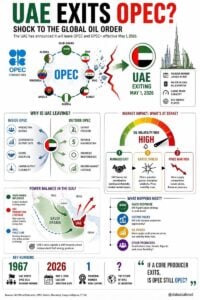
As a founding member that joined in 1967 and the organization’s third-largest producer, the UAE’s departure signals a profound shift from collective market management to national strategic autonomy. This move is not merely an economic recalculation but a complex legal manoeuvre rooted in the principles of international jurisprudence and sovereign rights. To understand the gravity of this exit, one must analyse the legal framework of the OPEC Statute, the economic drivers of production freedom, and the precedents set by other exiting member states.
From a legal perspective, the UAE’s exit is governed by Article 8 of the OPEC Statute. This provision outlines the procedural requirements for withdrawal, typically necessitating a notice period that concludes at the end of a calendar year. However, the UAE’s specific effective date of May 1, 2026, suggests a negotiated transition or a strategic interpretation of the Statute to align with its domestic production milestones. Under international law, this action is an exercise of “permanent sovereignty over natural resources,” a principle enshrined in UN General Assembly Resolution 1803. This doctrine asserts that a state has the inalienable right to dispose of its natural wealth in the interest of its national development. By leaving OPEC, the UAE is effectively reclaiming its right to set production levels without the “quantitative restrictions” imposed by the cartel’s quota system.
Furthermore, the legal implications extend to the realm of international antitrust and sovereign immunity. For decades, OPEC has operated in a legal grey zone, often targeted by legislative efforts in the United States, such as the No Oil Producing and Exporting Cartels (NOPEC) bill. These efforts seek to strip OPEC members of their sovereign immunity to allow for litigation against price-fixing. By exiting the cartel, the UAE potentially shields itself from being labelled a “cartel member” in future international litigations, shifting its legal status to that of an independent market participant. While the UAE remains bound by its existing international treaties and bilateral agreements, it is no longer legally tethered to the collective decisions of the OPEC Secretariat, thereby increasing its legal manoeuvrability in global trade disputes.
Economically, the UAE’s exit is driven by a desire for revenue maximization and strategic independence. The UAE has invested billions of dollars to expand its production capacity to 5 million barrels per day. Under OPEC’s restrictive quota system, much of this capacity would remain “shut-in,” representing a significant loss of potential return on investment. By operating outside the cartel, the UAE can achieve output freedom, allowing it to monetize its reserves more aggressively before the global energy transition reduces long-term demand for fossil fuels. This strategy mirrors the revenue maximization model where a producer seeks to capture market share through volume rather than solely relying on high prices maintained by artificial supply cuts.
The economic repercussions for the remaining OPEC members and the global market are significant. The UAE’s departure removes a substantial portion of the group’s “spare capacity”—the buffer used to stabilize markets during supply shocks. Strategists argue that this leads to cartel stress, where other members may question the efficacy of production cuts if a major neighbour is producing at full capacity. This creates a price war risk, as competition for market share increases, potentially leading to lower global oil prices but higher volatility. Scholars in energy economics often point to the “free-rider problem,” where non-members benefit from the price supports created by OPEC’s cuts without having to reduce their own output. The UAE is now positioned to be a strategic independent actor, benefiting from any stability provided by remaining members while maintaining its own production at peak levels.
Precedent for such a move can be found in the recent exits of Qatar in 2019 and Angola in 2024. Qatar’s withdrawal was framed as a strategic pivot toward Liquefied Natural Gas (LNG), reflecting a realization that its national interests no longer aligned with an oil-focused cartel. Angola’s exit was more confrontational, stemming from a direct dispute over production quotas that the country viewed as an impediment to its economic recovery. The UAE’s exit combines elements of both: it is a strategic pivot toward a diversified post-oil economy funded by immediate oil wealth, and a rejection of a quota system that it perceives as outdated given its massive infrastructure investments.
In conclusion, the UAE’s exit from OPEC is a calculated assertion of national interest over collective discipline. Legally, it reinforces the principle of sovereign control over natural resources and alters the state’s standing in international antitrust contexts. Economically, it prioritizes volume and market share over price-fixing, signalling a shift in the Gulf’s power balance toward a more independent and competitive posture. While the move introduces significant uncertainty and potential volatility into the global energy market, it provides the UAE with the strategic leverage necessary to navigate the complexities of the 21st-century energy transition. The precedent set by the UAE may very well encourage other high-capacity producers to seek similar flexibility, fundamentally questioning whether a core producer’s exit leaves OPEC as a viable entity in the long term.
By Attorney Rafik Oreh Walid Ghraizi
Managing Partner at Middle East & Partners Law Firm