In what is becoming a less than happy New Year for university students facing incredible uncertainties about their learning in this new term, it is encouraging to see universities continuing to innovate and bring new offerings to the LLB program in England and Wales.
Press Release – Goldsmiths first UK university to offer pioneering Harvard Law School course
Harvard Law School’s innovative online course, ‘Zero-L’, will be offered free to undergraduates at Goldsmiths, University of London studying the LLB Law programme.
Zero-L, taught by 18 leading Harvard Law faculty members, introduces foundational legal concepts, legal methodology, career orientation as well as subject-specific knowledge. Over the summer Harvard Law School offered a number of US law schools the opportunity to embed Zero-L into their programmes. Goldsmiths is understood to be the first university outside the US to have secured access for its students.
Harvard Law School designed Zero-L as a tool aiming to ensure that all their incoming students, whatever their backgrounds and previous areas of study, would start with foundational legal knowledge that would enable them to thrive in law school.
Zero-L is comprised of approximately a dozen hours of video lectures, vocabulary, and periodic comprehension checks that students can take at their own pace. Course modules cover a range of topics, including: an introduction to law and the legal profession; the history of the American Constitution; separation of powers and federalism; the stages of litigation; citizenship rights (civics) and much more. It also provides students with instruction and practise in basic skills, including how to read a case.
Professor Dimitrios Giannoulopoulos, Head of the Department of Law at Goldsmiths, said: “We are thrilled to collaborate with Harvard Law School in embedding their highly innovative course into our Law degree. Zero-L is an outstanding addition to our LLB Law programme, giving our students a firm foundation in legal theory and legal institutions, and allowing them to understand how the English and US legal systems compare. This exciting development reflects the international outlook of our programme where we invite our students to look at the English legal system in a global context and go on to study areas of international relevance such as Human Rights Law, Art Law, and AI, Disruptive Technologies and the Law.”
Dr Dagmar Myslinska, Lecturer in Law at Goldsmiths said: “Goldsmiths’ law lecturers are excited to be embedding Zero-L sessions into our modules, drawing out commonalities in Anglo-American legal doctrine and the practice of law, while providing comparative insights. The programme reinforces our emphasis on teaching foundational analytical frameworks that will equip our students with transferable skills. Notably, Zero-L sessions are very much in line with Goldsmiths law department’s emphasis on placing legal doctrine and procedure within broader socio-economic contexts and noting how law and legal practice intersect with gender, class, and race. Overall, Zero-L’s coherent framework reinforces our efforts to create ongoing synergies between substantive modules, clinics, skills training, and career opportunities that we provide to our students.”
Alongside Zero-L, LLB Law students will also have access to advice and commentary from Goldsmiths law academics on how the content of the course relates to existing LLB modules such as Tort Law, Criminal Law, and Property Law. Students will be invited to reflect on specific comparative points of interest for further investigation and discussion as part of the wider programme.
For more information, check out the course program from the links in the article and go to the Goldsmith Law School website.
BPP University granted indefinite taught degree awarding powers – while HESA’s Graduate Outcomes survey shows BPP outperforming all Russell Group Unis –
BPP University has been granted indefinite taught degree awarding powers (TDAP) under the Office for Students (OfS) new regulatory framework.
The award of indefinite TDAP, which will come into force on 1st September 2020 acknowledges the University’s academic integrity as a mature higher education institution with rigorous standards and academic governance.
The decision is the “culmination of a long journey with a clear goal and a lot of hard work involved, that we set out to achieve in 2000” says Vice-Chancellor Professor Tim Stewart.
Until now, the university – which offers a range of qualifications including master’s degrees in law, business, technology, nursing and healthcare – had the authority to award degrees but this was time limited.
In September 2007, BPP University made academic history by becoming the first publicly owned company in the UK to obtain time-limited taught degree awarding powers. It then went on to obtain University Status in 2013, authorised by the Privy Council.
One part of the assessment process includes a review by the QAA. In its summary assessment report of indefinite TDAP, the QAA said that BPP “clearly articulates and implements a strategic approach to learning and teaching” and noted it for “its commitment to professional practice and the application of knowledge to real-life situations [which is]….appreciated by external stakeholders and students.”
Professor Stewart commented that the recognition of the QAA was a “significant milestone for BPP and a validation of all the hard work put in by current and previous colleagues and our close partnership with the Students’ Association over the years. The experience and expertise that our staff bring to programme design, delivery and review has been fully acknowledged with this decision.”
BPP University has around 15,000 students, studying across 13 centres, in eight locations across England and online around the world. 70% are full-time and 84% are on postgraduate programmes.
This acquisition of indefinite TDAP strengthens the standing, reputation and achievement associated with BPP University alumni.
Separately, HESA’s Graduate Outcomes Survey results*, has revealed that postgraduate students who study with BPP and go into employment are more likely to secure highly skilled employment roles compared to students from other universities.
The study, taken 15 months after students in 2018 graduated, showed that of BPP alumni in employment, 98% were in highly skilled roles, typically being professional and managerial positions.
UniversityPercentage of post-grad students Rank working in highly skilled roles
1. BPP 98.1%
2. Cambridge 97.5%
3. Imperial College 96.8%
4. Warwick 96.6%
5. Oxford 95.7%
6. Cardiff 95.5%
7. UCL 94.2%
8. Birmingham 93.9%
9. Southampton 93.8%
10. Edinburgh 93.1%
Looking specifically at BPP University Law School, an astounding 100% of LPC graduates, 95% of BPTC (now the BTC) graduates and 91% of GDL (now the PGDL) graduates who were in employment were in highly skilled occupations 15 months after graduating.
Commenting on the findings, Professor Stewart said that, “we have always been proud of the fact that our alumni go on to work at major companies, global law firms, and top ranked chambers. The future employment possibilities of students is paramount to us and the Graduate Outcomes results is a clear demonstration that the practical skills we teach our postgraduates are highly valued and help to build and shape many thousands of careers”.
A major concern for students, recent graduates and career changers in our current mid-pandemic situation is, ‘how do I get legal work experience during Covid-19?’ On-campus and traditional in-office experiences are either impossible, or at least limited at the moment due to the necessary health and safety conditions. This has, in terms of commercial awareness and legal experience, limited access and opportunity vital to a successful training contract application.
Within this context, Clifford Chance’s new Global Virtual Internships have arrived at the right time. It fits the need of law students globally who are worried about their prospects, focused on boosting their resumes. The internships offer students, and any would be legal CV boosters, an insightful experience. The programs offer a chance for students anywhere in the world on any budget to experience an internship with Clifford Chance.
‘Upskill yourself by completing trainee-level tasks’
The internships include over 20 hours of practise inspired modular content, and ‘represent the future of virtual work experience.’ They are entirely free of charge to students anywhere in the world and form a major part of the firm’s educational aspect of its UN Sustainability Goal commitments and its pro-bono and event programs.
Clifford Chance details that, ‘as a signatory to the UN Sustainable Development Goals, we believe that education is vital for building a better world for all. As such, access to education is one of the three pillars of our Global Community & Pro Bono Strategy. Our Global Virtual Internships are open-access which means anyone can participate and have access to these programmes from anywhere.’
‘Gain an insight into challenges facing our clients around the world’
The internship scheme offers three separate streams: Cyber Security, Climate Change, and Business and Human Rights. Each internship takes around 5 to 6 hours to complete and involves completing tasks set and comparing your work with models prepared by Clifford Chance lawyers. For example, in the Cyber Security internship students will develop practical guidance for a client on how to respond in the event of an ICO Dawn Raid. Students will follow detailed instructions from Clifford Chance partners, associates and trainees allowing them to make their way through completing the set tasks. The tasks involve drafting, research and client advising skills, all highly valuable experience.
The structure and content of the internships were developed by Clifford Chance in conjunction with the University of York Law School. The university is well regarded for its expertise in problem based learning (PBL), the central education strategy of the internship program. Stephen Levett, Director of Professional Practice at York Law School, comments that ‘working with Clifford Chance on this project has been a real eye-opener. Their total commitment to innovation and finding new ways of doing things is inspiring and really connects with the way we approach our teaching at York Law School’.
This teaching strategy is emphasised by Clifford Chance through the internships, commenting that ‘the university contributed towards idea generation for the internship tasks, reviewed the content once our lawyers had designed it, and provided some useful guidance about PBL – which should help you if you decide to work on the tasks in a group’.
‘Learn first-hand from our trainees and lawyers around our global network’.
Each internship covers prominent areas of interest to students and increasingly important topics raised by the firm’s largest and most significant global clients.
The Cyber Security Internship features assignments and teaching on topics from data protection crisis management, ICO Dawn Raid reaction, and preparing clients for data related damages claims.
The Business and Human Rights Global Internship covers human trafficking and slavery in supply chains, advising clients on EU reporting requirements of non-financial information about employees under European Directive 95/2014, the human rights risks within an M&A transaction, and court rulings involving the European Convention for the Protection of Human Rights and Fundamental Freedoms.
The Climate Change Internship covers the impact of US Climate change legislation by researching potential new laws and assessing their impact on clients. It also features a ‘Management Induction’ on climate-related disclosure duties where the student will present to a client on its duties around climate-related information reporting.
‘Practise advising clients on how to protect themselves and deal with these risks responsibly’
Clifford Chance, as a leading global law firm with Magic Circle value and status, is typically leading the way in terms virtual internship opportunities. This rare opportunity is exactly the kind of CV boosting legal experience that is helpful for training contract applications, as it can be done at the student’s own pace and from any location, all for free.
“This is by far the most intellectually-challenging module I have done on InsideSherpa. It’s intellectually stimulating yet rewarding at the same time. It’s in-depth, technical, and I really felt like I was working on real-life tasks.” – a student participant.
The ability to place yourself in front of Clifford Chance recruiters by sharing your internship results with the firm is also one not to be scoffed at, as it can be valuable in a competitive applicant field. This virtual internship opportunity is one not to miss.
The legal industry has always been highly competitive and even more so for those at the start of their careers looking to make their mark and progress through the ranks. Savvy younger solicitors have always tried to get ahead by networking, applying early for training contracts and taking a targeted approach to securing a job at the firm of their dreams. However, with the rule book truly shaken up as 2020 has turned most sectors on their heads, including the legal industry, there is an opportunity for ambitious young professionals to find new ways of standing out from the crowd. The pandemic has bought huge changes in terms of the way we work, expectations and priorities for firms and clients and which sectors will survive and thrive in the coming years. For those at the start of their careers, getting recognition will be about understanding and harnessing what this means for law firms and the skills they’ll need. Jody Tranter, head of BARBRI Altior explains.
Soften up – skills for success
According to new research carried out post-pandemic by legal software company Wolters Kluwers in its 2020 Future Ready Lawyer survey, ‘meeting changing client/leadership expectations’ was the second biggest trend international lawyers predicted would impact their firms over the next three years. While legal training is, of course, mandatory and a key part of the early career of a young solicitor with the Professional Skills Course (PSC), training in softer skills, vital for building and managing strong client relationships isn’t always considered as important as technical knowledge. However, being able to gain the trust and respect of clients and colleagues is key to being successful and advancing your career. Your Continuous Professional Development (CPD) should include developing these softer skills further. Particularly in a post-pandemic world where being able to navigate through unchartered waters and engender the confidence of others is essential to your success.
Where to start – quality training
Many individuals at all stages of their career will choose to focus on CPD to support career progression, as well as the regulatory competence statement. There are a variety of legal training providers on the market, however, choosing one that has specific legal sector experience and understands the nuances of the industry is the best place to start. BARBRI Altior has over 40 years’ experience, specifically in legal sector training and works with solicitors from their early days in the profession, right through their legal careers. Personal development courses which help nurture skills including; business development and networking, time and stress management, negotiation skills and dealing with difficult people will prove vital over the coming months. Investing in the development of your personal and professional skills, given their increasing importance in the ‘new world’ post-COVID-19 is certainly one area where you can give yourself an added edge.
Take it higher – expanding your horizons
In addition to this, consider what areas of your professional practice you could enhance to make you stand out too. The Higher Rights of Audience (HRA) course is a popular choice at BARBRI Altior with solicitors looking to do just that. It enables them to practice in the Higher Courts in England and Wales and can now be undertaken via an online exam, making it extremely accessible as many continue to operate remotely. Course attendees can seek to qualify for either the civil or criminal courts, or both. Using BARBRI Altior’s legal industry know-how the course programme has been designed to be directly applicable in the workplace and benefits attendee’s overall communication and case management skills as well as enhanced advocacy. Being qualified to offer additional services will create a point of difference between you and your peers and potentially open up new opportunities to you, with increased earning potential and enhanced professional status.
Next generation know-how – tech smarts
As well as investing in your own skillset, think about what you can do to help your firm thrive. Leadership figures will notice those who embrace the ‘new normal’ and help the firm navigate the crucial next couple of years. Technology know-how is one of the key areas where many younger legal professionals inherently have the skills their firm needs to both survive and thrive post-pandemic. After all, investment in LawTech has almost tripled over the past two years. Yet, while not denying its huge potential and growing importance in the legal sector, many partners and senior lawyers have failed to harness it, partly due to lack of time, but also due to lack of understanding and fears around data, home working and other things that need careful consideration. However, due to the need to embrace technology overnight when COVID-19 first hit to support home working and client-facing and operational necessities, law firms had no choice but to react and adapt. From a positive perspective, this has rapidly accelerated firms use of technology to the benefit of clients, staff and operations. For this reason, young legal professionals who understand technology and its potential have become more attractive to law firms than ever.
In addition to simply being a ‘digital native’ by generation, stand out from your peers by enhancing your understanding of the latest homeworking technologies, legal social media strategies and the emerging LawTech industry. Get involved in internal technology committees and other initiatives at your firm for a chance to demonstrate your expertise in these areas, while at the same time reminding colleagues of the value you add to the firm.
We are rapidly approaching another major milestone in the training contract calendar. July 31st, is a big day for training contract deadlines. While it is not advised to rush out and quickly write up an application in a panic, it is important to know what’s coming up. Here’s a list of firms to check over if you’re planning to apply on July 31st.
Addleshaw Goddard – July 31st
Cleary Gottlieb Steen & Hamilton – July 31st
Cripps Pemberton Greenish – July 31st
Farrer & Co – July 31st
HFW – July 31st
Hodge Jones & Allen Solicitors Limited – July 31st
Hogan Lovells – July 31st – undergraduate law students only
Macfarlanes LLP – July 31st
Mayer Brown International July 31st
Memery Crystal – July 31st
Millbank LLP – July 31st
Payne Hicks Beach – July 31st
Pennington Manches Cooper – July 31st
Stephenson Harwood – July 31st
TLT LLP – July 31st
Travers Smith – July 31st
Vinson & Elkins LLP – July 31st
For a full list check our training contract application deadline page, and confirm with each firm.
Use your legal knowledge in a job which sits at the heart of an organisation with boardroom responsibility, is jam-packed with variety and a competitive salary to boot. Consider a career in governance as a company secretary. Hawys Boobier, freelance writer and editor, finds out more about this unique and exciting role and how you can experience it.
Company secretaries fulfil a crucial role at the top of an organisation, advising directors on governance – the system that enables management and the board to deal more effectively with the challenges of running an organisation. It is a responsible, varied and influential role, and one which is only growing in importance. They are valued strategic advisers with in-depth knowledge of law, taxation, finance and management. They give independent, impartial advice and guidance to directors, shareholders and trustees as well as other key decision makers across the private, public and not-for-profit sectors. They support and advise the boards of organisations on their duties and responsibilities, as well as any changes and developments in the laws affecting the operations of the organisation and ensure that the organisation complies with regulatory standards. In an increasingly regulated world, it goes without saying that this is no mean feat.
To say that the role of a company secretary is broad would be an understatement. Typical responsibilities can range from organising the AGM to collating a company’s annual report from stakeholders across the business. While there is undoubtedly an administrative element to the role, particularly when you start, as the primary governance professional in an organisation, company secretaries do far more than simply record the minutes of meetings, issue notices and file statutory documents. “No two days are the same”, says Samira Chambas, Company Secretarial Assistant at Aviva Secretariat. “My day could involve a variety of tasks, including drafting and uploading papers for board meetings, attending and minuting meetings, preparing and submitting RNS stock market announcements, performing board effectiveness reviews, as well as notifying Companies House, the Financial Conduct Authority and other relevant regulatory bodies on company changes such as share capital increases/decreases, director appointments or resignations and dissolutions or liquidations. There is also quite a lot of research involved in the role of company secretary, such as reviewing the impact of government policy and publications and making sure that the board and the company as a whole adheres to the highest legal governance standards.”
The eyes, ears and conscience of an organisation
Company secretaries are the eyes and ears of an organisation, ensuring that crucial information flows securely to the correct people, that board meetings are effective and that proper records are kept. Working in such close proximity to the board of directors inevitably means being privy to some of the most important decisions made within an organisation. “When I worked in professional services, I had close contact with the board,” says Samira. “In a listed company, a lot goes through the deputy company secretary or the general counsel, but I do get to work closely with the board on some things. Being privy to important information by being the first point of contact when the company wants to set up an insider, confidentiality or project list, makes the role feel really important. You have to know what is going on and you have to be confidential”.
Company secretaries gain an insight into the many different areas within a business, making them all-seeing, all-knowing and consequently extremely valued. They become an integral cog, to such an extent that company secretaries are often referred to as ‘the conscience of an organisation’.
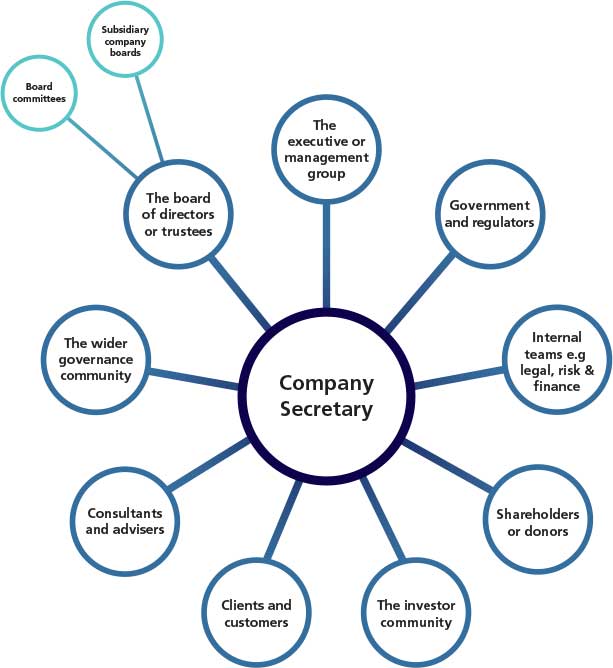
They also interact with a wide variety of different stakeholders, both internal and external.
“Working with different stakeholders and for different departments you see the length and breadth of everything that is going on in the organisation,” says Samira.
Unlike lawyers who will present to the board on a particular issue and then leave the meeting, a company secretary will sit through the entire meeting and consequently obtain a vast repository of knowledge about the entire organisation. The breadth of the role means that knowledge is acquired quickly and rising up the ranks can happen more swiftly than you might think. As the responsibility grows, so too can the salary, meaning that the move up the remuneration ladder can also be a rapid one.
The career progression path is clear, although it is by no means narrow or rigid. The skills acquired are transferrable, so despite having the word ‘company’ in the job title you can apply them to a field outside the corporate world – working for a charity, sports organisation, educational establishment or in the health service, for example.
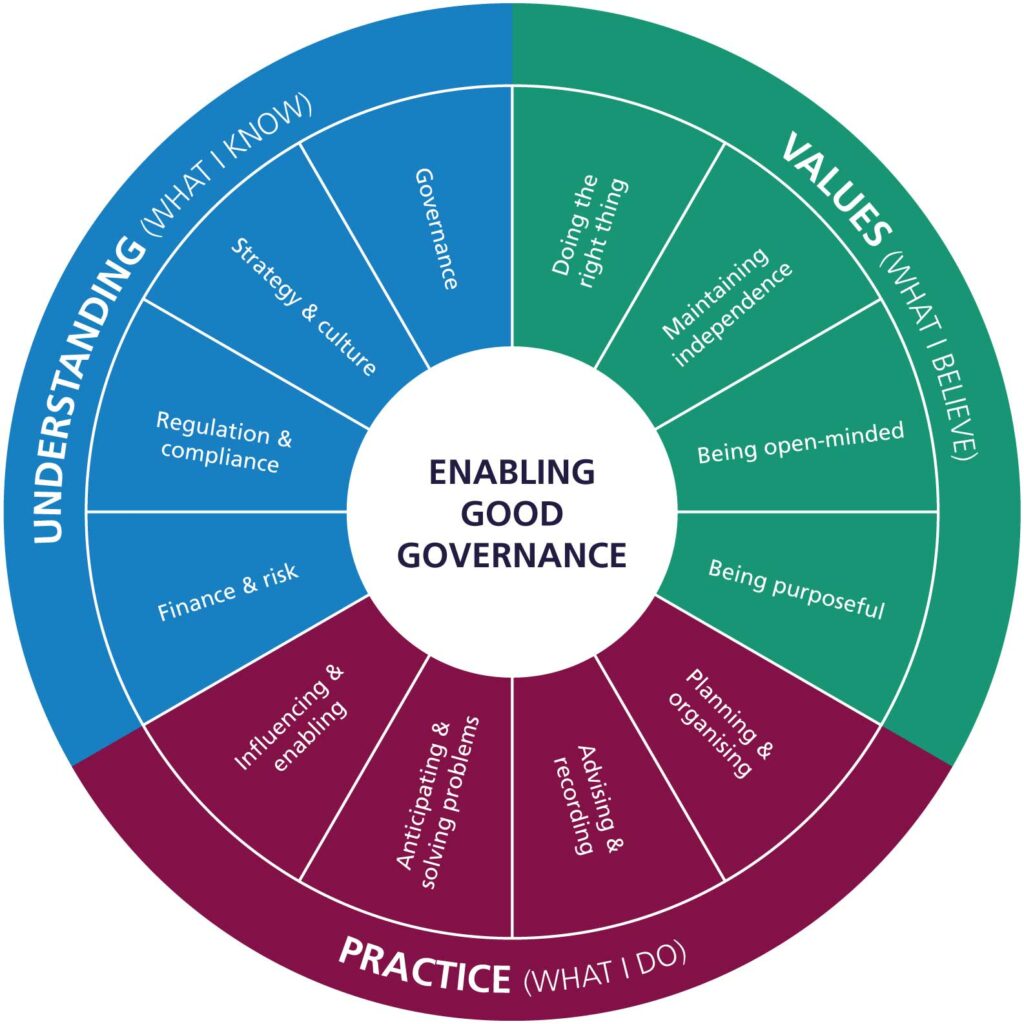
In order to do the job well, you will need values, understanding and practice (see chart below). Having a strong moral code is a must as you will be responsible for ensuring that your organisation operates legally, appropriately, ethically and fairly.
The role is full of variety, but also responsibility. Governance has grown in importance since the 2008 financial crash as businesses and other types of organisations have sought to avoid the pitfalls which led to the crisis. It evolves constantly as new challenges arise: Brexit, COVID-19… whatever the scenario, there is always a pressing need for high-quality company secretaries to help steady the ship.
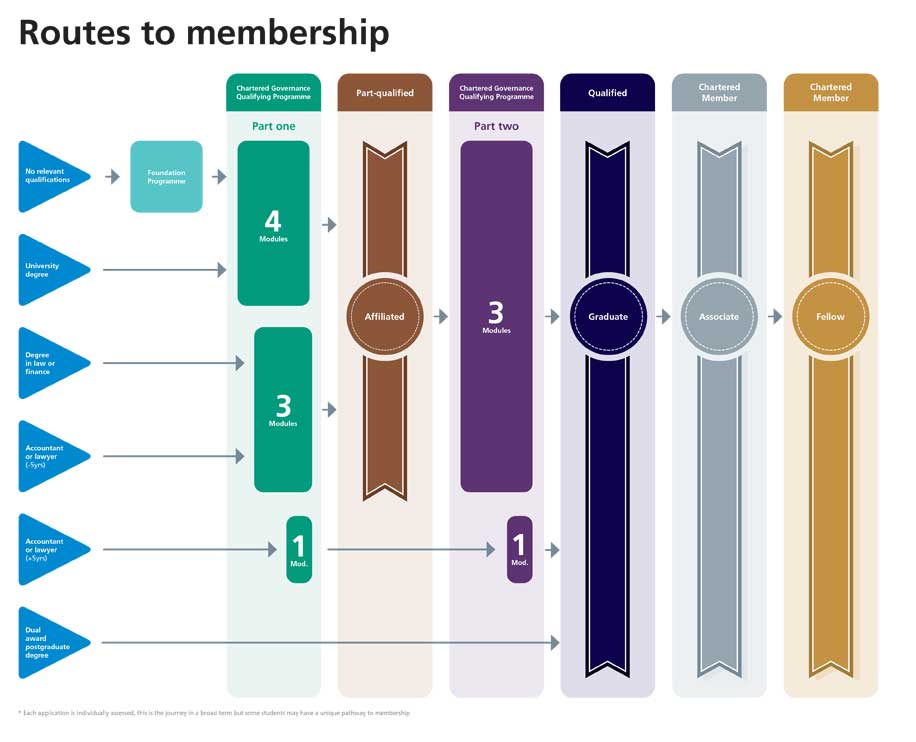
The importance of the role means that professional qualifications are desirable. The Chartered Governance Institute has a number of qualifications, which are recognised worldwide for their depth and status. The Chartered Governance Qualifying Programme is the Institute’s flagship qualification and the most common route to GradCG status and Chartered membership of the Institute. If you have a law degree or a certain number of years in a legal role under your belt, you have fewer modules to take. See the diagram below for routes into the programme.
How do I know if it’s for me?
As with any role, the best way to find out if a company secretarial position is for you is to see it in action. Work experience is an invaluable way to get a real feel for the role and to meet people who can give you advice gained from first-hand experience.
Public limited companies, housing associations, charities, the NHS and universities: all of these institutions have secretariats that you can seek work experience in. Or you could volunteer for a committee, for example a sports association or a university committee.
But don’t worry if you don’t have a couple of weeks to spare. Every year, The Chartered Governance Institute supports DMJ Insight Days, which are held in conjunction with companies such as Aviva plc, Sky plc and Rolls Royce plc. Insight Days allow you to go into a company for the day and take a look behind the scenes at the various responsibilities of a company secretary. They are open to students, post graduates, or anyone considering an entry to company secretarial practice. The Chartered Governance Institute also offers one-day to one-week shadowing opportunities, AGM invitations which provide a rare insight into a key event in the company secretary’s calendar and student open evenings. If you want to explore the opportunities and benefits of a career in governance – click here.
If you want more information about the Chartered Governance Qualifying Programme, click here.
For more details about The Chartered Governance Institute and the profession, visit www.icsa.org.uk.
Case Study Samira Chambas ACG
What is your job title? Company Secretarial Assistant, Aviva plc.
What does your role consist of?
My role within the Board and Corporate Governance team at Aviva plc is very broad and new opportunities arise on a daily basis. It consists of ensuring compliance of the UK Corporate Governance Code, The Listing Rules and Market Abuse Regulations, preparing and submitting RNS announcements to the market, drafting governance and shareholder sections for the full year and half year annual reports and accounts, undertaking research into relevant public consultations and drafting recommendations for board implementation – the list is endless. It also consists of liaising with senior stakeholders, shareholders and investors and ensuring that the corporate legal entity management system is updated at all times.
How did you get into the governance profession?
I found out about the industry in my second year of university in Portsmouth and, after undertaking some work experience at the Financial Conduct Authority, I decided that this was the role for me and followed it through by undertaking the Qualifying Programme exams with the Institute while working full time in a trainee governance role.
What is the most exciting work project you’ve been involved in?
The industry as a whole is exciting. I like the variety of the role; no two days are the same as cliché as it may sound. There is always something new and challenging which allows you to broaden your knowledge and experience.
I also really like the research aspect of the role. I’m currently working on the Parker Review, which looks at getting more ethnic diversity into the boardroom. When I started out in industry, I didn’t see that many people who looked like me at the top both in the boardroom and in the governance profession, so the Parker review is something I am really excited about and I look forward to seeing how companies put that into action. I have recently launched a page on LinkedIn called ‘Black Governance Professionals Network’ which is open to anyone who supports our objective and commitment to ensuring that black governance professionals have a seat at the table, have quality of access and are being recognised, retained and promoted.
What skills do you need to succeed in your job?
The role requires and teaches you various skills, including but not limited to:
Attention to detail
Ability to work in a team and as an individual
Ability to prioritise and multitask effectively
People skills to be able to work with senior stakeholders and the Board
Time management especially in a listed company where there are legislative and regulatory deadlines such as submissions to the market.
What are the biggest challenges in your job?
The ever-changing regulatory and legislative requirements require one to be and remain commercially aware at all times. Also, the current pandemic is challenging as governance professionals have to be innovative and find new ways in the governance sphere. Despite the many challenges the role brings, new opportunities are being created day in day our and it is a great time to pursue a career in governance.
What advice would you give to somebody studying law who is interested in a career in governance?
Have passion for governance and for being a change maker. A career as a governance professional should be a deliberate choice rather than a fall-back option. If you are after a diverse, challenging yet rewarding career then becoming a governance professional may well be the career for you. I would advise anyone studying law who is interested in a career in governance to read a lot about the industry, secure work experience if you can and attend Insight Days and student open evenings put on by The Chartered Governance Institute and DMJ to obtain invaluable insight into what the career has to offer.
It’s that time of year again where training contract deadlines seem to come all at once. Despite the pandemic and the overall uncertainty within the economy, politics and society, the training contract schedule pushes on for the most part unabated. Here are the upcoming deadlines in the next two weeks as registered with the Lex 100.
Covington & Burling LLP – July 10th
Akin Gump Strauss Hauer & Feld – July 12th
Kirkland & Ellis – July 12th
Norton Rose Fulbright – July 12th – penultimate year law students only
Watson Farley & Williams – July 13th
Blaser Mills Law – July 14th
Morgan Lewis & Bockius UK LLP – July 15
White & Case – July 15th
Sidley Austin – July 17th
Have a look at each firm’s website as well as its Lex 100 profile for details about how to apply.
Also, July 31st is a major deadline day for applications for more details check the training contract deadline chart here:
The summer training contract application push is upon us. This year’s recruitment round is naturally affected by the Coronavirus pandemic, but there are plenty of law firms still recruiting for 2022 and some of them have their deadlines coming up soon.
Brabners LLP’s had previously been due on June 30, but its deadline has been extended to 31 October 2020 in light of the pandemic.
This list contains the most urgent deadlines, but is not exhaustive. There are many more firms with deadlines throughout the summer. We will be keeping an eye on the deadlines and will have further updates.
To see a full list of deadlines registered with the Lex 100 click here:
Kennedys are hosting a virtual insight event for students on Thursday 9 July at 1pm. If you are a university student interested in pursuing a career in law, we would love you to join us! Register now to secure your place and find out more here. https://bit.ly/3eImj8d
As the impact of the Covid-19 pandemic continues to have a dramatic impact on the legal industry, further changes to the summer vacation scheme season are announced.
Akin Gump, a major American global firm with a strong City presence, has announced its summer 2020 vacation scheme will now be entirely digital.
In a communication to its upcoming vacation scheme attendees the firm outlines the new program plan.
‘As your safety and health, as well as that of the London office, remain our top priority during the COVID-19 working restrictions, we have been busily working behind the scenes to ensure you will be able to have a meaningful, rewarding and, most importantly, safe experience with us this Summer.
Our programme will begin on Monday 22 June and remain as a full, two week period. Due to the remote working situation extending across the Summer period, we will be holding our Vacation Scheme programme on an entirely virtual basis. We truly wish we could have an in person programme but can comfortably assure you that an array of opportunities will still be on offer for you to get to know more about the firm and our practices, build professional and legal skills and also to network with our trainees and lawyers.
Full details of our virtual programme schedule will be shared with you shortly.’
Akin Gump is not the only firm taking this step. Skadden announced that its vacation schemes will be conducted remotely as have Clifford Chance, Pinsent Masons and others.
As is clear from the news across the industry that law firms are reducing working hours, limiting face to face meetings, working remotely and furloughing and in some cases laying off staff. These measures are to be expected and I expect to continue.