



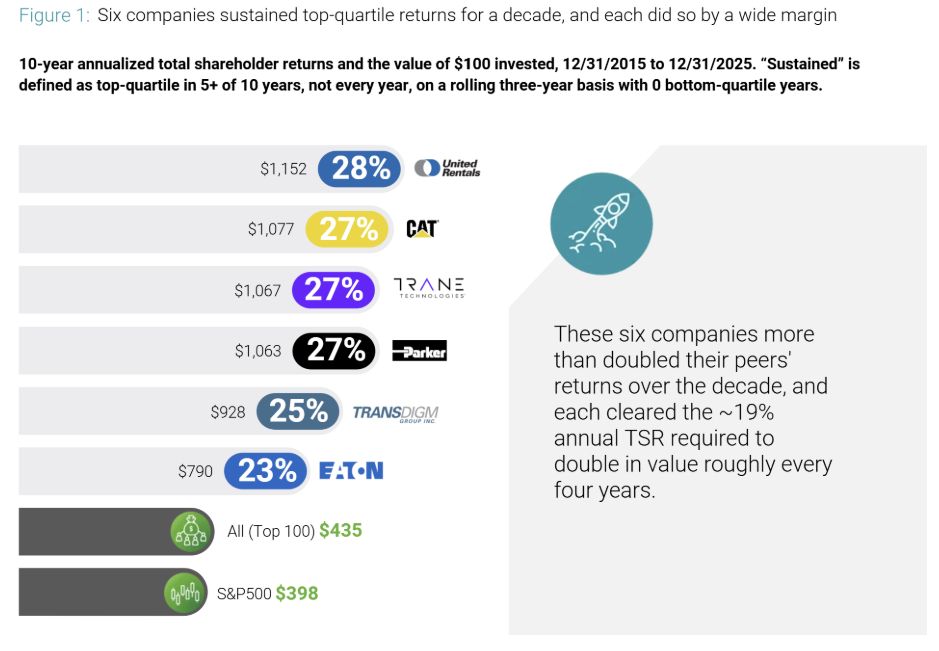
Only six of the 100 largest global industrial companies sustained top-quartile shareholder returns over the past decade. What separated these six top performers was what we call their performance systems: the collection of operating models, competencies, and management disciplines that together account for how a company performs. At its simplest, a performance system defines how we do things around here, and why.
From an AI impact perspective, large, global industrial companies are an interesting group to analyze. They are typically highly complex, capital-intensive, and technologically sophisticated enterprises, where achieving consistent high performance requires doing the right things and doing them well. Unlike certain pure software and technology-enabled companies whose very existence may be threatened by AI, large industrial companies, for the most part, don’t face an existential threat. They do face significant disruption from AI. But there is also considerable opportunity. The key question is where and how to deploy AI for the greatest impact. That is what we want to unpack.
But first, we need to lay the groundwork for what, in our view, underpins strong and consistent industrial company performance. Specifically, we see three essential elements that make for winning performance systems in today’s environment:
- How leading companies set their shared definition of winning so the business is aligned toward a single direction and performance criteria
- How they organize to win through a set of performance-enabling building blocks, which we have grouped into Three Rights, each with a different role and challenges to master
- Where AI actually moves the needle and how companies build it into their performance system
Winning has to mean one thing: expanding your share of attractive profit pools
Every high-performing company focuses on one clear, widely understood definition of winning: a single measure that every function, investment decision, and incentive is optimized against. Without it, functions tend to pursue competing definitions of winning and the system fragments.
A company’s shared definition of winning needs to be the right one, measured the right way, because a system will enforce whatever measure it is given. Consider a large diversified industrial company that spent years running a highly regarded management system. Operating margins roughly doubled, and returns on capital moved from around the cost of capital to comfortably above it.
But the company had defined winning as margin and return percentages. Over time, that discipline led it to pass on profitable, strategically important growth that would have added shareholder value but diluted its margins. It lost share of the most attractive profit pools, eventually drew activist attention, and ended in a breakup. Ultimately, the system did exactly what it was built to do. It was just built around the wrong definition of winning.
The best definition of winning for an industrial company is economic profit growth over time: growth in earnings above the cost of the capital used to generate them, sustained over years rather than quarters or a single strong year. Total shareholder returns follow economic profit growth. Expanding your share of attractive profit pools is how you deliver that growth.
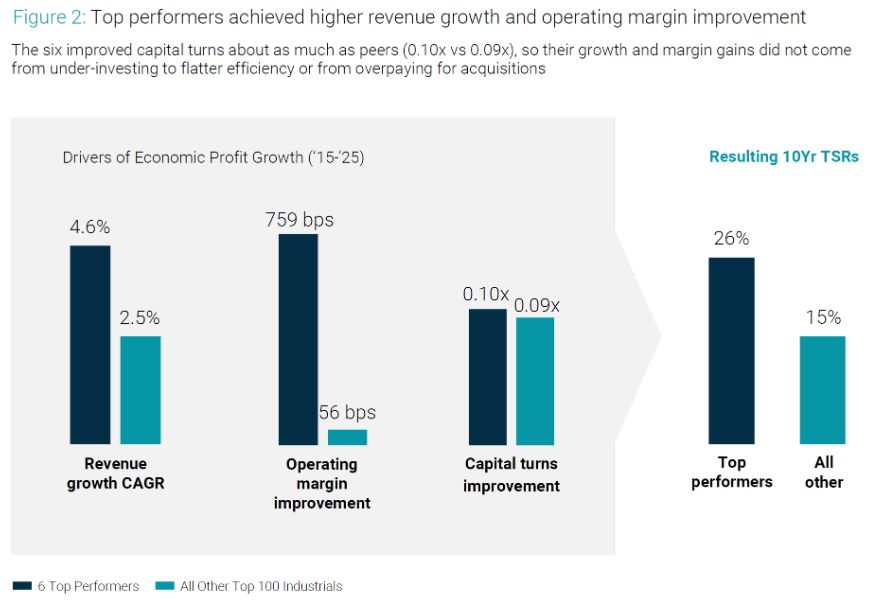
Sustained economic profit growth requires revenue growth, margin expansion, and capital efficiency working together, rather than as independent line items optimized in a carousel of competing goals. The six top-performing industrial companies improved capital efficiency about as much as their peers, but grew revenue and expanded operating margin far faster than the rest of the top 100. A cost program or new product launch can lift margins for a few years. Delivering all three for a decade takes a performance system.
Establishing an effective performance system starts by analyzing your business in granular detail. Most management teams believe they know where their business makes money. Far fewer can show it in enough depth to know where the next investment dollar should go: which market segments, customers, products, and geographies earn well above the cost of capital, which barely cover it, and which destroy value. The external and internal profit concentrations that granularity reveals are what make a definition of winning actionable rather than aspirational.
Once the definition and the measure are right, they should not change. Their permanence is what makes them powerful, because every function, investment decision, and incentive can then drive toward the same outcome, quarter after quarter, year after year. What does change is the business environment. Profit pools shift, sometimes quickly, so leading companies regularly revisit where they are aiming their resources while holding the measure of success fixed.
With the right profit pools identified, the key leadership task becomes aligning the whole business behind them.
The content of this article is intended to provide a general guide to the subject matter. Specialist advice should be sought about your specific circumstances.





