In a recent piece in this series, our colleagues showed
that funds set hurdle rates differently depending on the asset
class. Funds also use different approaches for calculating hurdle
rates.
Funds typically use one of three main approaches to calculate
the hurdle: compounding interest rate, internal rate of return
(IRR), or percent of amounts drawn or committed.
When all funds are considered together, the compounding interest
rate approach is the most popular. An analysis of Goodwin's
Private Funds Terms Database shows that 50% of funds overall use
this approach, while 38% use IRR, and 12% use percent of amounts
drawn or committed.
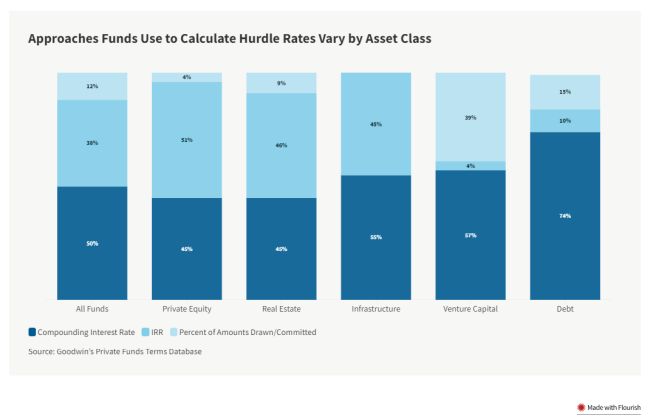
The picture changes when funds are grouped by asset class. For
private equity, real estate, and infrastructure funds, the split
between those using the compounding interest rate and the IRR
approaches is close to even. A small percentage of these funds use
the percent of amounts drawn or committed approach.





