

Share on LinkedInShare on LinkedIn

ARTICLE · 20 APRIL 2021

Has The Court's Unanimity Rate Been Impacted By Shifts In The Party Alignment Of The Court (Part 2 – Civil)?

Arnold & Porter
Arnold & Porter
Contributor
Arnold & Porter

Arnold & Porter

With over 1,000 lawyers across 16 offices worldwide, Arnold & Porter is renowned for its...

View firm profile
Explore more from Arnold & Porter

This week, we're tracking the Supreme Court's unanimity rate in civil cases, matched against the evolving party alignment of the Justices. Last time, we reviewed the data for the 1990s.

United StatesLitigation, Mediation & Arbitration

This week, we're tracking the Supreme Court's unanimity rate in civil cases, matched against the evolving party alignment of the Justices. Last time, we reviewed the data for the 1990s. Today, we're reviewing the data for the years 2001 through 2010.

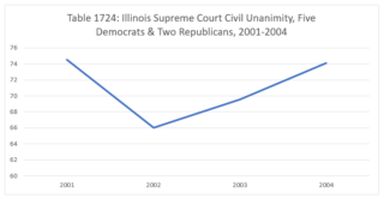
With Democrat Thomas Kilbride having replaced James Heiple in the final days of 2000, the Court was at five Democrats and two Republicans from 2001 through the end of 2004. For these four years, the overall unanimity rate was 71.14% – ten points higher than it was in the nineties. The unanimity rate in 2001 was 74.51%. It fell to 66% in 2002, rose to 69.57% in 2003 and rose back to 74.07% in 2004.

1059560a.jpg

The party alignment fell back to four Democrats and three Republicans in the closing days of 2004 as Justice Lloyd Karmeier replaced Justice Philip Rarick. For the five years that followed, the overall unanimity rate increased three points to 74.66%. The reversal rate in 2005 was 81.25%. It fell precipitously in 2006

We operate a free-to-view policy, asking only that you register in order to read all of our content. Please login or register to view the rest of this article.

The content of this article is intended to provide a general guide to the subject matter. Specialist advice should be sought about your specific circumstances.

See more popular content from
