Share on LinkedInShare on LinkedIn

ARTICLE · 17 FEBRUARY 2015

Delayed Retirement Effects Of Investment Costs And Behavioral Tendencies

Most people know (at least in the abstract) that choices have consequences. Choices you make to manage your behavioral tendencies (or not) and about your investment costs may have tremendous consequences for when you can retire.

United StatesEmployment and HR

Most people know (at least in the abstract) that choices have consequences. Choices you make to manage your behavioral tendencies (or not) and about your investment costs may have tremendous consequences for when you can retire.

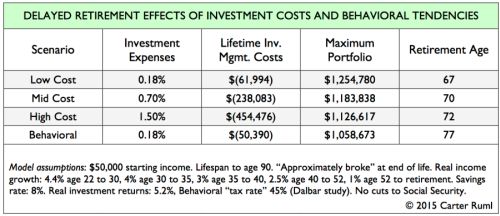
I built a model to explore the tradeoffs between retirement age, investment costs, and behavioral tendencies. Like any model, it makes necessary simplifying assumptions. Nonetheless, I think its results (summarized in the table below) are directionally useful for your own planning and decision-making.

To make this walk through the model a bit more fun, let's frame it as a story of four college roommates: Leo, Mike, Henry, and Bill. Through age 22, they've made really good, really similar choices. All four have studied engineering at a moderately priced state school and obtain great jobs prior to graduation.

We operate a free-to-view policy, asking only that you register in order to read all of our content. Please login or register to view the rest of this article.

See more popular content from

