
Share on LinkedInShare on LinkedIn

ARTICLE · 27 MARCH 2014

New Urgency For Corporate Inversion Transactions

Hogan Lovells Cadwalader
Contributor
Hogan Lovells Cadwalader

Hogan Lovells Cadwalader

Hogan Lovells Cadwalader is a global law firm trusted by clients to deliver on complex, high-stakes...

View firm profile
Explore more from Hogan Lovells Cadwalader

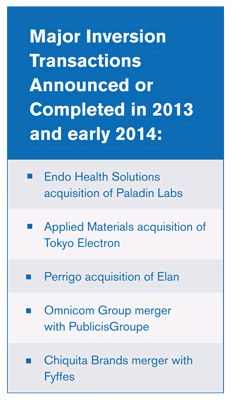
Corporate inversions have constituted an active and successful part of the M&A market in 2013 and early 2014, as acquirors have typically traded up on the date of announcement.

United StatesCorporate/Commercial Law

Corporate inversions have constituted an active and successful part of the M&A market in 2013 and early 2014, as acquirors have typically traded up on the date of announcement. However, there is now a new urgency for U.S. corporations seeking to invert to identify merger partners and complete their transactions.

In an inversion transaction, a foreign corporation is interposed between a U.S. corporation and its shareholders, typically to allow the U.S. corporation to distribute the untaxed earnings of its foreign subsidiaries to the shareholders of the new foreign parent, or to reduce its future tax liability through deductible payments to the new foreign parent, each without U.S. tax. For example, in Endo Health Solutions' 2013 acquisition of Paladin Labs, shareholders of Endo and Paladin exchanged their shares for those of a new holding company incorporated in Ireland, which will own the two companies as subsidiaries. This will allow Endo to reduce its effective

We operate a free-to-view policy, asking only that you register in order to read all of our content. Please login or register to view the rest of this article.

See more popular content from

