

Share on LinkedInShare on LinkedIn

ARTICLE · 23 NOVEMBER 2026

Demystifying Law Firm MSO Transactions (Video)

Mintz, Levin, Cohn, Ferris, Glovsky and Popeo, P.C.
Contributor
Mintz, Levin, Cohn, Ferris, Glovsky and Popeo, P.C.

Mintz, Levin, Cohn, Ferris, Glovsky and Popeo, P.C.

Mintz is a litigation powerhouse and business accelerator serving leaders in life sciences, private...

View firm profile
Explore more from Mintz, Levin, Cohn, Ferris, Glovsky and Popeo, P.C.

Private equity investment in law firms through Management Service Organization (MSO) structures presents unique opportunities and challenges. This analysis explores how MSOs enable capital investment while maintaining lawyer ownership, the valuation mechanics that drive deal terms, and the regulatory constraints that shape these transactions.

United StatesCorporate/Commercial Law

1872892.jpg

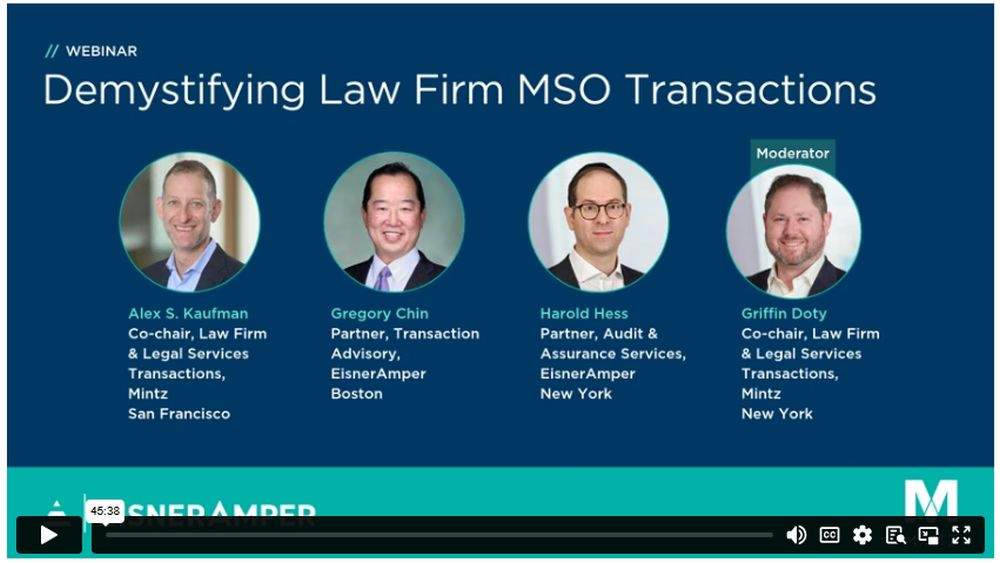
On November 10, 2026, Mintz and EisnerAmper co-hosted a webinar designed to demystify law firm MSO transactions. The webinar was moderated by New York–based Private Equity Member Griffin Doty and featured San Francisco–based Private Equity Member Alex S. Kaufman, as well as Gregory Chin and Harold Hess of EisnerAmper.

Here are five key takeaways from that conversation. 

An MSO allows private equity to invest in the business of law without owning the practice.

An MSO structure enables law firms to access private capital while maintaining lawyer ownership and control of the law practice. Non-lawyers typically cannot invest in US law firms because American Bar Association (ABA) Model Rule 5.4 generally prohibits sharing legal fees with non-lawyers. With few exceptions, some version of the rule exists in every state. 

We operate a free-to-view policy, asking only that you register in order to read all of our content. Please login or register to view the rest of this article.

The content of this article is intended to provide a general guide to the subject matter. Specialist advice should be sought about your specific circumstances.

See more popular content from
