
A look at the profitability and prospects for a typical UK dairy business.
The table below shows Andersons' 'Friesian Farm' model. Milk price increases look like restoring profitability for a typical dairy business in the current year. However cost rises are soaking up a large part of higher revenue, so overall profitability remains marginal. The prospects for 2012/13 look better, but this relies on the market delivering further price increases, and costs abating.
Friesian Farm produces 1.125 million litres from 150 cows and their replacements. It has year-round calving and is on liquid contract. It is 100ha (of which 40ha are rented on a farm business tenancy). The proprietor provides labour along with one full time worker (plus casual/relief). The table shows the farm's performance for the previous two milk years, based on actual returns and costs. An estimate is given for the current 2011/12 year, and a forecast budget for 2012/13.
There have been significant milk price rises over the last year. The Andersons' model also assumes that further increases should be forthcoming during the remainder of the year. This will partly be driven by the whole UK milk market belatedly catching up with booming global commodity prices. It is also envisaged that payments under standard liquid milk contracts (which Friesian Farm is on) will increase to reinstate the customary premium above milk going for commodity uses. Thanks to these milk price rises, the average price for the current production year is estimated to be almost three pence per litre higher. Unfortunately, this will not translate fully into higher profits.
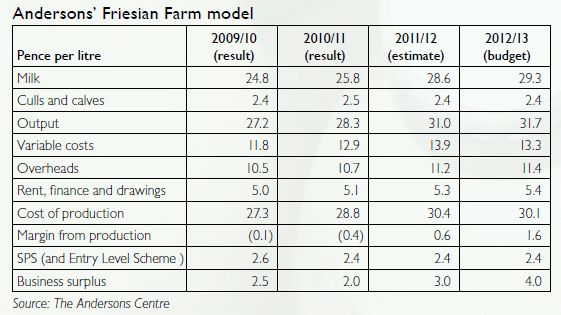
Variable costs increased compared to last year, largely driven by rises in feed and fertiliser prices. Often overlooked is inflation of 'other' variable costs, such as straw, vets and medication, seeds and dairy consumables. In terms of overheads, fuel and electricity contribute to the cost increases. The farm has also had to replace its main tractor this year – adding to machinery depreciation. Wage costs also continue to rise as the farm has to pay a competitive rate for increasingly scarce herdsmen.
The net effect is a positive margin from production – but only at very low levels. Adding in the SPS payment and Entry Level Scheme this provides a return of three pence per litre (it should be noted that the farmer's drawings are taken out before the margin figures). Based on the capital employed in this business (including the owned property), the return on capital is around 2.5%. This is obviously too low for long-term sustainability, and highlights the need for better returns from the market. Looking to the future, it is believed milk prices may increase a little more for 2012/13. Whether this happens is highly dependent on how the pound moves against both the dollar and euro, and currencies are presently very unstable. However, the fundamentals of global dairy commodity markets seem reasonable for the immediate future. There is some hope that costs may abate for the next milk year, albeit marginally. Fuel and fertiliser values may not reduce much, but feed costs should fall due to weakening cereals markets.
However, any reduction in raw material costs are unlikely to have a huge effect on winter 2011/12 feed costs, so an improvement for 2012/13 is perhaps more realistic. Overall, profitability is predicted to increase compared to the current year. However, the majority of the business surplus continues to come from support payments.
The content of this article is intended to provide a general guide to the subject matter. Specialist advice should be sought about your specific circumstances.






