


Directive (EU) 2024/825 (the “EmpCo Directive”) not only introduces new requirements for environmental claims, sustainability labels, and climate-related advertising claims; it also tightens the disclosure requirements surrounding commercial guarantee of durability. In the future, companies that sell products to consumers must, under certain conditions, provide clear and standardized information where the manufacturer offers such a guarantee. This is intended to facilitate purchasing decisions - but in practice, it raises numerous questions regarding scope and implementation.
Due to the transposition of the EmpCo Directive into Austrian national law, the KSchG and the FAGG (VerbRÄG 2026, BGBl. I No. 59/2026), since 27 September 2026, consumers in Austria must be informed about the existence and duration of a commercial guarantee of durability for certain goods prior to the conclusion of a contract by means of the harmonized label, the EU-GARAN label. The label is intended to make it clear at a glance that, in addition to the statutory warranty rights, the product is covered by a voluntary manufacturer’s guarantee for a specific period of time.
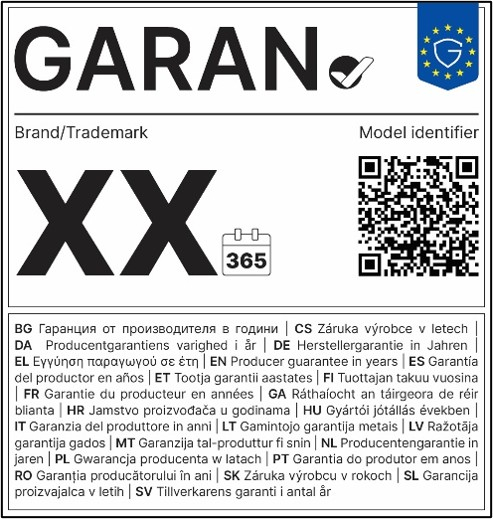
Figure: See Annex II of Implementing Regulation (EU) 2025/1960, design, text, and symbols are prescribed by EU law
Requirements for the obligation to provide information on the commercial guarantee of durability
A commercial guarantee of durability that is relevant for the label must meet the following requirements:
-
Provided free of charge: The guarantee must be granted to consumers at no additional cost. A guarantee extension subject to a charge or a separately purchasable guarantee package is therefore not sufficient.
- Term of more than two years: The guarantee must be valid for a period of more than two years. The guarantee period must be specified in years on the EU-GARAN-label.
- Coverage of the entire product: The guarantee must cover the entire product. According to the wording, guarantee that cover only individual components, accessories, or specific functions are generally not included.
Who is responsible?
The new regulation is particularly challenging in multi-tiered distribution structures. The durability guarantee is typically offered by the manufacturer, but the obligation to provide information to the consumer falls on the business that sells or offers the product.
Guarantee exclusions and limitations as a practical area of tension
Cases that are particularly open to interpretation include those in which guarantees are offered only on the condition of prior registration, where standard, minor exclusions apply, or where different guarantee periods (depending on the component) apply to the product.
In practice, guarantee terms regularly include exclusions that are typical for a particular product or industry, such as for consumable and wear-and-tear parts (e.g., in new-car guarantee).
- If the provision were interpreted narrowly, this would mean that there would be no obligation to provide information (key phrase: “for the entire product”). The fact that the obligation to provide information would then not apply to a large portion of the products due to such guarantee exclusions might not be in line with the intent of the (EU) legislator.
- At the same time, there is a significant risk to transparency: The standardized label could give consumers the impression that the entire product is covered by an unlimited commercial guarantee of durability for the specified duration.
Whether the requirements for a free durability guarantee covering the entire product are met in such cases will need to be carefully examined. While a generous interpretation of such exclusions might take into account the economic reality of many guarantee programs, it also carries the risk that the harmonized labeling format suggests a broader scope of guarantee protection than actually exists under the specific guarantee terms.
Against this backdrop, the new requirements could lead manufacturers to add corresponding exclusions to their guarantee terms or to limit the guarantee period to a maximum of two years in order to avoid using the “GARAN label.”
The content of this article is intended to provide a general guide to the subject matter. Specialist advice should be sought about your specific circumstances.


