
Share on LinkedInShare on LinkedIn

ARTICLE · 15 OCTOBER 2026

Clean Air Act Operator Liability: When Does A Parent Company Cross The Line? (Podcast)

Bracewell LLP
Bracewell LLP
Contributor
Bracewell LLP

Bracewell LLP

Paris is a vital energy hub in Europe, and our Paris office plays a central role in helping address...

View firm profile
Explore more from Bracewell LLP

Bracewell attorneys examine how parent companies can face Clean Air Act operator liability when they exercise control over a facility's environmental operations, analyzing the district court's application of the Bestfoods framework in United States v. EES Coke Battery, LLC. The discussion explores the evidence of control through master services agreements, parent-company involvement in operations, and authority over compliance spending that led to three parent entities being held liable alongside

United StatesEnvironment

1855432a.jpg

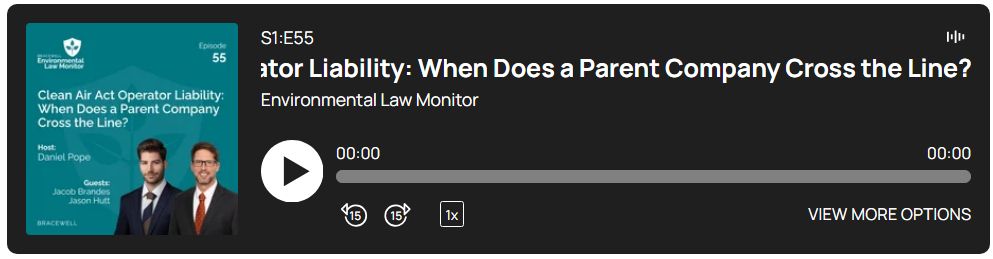
In this episode of the Environmental Law Monitor, Jason Hutt and Jacob Brandes, attorneys in Bracewell’s environment, lands and resources practice, join host Daniel Pope to discuss parent-company operator liability under the Clean Air Act through United States v. EES Coke Battery, LLC. They examine the district court’s application of the Supreme Court’s Bestfoods framework beyond its familiar CERCLA cleanup context.

A company can face operator liability when it participates in and controls a facility’s day-to-day environmental operations, even if another entity holds the permit. Jason and Jacob outline the facility’s permitting and reporting violations, the penalties and relief ordered, and the court’s reasoning for holding three parent entities liable alongside the subsidiary. The conversation also looks closely at the evidence of control: broad master services agreements, parent-company involvement in operations and authority over compliance spending.

We operate a free-to-view policy, asking only that you register in order to read all of our content. Please login or register to view the rest of this article.

The content of this article is intended to provide a general guide to the subject matter. Specialist advice should be sought about your specific circumstances.


See more popular content from
