
Originally published in Agricultural Bulletin, 2007
With the emptying of stores masking and influencing natural market forces, a shortage of grain production has resulted in an extreme hike in wheat prices.
World grain prices have been in a bear market for the past 15 years. Values fell from the highs of the mid 1990s as consumers easily procured sufficient grain to meet their requirements.
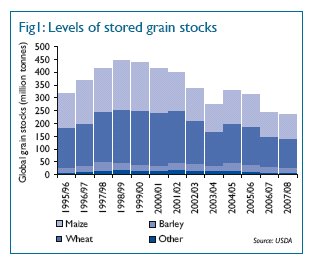
However, since 1999, some of this supply was met not from production, but from emptying stores (Figure 1). Stored stock levels have steadily decreased as the world has become more efficient at moving bulky commodities from places of surplus to places of deficit in short time periods. This has allowed importers to hold less grain stocks and still ensure that buyers are supplied on time. Furthermore, throughout the 1990s and first five years of this decade, a relatively peaceful world gave governments a sense of national security, resulting in a drop in government-held stocks.
In a perfect market, prices fall in times of surplus, less is produced and prices rise again. But when this effect is masked by emptied stocks, the market remains capable of supplying low prices, even less is produced, and the cycle continues.
Over the past decade, as demand was met in part through stored stock, land has come out of cereal production in several of the major grain-growing regions. For example, the Black Sea region now crops only twothirds the cereal area it did 25 years ago, a drop of 40m hectares. Meanwhile, China’s 2007/08 cereal area is 12.5m hectares less than its peak in the late 1970s.
But, in the last 12 months, grain availability has tightened and store levels have fallen to a point where they can no longer supply a production shortfall. The perfect market system has come into play again, resulting in a sudden, severe, price hike. Prices are now higher than they have been for over 11 years – not just in the UK, or Europe, but globally. And so the question begs, is this reversible?
In short, yes. From just the two regions mentioned we have already identified at least 50m hectares of potential cropable land. A low yield of two tonnes per hectare would provide sufficient grain to replenish global stocks by more than the total drawdown over the past five years.
Desertification has ruined a lot of this land so not all of it could be cropped again, and the rising demand from the growing population and for biofuels would soon devour the extra stocks. But if this analysis was undertaken throughout all grain growing regions, the potential would be staggering.
The content of this article is intended to provide a general guide to the subject matter. Specialist advice should be sought about your specific circumstances.






