
Today's entry discusses the presentation of written materials on the Planning Inspectorate website.
At a meeting of the National Infrastructure Planning Association Legislation and Guidance Working Group last night, one of the topics covered was the amount of written information that accompanies applications, and the examination of applications, under the Planning Act 2008, and how this affects accessibility by local communities in particular.
First, it is of course good that all written material relating to an applicaiton is made available to everyone. This has not been the case with previous regimes and is clearly good for openness and accessibility.
Secondly, the Planning Inspectorate (PINS) have a tough job to present such large amounts of information in a way that makes it easy to find - and easy to load (i.e. documents can't be too large). At the last count, the Thames Tideway Tunnel page on the PINS website contained 2,387 documents. It is a very large application and is bound to generate a large amount of material. There'll be a yottabyte of information there by the time we're finished.
Thirdly, the website has improved a lot since, say, a year ago, when finding new documents was like playing 'Where's Wally?'. The best new feature is the 'date loaded' column, and being able to search on it. The right-hand 'search' tab is your new best friend (I must get out more). You can search across the tabs for all documents loaded yesterday, for example. This has effectively solved the new document finding problem. Consistency of where things are likely to be located and the descriptions attached to documents are much better too - they used to say. for example, 'Natural England', with no other information.
But there is still work to do. Here are a few suggestions, and I - and no doubt PINS - would welcome yours too.
When loading a series of new documents, please load them in a logical order. Or, and I'm not a computer programmer, but was one about 100 years ago, include a 'display order' attribute that shows them nicely. Look at this lot of TTT information, for example.
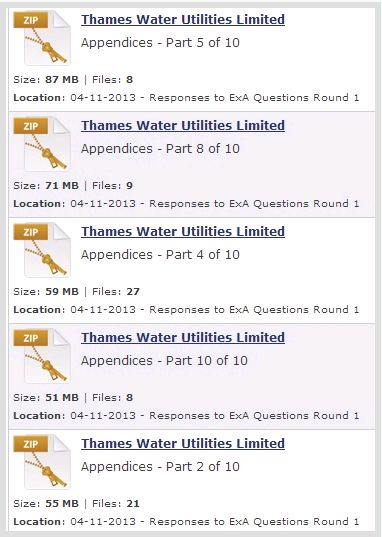
Secondly, when a large document is split up, there needs to be some sort of index. I was looking for Appendix 14.09.01 in that lot, but which part is it in? I was pretty bad at guessing and opened about five of them before I found it in Part 7 of 10. Not sure if that is a job for the applicant or PINS.
Thirdly, please check spelling. It does make it harder to find things when there are typos. I appreciate that massive amounts of material are being loaded in a short space of time, and time is probably more important than accuracy in the first instance, but a later check would be worthwhile.
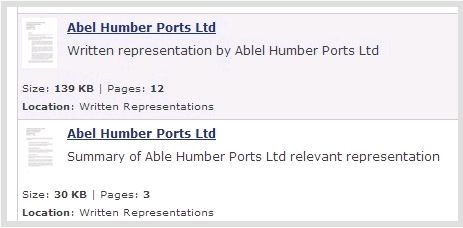
Here's a suggestion for applicants and other parties. It would help if you don't combine documents produced for different purposes into one document, e.g. written representations and answers to questions. Then PINS can categorise them and those looking for them can find them more easily.
Would a document naming convention help? I have been recommending one for application documents (e.g. TR010001/APP/9 is the DCO for the project with reference TR010001, since it is box 9 on the application form) and statements of common ground (e.g. TR010001/SOCG/1, etc.), but perhaps it would be a good idea for all documents. The written representation from Mrs Jones could be TR010001/WR/8803-0111, where the last bit is Mrs Jones's reference number. A few more codes for typical documents such as relevant representation: RR, answers to first questions: A1Q, and documents should be easier to find.
It's going too far to require this, but perhaps something to consider following voluntarily.
The content of this article is intended to provide a general guide to the subject matter. Specialist advice should be sought about your specific circumstances.








