Use it or lose it – Small scale use needs cogent proof
Whether a brand is protected as a Community trade mark or through UK registration, the brand owner is under an obligation to use it for the claimed goods and services. The mark must be put to genuine use within five years of registration and there must be no continuous period of five years non-use. Non-use renders a mark liable to revocation and the mark cannot be relied on in opposition or invalidation proceedings.
The European Court of Justice (the "ECJ") has confirmed that even minimal use may suffice provided it is commercially warranted. However, a recent ruling of the Court of First Instance ("CFI") makes it difficult to predict when small-scale use counts as genuine.
In Sonia Rykiel v. OHIM, the CFI held that proven sales of 85 units of ladies' underwear totalling EURO 432 under the SONIA mark to nine different customers over a period of 13 months was not genuine use. By contrast, in Sunrider v. OHIM, the sale of 300 cases of fruit juices totalling EURO 4.800 to a single customer over a period of 12 months was genuine use of VITAFRUT.
In SONIA, the CFI commented unfavourably on the lack of evidence placing the sales in context. For example, there were no turnover figures nor details of any advertising spend. Where use is small there is a need to produce additional evidence to dispel any possible doubts as to the genuineness of the use.
DREAM IT, DO IT!
The applicant, an organisation assisting social entrepreneurs, applied to register the slogan DREAM IT, DO IT! for various economic and social support services that it provides to its members.
Confirming the decisions of the Examiner and the Board of Appeal, the CFI dismissed the applicant's appeal on the grounds that the mark lacked one of the essential functions of a trade mark, namely the ability for consumers instantly to determine the commercial origin of services offered under the DREAM IT, DO IT! slogan.
The CFI's decision represents a predictable application of the ECJ case law on the registration of slogans. In reaching its decision, the CFI re-stated the general position that marks that are also used as advertising slogans are not automatically excluded from registration by virtue of such dual use. However, a potential applicant should be aware that its advertising slogan will only be deemed sufficiently distinctive for trade mark registration purposes if consumers will immediately perceive that goods and/or services offered under the slogan originate from the applicant. If there is a possibility that a consumer would be confused as to the origin of the goods and services in question, the mark will not be considered to be sufficiently distinctive and registration will be refused.
On a practical level, it is therefore unlikely that a slogan will be accepted for registration unless evidence of consumer perception is presented in support of the application. Accordingly (and not least from a costs perspective), potential applicants should gauge consumer perception at an early stage when considering applying for a slogan registration.
Who says THERE AIN'T NO F IN JUSTICE?
A UK trade mark application for THERE AIN'T NO F IN JUSTICE was originally objected to for "T-shirts, baseball caps and the like" in Class 25 as it was held to be devoid of distinctive character. The Hearing Officer found that the mark was no more than a moral statement. He considered that the normal and fair use of the mark on the goods in question would include placing the sign on the exterior of the goods. As a result he found that the public were likely to see the slogan, when used in this way, as a statement by the wearer about the justice system, unless they were educated to the idea that it was an indicator of trade origin through use.
On appeal the Appointed Person overturned the Hearing Officer's decision. The Appointed Person held that the manner of use of the mark is a matter for the trade mark owner and is relevant to how the trade mark is used, not whether it meets the criteria for registration. Like any other trade mark, if THERE AIN'T NO F IN JUSTICE is not used in accordance with its essential trade mark function, it will be liable to revocation. The Appointed Person also considered that in assessing the distinctive character of a trade mark, it is appropriate to take account of practices in the marketplace including, in the present case, the well known use of slogans and clothing brands, e.g. FRUIT OF THE LOOM, CITIZENS OF HUMANITY and 7 FOR ALL MANKIND. The application proceeded to advertisement.
Strict test of acquired distinctiveness
Proving acquired distinctiveness before the UKIPO of a non-traditional trade mark (e.g., colour) can be an uphill struggle especially where it is used with a conventional trade mark (e.g., a word). The Registry requires proof that the average consumer relies upon the sign as an indication of origin. It is not enough that through use the consumer associates the sign with the applicant in the sense that if asked who marketed the goods, the consumer would say the applicant.
The correctness of the Registrar's practice was challenged in Vibe Technologies' Application. The sign in question was a decorative surface finish used alongside VIBE in relation to the applicant's loudspeakers. The Appointed Person was unsure whether the Registrar's practice coincided with that of the ECJ articulated most recently in Nestlé v Mars. The Appointed Person would have referred the question to the ECJ but neither the Registrar not the applicant agreed. In the absence of a reference the Appointed Person had no choice but to confirm that the Registrar's practice was in line with English case law on the issue.
No smoothing out of the wrinkles
A UK application to register the mark SMOOTH CURVES for socks and tights has been rejected on the grounds it is descriptive. The Hearing Officer found that the mark was objectionable for such items of clothing on the grounds that they could give the wearer a smooth and curvaceous figure and give her "smooth curves". As such they described the intended purpose of the goods. The mark was also not distinctive.
Evidence of use put forward by the applicant was not sufficient to overcome the objections as use only started just over a month before the application date and no market share information was provided. The application was allowed to proceed for footwear, hats, belts, gloves and scarves.
Shopping mall operators triumph
The English High Court has decided an important test case in favour of operators of shopping centres (e.g. Brent Cross – not party to the present proceedings).
It held that the services such operators offer – a selection of retail outlets, restaurants, entertainment and other facilities – were "normally provided for remuneration" and constituted "services" for which trade mark registration could be obtained under the European Community Harmonisation Directive and the UK Act. It did not matter that the services were not separately involved. They were part of a mall operator's trade in attracting and bringing custom to that particular location.
The judge applied by analogy the reasoning of the ECJ in Praktiker Bau allowing the registration of trade marks for retail store services.
The knives are still out
In our October 2007 edition, we reported an application to declare invalid two UK trade mark registrations for JUDGE SABATIER and STELLAR SABATIER both in respect of knives. The applicant had earlier UK trade mark registrations for SABATIER, PROFESSIONAL SABATIER and SABATIER with a lion device. The Hearing Officer found that both parties' products had been on the market for many years and there had been no instances of confusion. He also decided that, despite the mark SABATIER being distinctive, the addition of the words JUDGE and STELLAR was sufficient to distinguish the later marks from the earlier registrations.
On appeal to the High Court, the judge found in favour of the earlier rights owner. He said that the word SABATIER played an independent distinctive role in the later marks and that in line with the THOMSON LIFE case there is therefore a likelihood of confusion between the earlier marks and JUDGE SABATIER/STELLAR SABATIER.
It's confirmed: Designs can tumble over prior art from any sector
The English Court of Appeal has confirmed that, to be validly protected as a registered (or unregistered) European Community design, a design must be new and have individual character compared with the prior art in any sector, and not just the prior art in the design's product sector.
The earlier supply of spiky plastic balls as massage balls by the defendant therefore meant that the claimant's later design registrations for similar balls used for laundry drying (see below) rendered the claimant's registrations invalid - even though the prior art sector (massage balls) was very different from the claimant's sector (laundry drying).
This important rule should be borne in mind when carrying out design clearance searches and considering potential invalidity defences to infringements. Just because a design is original in one sector does not mean that it cannot be trumped by another earlier design from a completely different sector. However, the Court did note that there might be a limited exception to this rule where the prior art is obscure even in the sector from which it comes.

Grass mower design doesn't cut it
Design rights protect the specific elements of a design, not the general idea of a design.
Applying this principle in Rolawn Limited v. Turfmech Machinery Limited, which involved two conflicting wide area grass mowers (see below), the English High Court held that, although there was some overlap between the general idea of how the respective machines were put together, no material parts of the claimant's machine had been reproduced in the defendant's and, viewed element by element, the defendant's machine produced a different overall impression from the claimant's. The defendant had therefore not infringed the claimant's registered or unregistered UK design rights.
This case, and others like the Proctor and Gamble v. Reckitt air freshener case, illustrate an important limitation of the scope of design rights: similarities at a too high level of generality between conflicting designs will not result in infringement (or prior art invalidity). However, the cases also note that the more design freedom there is in the relevant field, the greater the likelihood that similarities will result in infringement (or invalidity). Although that did not assist the claimant in this case, it could tip the balance the other way in other cases with broader design freedom.

THE POWERPUFF GIRLS vs THE POWDERPUFF GIRLS
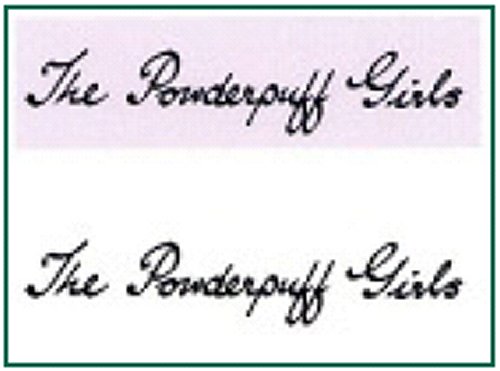
Katie Reynolds applied to register the above series of two marks for THE POWDERPUFF GIRLS in respect of hairdressing and beauty salon services. The Cartoon Network Inc opposed the application on the basis of a likelihood of confusion with the three THE POWERPUFF GIRLS marks shown below and also a reputation in these marks. The Opponent's marks covered various goods including hair lotions, shampoos and cosmetics but none of the marks were registered for hairdressing or beauty salons.
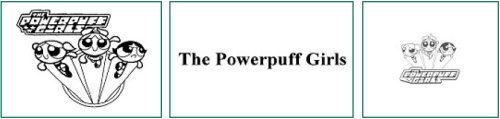
The Hearing Officer found that the average consumer for the relevant goods and services were the same and that although the marks had a low level of visual similarity, they were aurally very similar. He also concluded THE POWDERPUFF GIRLS to be conceptually dissimilar to the POWERPUFF GIRLS device marks as the latter conjured up three little girls with supernatural powers. He did concede that there was "a degree of similarity between the respect goods and services but that this similarity was on the low side". As the marks were conceptually dissimilar the Hearing Officer found that there was no likelihood of confusion.
While our little heroes THE POWERPUFF GIRLS had a substantial reputation amongst young girls (and some big girls who will go unnamed) and their parents for cartoon television programmes, the question became whether this reputation extended beyond such programmes. The Hearing Officer's answer to this was that, despite merchandising in relation to items such as clothing, DVDs and video games, the reputation of THE POWERPUFF GIRLS did not extend outside the sphere of the television cartoon. Furthermore, he found that the mere existence of a link between the marks THE POWERPUFF GIRLS and THE POWDERPUFF GIRLS is not enough to support a conclusion that there would be detriment to the distinctive character of the earlier marks if THE POWDERPUFF GIRLS was used for hairdressing and beauty services. The reputation (and supernatural power) of THE POWERPUFF GIRLS was therefore not strong enough to cause the requisite damage. If the cartoon is anything to go by, however, our heroines will certainly live to fight another day!
No watering down of SPA
The CFI has upheld an opposition against a CTM application for the mark MINERAL SPA for soaps, essential oils and cosmetic products. The mark was opposed on the basis of the earlier mark SPA, which is registered in the Benelux in respect of mineral water and other non-alcoholic beverages.
The CFI decided that the two marks had a degree of similarity visually and aurally since the word "SPA" is common to both. It found that the average consumer in the Benelux would focus his attention on the second component of the expression MINERAL SPA since the word "MINERAL" describes the components of the goods in question on account of the common use of minerals in the cosmetics sector. It also found they were relatively similar conceptually.
The mark SPA was found to have a very significant reputation for mineral water in the Benelux. It had been used continuously for a number of years; SPA-branded water was available throughout the territory with a strong presence in both mass and small-scale distribution; and the mark's proprietor is the market leader with a market share of 23.6%, has made significant advertising investments and sponsors a number of sports events.
The CFI also found that it was likely that the applicant would take unfair advantage of the repute of the SPA mark. There was a risk of a "free-riding transfer" of the advertising effort made by the proprietor of SPA to the mark applied for.
The judgment is a reminder to those applying for new marks to consider carrying out wider availability searches including against individual words that may, like "SPA", look generic or descriptive. Owners of trade marks with reputations will welcome the decision, especially where their mark may appear, on first blush, to be non-distinctive or descriptive or, as was the case here, both.
Spot the differences: Is Rory a cereal killer?
A UK application to register a series of three tiger logos (a tiger called Rory) below right for entertainment, sporting and temporary accommodation was opposed by Kellogg's on the basis of their earlier registration for their, below left, Tony tiger for identical services.
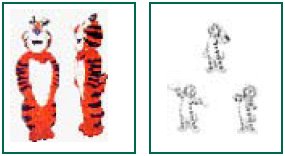
The Hearing Officer took into account that the average consumer has rarely time to make a direct comparison between the marks, despite being well informed and circumspect. He held that the differences pointed out by the applicant, Tony's blue nose and neckerchief, were not dominant features of Kellogg's mark. He found that Tony and Rory were both animated, anthropomorphised tigers, therefore, visually and conceptually similar. He also considered the absence of confusion argument irrelevant.
The applicant argued that Tony's enhanced distinctiveness and reputation in cereals would allow the average consumer to distinguish it from Rory. The Hearing Officer dismissed such argument and said that he had to consider the likelihood of confusion between Kellogg's mark and the applicant's mark on services for which there is no reputation. Further, he also referred to the firmly established jurisprudence that there is a greater likelihood of confusion where the earlier trade mark has a highly distinctive character. On the basis of the identity or close proximity of the services and close similarity between the marks, he concluded that there is a likelihood of confusion. Rory was not a cereal killer after all!
Time for an Irish party
UK trade mark applications were filed for FIANNA FAIL and FINE GAEL for fruit and vegetables, advertising and education services. Fianna Fail and Fine Gael are major political organisations in Ireland and they objected to the applications on various grounds, including that they had been filed in bad faith.
The Appointed Person overturned the decision and found that the applications had been filed by the applicant in bad faith who had registered the names to further its own objectives. He said that the applicant's strategy was "leech like in its efforts to fasten upon and feed off the distinctive character and repute of the names". The applicant's subjective perception of the applications was not relevant. Costs were awarded off the scale in favour of the opponents.
Guidance on detriment and unfair advantage
Can the owners of the trade mark 'Intel', which has a reputation in respect of computer related goods and services, invalidate the later mark of 'Intelmark' registered in respect of marketing services? The Advocate General here considered what factors should be taken into account when determining a 'link', free riding, blurring and tarnishment.
For the average consumer, the earlier mark must be 'brought to mind' by the later mark. This implies a mental process, something more than a vague, indefinable feeling.
The likelihood of establishing a link may be increased if:
- the earlier mark has a particularly distinctive character; or
- if the earlier mark is used for goods or services familiar to the general public or where the earlier and later names are both used for similar products.
A later mark is more likely to take unfair advantage from being linked with an earlier mark in the mind of the public and be free riding if the earlier mark has a reputation and if the goods/services are similar. Courts should also consider the prestigious connotations of the earlier mark and the context in which the later mark is used.
Blurring focuses on the harm to the earlier mark. For example using Coca Cola for numerous different products will lead to a blurring of the distinctiveness of the mark so that eventually the mark will not be capable of arousing immediate association with a particular class of goods. The more distinctive a mark is, the more likely it is that its distinctiveness will be impaired by the presence of other similar marks.
Factors to take into account include:
- The strength of the distinctiveness and reputation of the earlier mark;
- The degree of similarity of the goods or services.
Tarnishing is a step beyond blurring; the mark is degraded by the link which the public makes with the later mark. An example would be using Coca Cola for cheap paint stripper.
Factors include:
- the extent of the earlier mark's reputation and uniqueness; and
- whether the connotations of the later mark are such as to harm the repute of the earlier mark.
Until this case, there has been very little ECJ jurisprudence on what unfair advantage and detriment mean and what factors are important. The Advocate General has provided useful guidance.
Olympic Games – Focus on London 2012
The Olympic flame has now been extinguished in Beijing and control of the summer Olympics has been formally handed over to London to stage the 2012 Olympics. With the inevitable commercial opportunities that this will bring and buoyed by the recent successes of the British team, UK brand owners may be considering engaging in marketing activities to demonstrate their support for the London Olympics. However, brand owners will need to tread very carefully in order to avoid falling foul of the stringent legislation that is already in force in the UK to combat ambush marketing and to protect the commercial value of the Olympic rights.
The recent "Handover Party", or to give its full name, the "Visa London 2012 Party" highlighted the ease with which clever and cost-effective ambush marketing can be employed with great effect. The partygoers were issued with official 2012 miniature flags that were co-branded with Visa's logo. Whilst not ambush marketing in the traditional sense as Visa are an official Olympic partner, the BBC who provided live television coverage of the event and who have strict rules on not permitting advertising or product placement, may have felt differently as every crowd shot featured hundreds of Visa branded flags waving in time with the music.
Any non-official sponsor who had attempted to do the same as Visa would most likely have found themselves at the receiving end of a broadside from LOCOG, the body charged with policing and enforcing the Olympic symbols and related rights. The legislation in the UK, in the form of the London Olympic Games and Paralympic Games Act 2006, prohibits any activity that seeks to make an unauthorised commercial association with the Olympics. From a nonsponsor's perspective the legislation is draconian. Even seemingly innocent words or phrases have effectively been prohibited over the next four years, unless the advertiser is brave enough to risk picking a fight with LOCOG. Question marks remain over how effective the legislation will prove to be should an alleged infringer decide to fight in court. However, nobody wants to be the guinea pig. In order to quash any uncertainty LOCOG would relish a showdown with a major brand owner to send out a strong message to the market that it means business.
However, no matter how draconian the legislation, ambush marketing is a legitimate tool in the modern advertising world. Its strength is in the ever-changing methods with which it can be employed. Whilst the aim of the legislation may be to snuff it out, it is likely to be as much a part of the London Olympics as the Olympic flame itself.
The content of this article is intended to provide a general guide to the subject matter. Specialist advice should be sought about your specific circumstances.






