


International Financial Services
Ireland has a long history of success as a location for international investment fund and finance companies. There has been continuous growth in all sectors, including regulated funds and securitisation companies.
Ireland as a Location for Funds
Ireland is one of the leading European jurisdictions for regulated investment funds (UCITS and non-UCITS) with over €1 trillion of assets held by Irish funds.
Regulated funds can be structured as companies, investment limited partnerships, common contractual funds and unit trusts. Each type of entity offers different legal, regulatory and tax features to suit international fund managers and their investors. All regulated funds benefit from a range of attractive tax features:
- they are exempt from Irish tax on their income and gains regardless of the residence of their investors;
- there are no periodic tax charges on the value of the fund's assets;
- under Irish law, there is no withholding tax on income distributions or redemption of units to non-Irish residents, provided an appropriate residency declaration is in place;
- no Irish stamp duty arises on the issue, sale or transfer of shares or units; and (e) many of the services which the fund receives are VAT exempt.
Recent helpful changes mean that a fund can avoid the burden of obtaining residency declarations from its investors. This treatment is available if the fund has procedures in place to ensure that any investor (or class of investor) is non-Irish resident, and these are approved by the Irish tax authorities.
New legislation has also been introduced to provide for the re-domiciliation of corporate investment funds by way of continuation or legal migration into Ireland. The legislation has been drafted to specifically allow a fund formed under the laws of another jurisdiction to re-register in Ireland with its original corporate identity retained. The migrating fund can make a declaration as to the non-residence of its investors, thus easing the administrative burden of migration.
The Irish regulatory authority has also signed Memoranda of Understanding with regulatory authorities in other jurisdictions, thereby facilitating investment by local investors in both Irish domiciled UCITS and non-UCITS funds.
Securitisation and Structured Finance
Ireland's securitisation and structured finance regime is well established and familiar to the international investor community.
Section 110 Irish Taxes Consolidation Act 1997 – Background
The section 110 regime has been in existence for over 20 years. It effectively allows for corporation tax neutral treatment for Irish special purpose companies which hold and/or manage "financial assets" and meet certain conditions. The regime is widely used by international banks, asset managers and arrangers for establishing securitisations, CDOs, repackagings, investment platforms and capital markets bond issuances generally.
Financial assets are broadly defined and include shares, bonds, receivables, lease portfolios and commercial paper. As a result of a recent change, section 110 companies may also hold or manage commodities dealt in on a recognised commodity exchange. The term has also been expanded to include plant and machinery (including aircraft). These changes have expanded the possible uses for section 110 companies and they are increasingly being considered as vehicles for commodity funds and aircraft financing.
Section 110 companies must be centrally managed and controlled in Ireland, therefore the board of directors is typically comprised of a majority of Irish residents who are involved in the industry. The minimum asset value in respect of the first transaction undertaken by the section 110 company is €10 million.
The section 110 company is subject to tax in Ireland as if it was a trading company. Provided an appropriate structure is adopted, this treatment, together with the ability to secure a deduction for interest expense on notes which are held by investors, can result in a nominal amount of profit being retained in the company, which is then subject to tax at 25%.
There is an exemption from Irish withholding tax on payments of interest by a section 110 company where the note holders are resident in an EU jurisdiction, or a jurisdiction with which Ireland has a double tax treaty. There is also an important exemption for interest paid in respect of "wholesale debt instruments" (broadly, bonds with a maximum two year maturity) and listed securities, known as Quoted Eurobonds. These apply regardless of the location of the recipient. Quoted Eurobonds are securities, issued by a company, which carry a right to interest and which are quoted on a recognised stock exchange. The Irish Stock Exchange has proved itself to be an efficient provider of this listing and is frequently used by section 110 companies intending to avail of the Quoted Eurobond exemption.
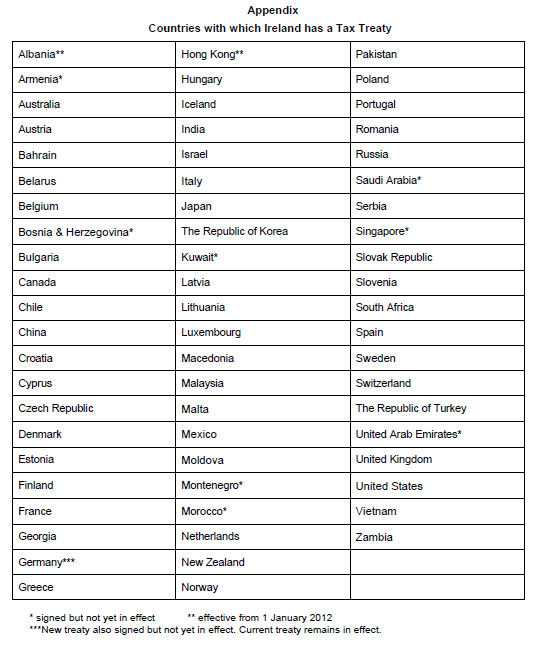
An Irish section 110 company can typically obtain the benefit of Ireland's double tax treaties. Ireland has over 60 such treaties in force (see Appendix for complete list). This provides the Irish company with a significant advantage over other jurisdictions which do not have such a network, reducing the incidence of tax leakage suffered in the structure.
Provided the conditions of section 110 continue to be satisfied, there is no Irish stamp duty payable in respect of the issue or transfer of notes issued by the section 110 company. There should be no Irish VAT arising in respect of the activities of the company. There is also no charge to Irish VAT in respect of the corporate administration services provided to the company.
Combining Section 110 and Funds
In certain circumstances, a combination of an Irish regulated fund with a section 110 company can prove a useful vehicle for investing in certain assets. In these structures, the fund holds its investments through the section 110 company, which can facilitate access to double tax treaty benefits.
Maples – Global Knowledge, Irish Expertise
Maples and Calder is an international law firm, providing a full range of corporate and finance law advisory services. We advise leading domestic and international corporates and financial institutions on the laws of Ireland, the Cayman Islands and the British Virgin Islands.
The Maples Group comprises over 700 people worldwide, 175 of whom are based in our Dublin office. We combine an extensive knowledge and experience of Irish law with the in-depth strength of a global law firm.
MaplesFS
Our affiliate business MaplesFS is an independent global provider of specialised fiduciary, accounting and administration services. MaplesFS offers a wide range of expertise in accounting, company management, corporate, fiduciary, trust and fund administration. This close working relationship offers clients the maximum convenience and efficiency in establishing and administering companies, funds and investments.
Originally published 25 March 2011
The content of this article is intended to provide a general guide to the subject matter. Specialist advice should be sought about your specific circumstances.





