Share on LinkedInShare on LinkedIn

ARTICLE · 05 MARCH 2026

Indian Safe Harbour Regime Revamped: Draft Income-tax Rules, 2026

Safe Harbour Rules ('SHR') were first introduced in Indian Transfer Pricing (‘TP') regime by the Central Board of Direct Taxes ('CBDT') in September 2013 under Section 92CB of the Income-tax Act...

IndiaTax
Aurtus Consulting LLP

AT A GLANCE

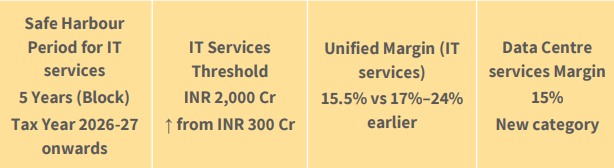
1752790.jpg

BACKGROUND

  • Safe Harbour Rules ('SHR') were first introduced in Indian Transfer Pricing ('TP') regime by the Central Board of Direct Taxes ('CBDT') in September 2013 under Section 92CB of the Income-tax Act, 1961 ('the Act'). Designed as a litigation-reduction mechanism, SHRs allow tax authorities to accept a taxpayer's declared transfer price for specified international transactions without detailed scrutiny, provided predefined conditions are satisfied.
  • Over successive years, the CBDT had been extending the applicability of SHRs on a year-by-year basis, an approach that created compliance uncertainty for multinational enterprises ('MNEs') operating in India. Further, in general taxpayers have found the safe harbour margins to be on a higher side.

We operate a free-to-view policy, asking only that you register in order to read all of our content. Please login or register to view the rest of this article.

The content of this article is intended to provide a general guide to the subject matter. Specialist advice should be sought about your specific circumstances.

See more popular content from

