





Indian economy | September 2026
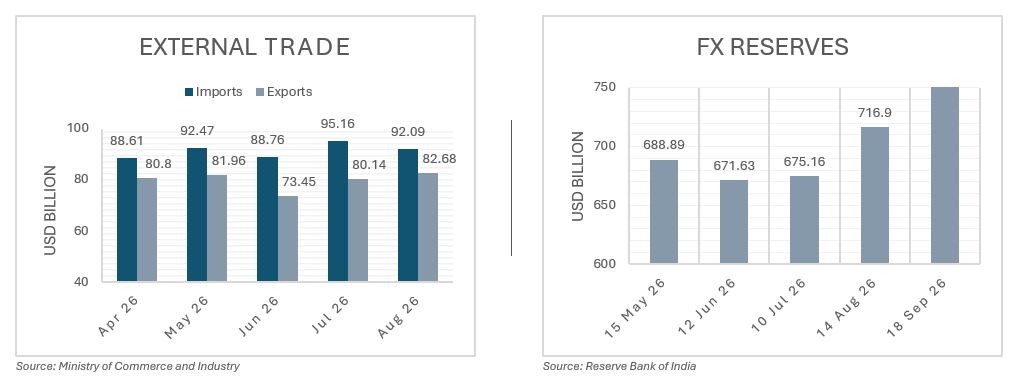
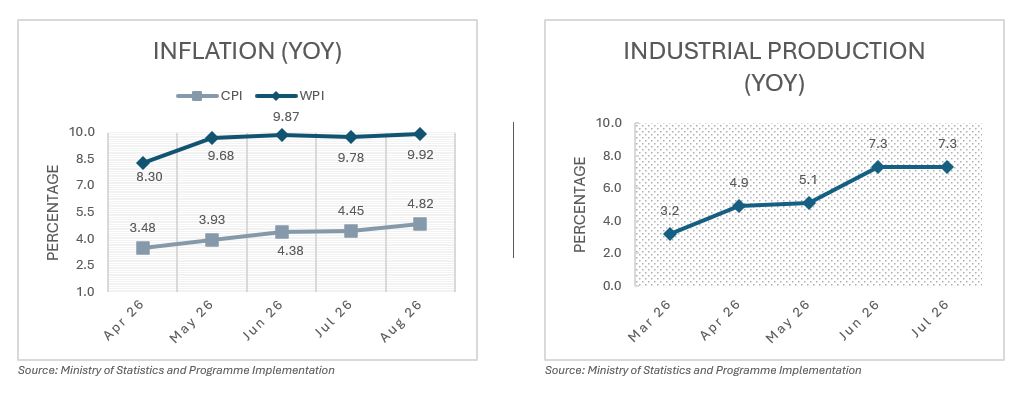
Snapshot of key indicators
As per the latest available data till September 2026

MCA clarifies foreign company registration and compliance requirements
FAQs for foreign companies and Indian subsidiaries
The MCA has recently issued FAQs to provide procedural clarity on the registration and continuing compliance requirements applicable to foreign companies having a place of business in India and Indian companies incorporated or controlled by foreign entities.
Key clarifications
- FC-1 and subsequent changes: A foreign company establishing a place of business in India must file FC-1 within 30 days. A subsequent project generally does not require a fresh FC-1 unless it results in a separate place of business; other changes are generally reported through FC-2.
- Foreign office v. Indian subsidiary: The FAQs reiterate that the nature of the Indian presence determines the applicable compliance framework. A wholly owned Indian subsidiary remains an Indian company, while a branch, liaison, or project office is subject to the foreign-company framework.
- Scope of permitted activities: Permissible activities differ by office type. While a branch office can undertake specified commercial and professional activities, retail trading and manufacturing/ processing are generally restricted. Project offices remain linked to their approved projects.
- Authentication of foreign documents: Notarisation, apostillation, or consularisation requirements depend primarily on the jurisdiction where the document is executed, rather than the nationality of the signatory. Non-English documents should also be accompanied by certified English translations.
- Name reservation and regulatory approvals: Availability of a name on the MCA database does not by itself ensure approval; the proposed name must also satisfy the applicable similarity and resemblance requirements. Separately, MCA registration does not replace sectoral approvals, including RBI or IFSCA approvals where applicable.
- Country-specific and forex considerations: Foreign investment involving entities or persons from countries sharing a land border with India may trigger additional approval or security-clearance requirements. Similarly, routing NRI investments through Non-Resident External (NRE)/Non-Resident Ordinary (NRO) accounts does not, by itself, remove applicable forex requirements.
Key considerations for foreign entities
The FAQs are particularly relevant for foreign groups evaluating their mode of entry into India and for existing foreign establishments undertaking additional projects or restructuring their Indian operations with the following key considerations:
- Determine the structure before commencing operations. Whether the Indian presence is established through a liaison office, branch office, project office, or an Indian subsidiary has consequences for permitted activities, regulatory approvals, and continuing compliance.
- Identify the FC-1 trigger date carefully. The 30-day filing period runs from the establishment of the place of business, making contemporaneous documentation of this date important.
- Plan foreign-document execution at the outset. Authentication requirements can materially affect incorporation timelines, particularly where consularisation is required.
- Treat MCA and sectoral approvals as separate workstreams. MCA registration should be sequenced with RBI, IFSCA, foreign direct investment or other regulatory requirements rather than viewed as a substitute for them.
- Distinguish ownership from legal classification. A wholly owned Indian subsidiary of a foreign parent remains an Indian incorporated company, while a foreign company operating through a place of business in India is subject to the separate foreign-company registration and compliance framework.
The FAQs bring together several issues that have historically required careful navigation across the Companies Act, 2013, Companies (Registration of Foreign Companies) Rules, 2014, Companies (Incorporation) Rules, 2014, Foreign Exchange Management Act, 1999, MCA forms, and jurisdiction-specific document authentication rules, including FC filings, permitted activities of foreign offices, authentication of foreign documents, name reservation, and regulatory approvals.
Without changing anything substantive, the FAQs introduce clarification on key aspects such as the distinction between a new project and a new place of business, the place-of-execution approach to document authentication, and the separate treatment of Indian subsidiaries and foreign companies, which will help reduce avoidable rework during incorporation and registration. At the same time, they do not eliminate the need for a transaction-specific assessment where the proposed activity, ownership structure, regulatory sector, or jurisdiction triggers additional approval requirements.
To view the full article please click here.
The content of this article is intended to provide a general guide to the subject matter. Specialist advice should be sought about your specific circumstances.






