


This article forms one part of a broader decision framework for evaluating whether patent or trade secret protection is appropriate for AI innovation.
The framework is designed to help decision-makers (e.g., innovators, in house, CTOs) align patent and IP strategy with underlying business realities and moving beyond purely "legal" considerations.
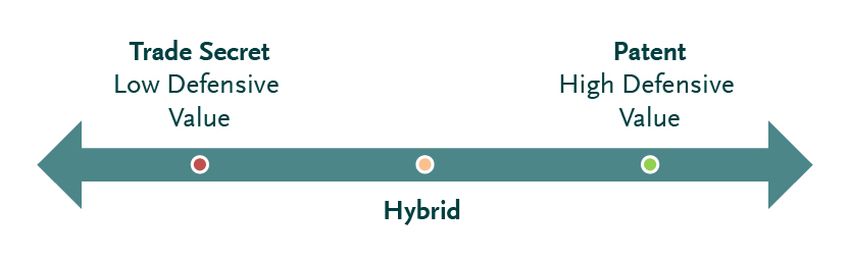
Defensive blocking considers whether a patent can prevent others from patenting or controlling adjacent technical or commercial space.
Defensive blocking matters for two main reasons: (i) to stop competitors from obtaining AI patents that could later restrict your ability to operate, and (ii) to provide leverage for counter-assertion if a competitor brings a patent claim against you.
This consideration also extends to the risk that competitors may gain access to the technology through your former employees with detailed knowledge of your systems (i.e., despite the internal function of the system not being reproducible).
|
Examples: Competitor Defensive Positioning
|
Applying the Decision Tool: Patents or Trade Secrets
For a further discussion of the decision framework and remaining decision factors in the framework, please see the following:
Framework: Patents or Trade Secrets
Factor 1: Nature of AI Innovation
Factor 2: Enforceable Scope of Patent Protection
Factor 3: Reproducibility of AI Innovation
Factor 4: Business Delivery Model
Factor 5: Commercial Longevity
Factor 7: Patentability Potential and Layered Strategies
If your organization needs assistance evaluating which aspects of its AI innovation are better suited to patent protection versus trade secret protection, our team can help. Our team can also support patent filing and the development of a broader IP strategy.
The content of this article is intended to provide a general guide to the subject matter. Specialist advice should be sought about your specific circumstances.
The content of this article is intended to provide a general guide to the subject matter. Specialist advice should be sought about your specific circumstances.




