UK dairy farmers are once again caught up in a dreaded cost/price squeeze. Milk prices have been tumbling whilst input costs have been escalating.
A long cold winter followed by a very wet spring and a summer drought will force many farmers to enter this winter with low forage supplies.
Tumbling Prices
The average weighted farm gate price for the 2005/06 milk year was 18.5 pence per litre (ppl), similar to the 2004/05 price of 18.4ppl. Unfortunately, this period of relative stability has been shattered by the substantial cuts (0.5-1.0ppl) made by purchasing dairies this summer.
These cuts are reflected in the monthly average prices, with June 2006 being down 0.5ppl on June 2005. The rolling 12-month average is likely to dip below 18ppl to 17.85ppl by March 2007, unless these cuts are restored across the board.
Escalating Costs
Farmers have to shoulder the burden of a falling market and, at the same time, incur cost increases in fuel, fertiliser and feed. A recent Milk Development Council report refuted the suggestion that milk production should decrease to only meet high-value processing and liquid consumption demand.
The report quite rightly pointed out that the effort and cost involved in decreasing production by 30%, and the number of producers by 40%, would not be worth it. Furthermore, UK producers are better placed than most EU farmers climatically, and in terms of herd size, to be more competitive in milk production.
Farmers need to work more closely with their milk buyers to determine levels of supply in terms of constituents, seasonality and quality, and they need to alter their production systems in order to improve cost efficiencies.
Poor Return On Capital
Net Farm Income (NFI) assumes that all farms are tenanted and that all tenant-type assets are owned by the farmer. It represents the return to the farmer and spouse for their manual and managerial labour and on tenant-type capital in livestock, crops, machinery, etc. The provisional UK average NFI for dairy farms in 2005/2006 was £26,000, a rise of some 9.7% over the previous year. Although an increase, it is still a relatively poor return on capital compared to other industries – in fact, if NFI is taken as a wage there is zero return to management or capital. Of course, averages must only be used as a guide to identify trends as performance varies significantly across dairy businesses.
The Squeeze On Profit
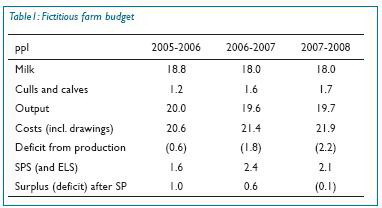
What is currently distressing the industry is the profitability ‘forecast’. Table 1 depicts figures for a fictitious farm,with a quota of 1.125m litres and above-average performance.
The budget shows an expected 0.8 ppl drop in the milk price, partially offset by better returns from cull cows and calves – the result of a strong beef market following the end of the Over Thirty Month Scheme and the lifting of the beef export ban. Output falls by 0.3ppl. Costs (including depreciation, rent, and interest and drawings) rise relentlessly over the period by 1.3ppl so that the deficit from production increases from -0.6 to -2.2ppl. It is only after bringing in the SP (and ELS) that the farm shows a profit in 2005/06 and 2006/07 of 1ppl and 0.6ppl respectively.
The business is budgeted to show a loss in 2007/08 if it makes no changes to its structure or performance. This is due to input costs increasing and output staying constant or decreasing, and the English SP peaking in 2006, but falling in subsequent years to 2012 on dairy farms.
Although an above-average performer, this business clearly needs to take action to improve cost efficiency if it is to remain a dairy business with no alternative income.
The Future: Alternative Forms Of Income
Indeed, many farms are looking to alternative ways of developing their future income streams. Taking steps into unknown ventures will involve new risks, but sometimes the potential long-term returns are either more rewarding or more reliable than producing highly perishable agricultural commodities with low margins.
The Department for Environment, Food and Rural Affairs (Defra) figures suggest that almost half of farm businesses have some kind of diversification enterprise alongside their agricultural production business. The bulk of these enterprises consist of the use of farm buildings in non-farming ways, but other farm resources are also being employed. The Total Income from Farming figures illustrate that, in real terms, the trading profitability from farming has been falling for 35 years. At the same time, the last decade has seen farming balance sheets strengthen on the back of rising land and property values. Many farmers are now seeing their future selves as ‘rural businessmen’ rather than food producers.
If this offers greater returns to their business, this is certainly the avenue to pursue, and one for dairy producers feeling the squeeze to consider.
The content of this article is intended to provide a general guide to the subject matter. Specialist advice should be sought about your specific circumstances.





