The devolved UK governments have plans for their RD programmes for the 2007-13 period. But more money is required, and so VM will be used to cover the shortfall.
Pillar II of the CAP is rural development (RD). On her appointment, Commissioner Fischer-Boel announced that this pillar would be the primary focus of her term in office. Indeed, at that point, the name of the department quietly changed from ‘Agriculture and Fisheries’ to ‘Agriculture and Rural Development’. In 2005, when EU heads of state decided upon the overriding budget for the financial period 2007-13, these good intentions took a battering. The amounts of funding available for the CAP were constrained, and it was politically more acceptable to squeeze the RD spend for the period rather than the Single Payment.
Furthermore, when the total RD pot was divided among Member States, the UK came off rather badly. The accession countries had already been promised minimum amounts of RD funds. Some other countries also secured specific allocations. The remaining RD funds were allocated on the basis of historical spend, rather than land area or farm numbers. So, although the UK has over 9% of EU agricultural land area, it will receive only 2.2% of total RD funding. Historically, the UK has not made much use of European RD funds, as it would have reduced the budget rebate, which returns unspent UK money.
The various devolved UK governments all have plans for rolling out, or continuing, their RD programmes for the 2007-13 period. In order to do this, more money is required, and so voluntary modulation (VM) will be used to cover the shortfall. This continues a policy used over the last two years, where a portion of the Single Payment has been removed and the money used to fund RD schemes.
The European Parliament opposes VM in principle and, until recently, stalled progress of the entire RD policy in objection to it. However, with one or two negotiating concessions, the objections have now been lifted and each Member State can start its programmes. The RD deal allowed the UK to allocate differing VM rates in each devolved region, and to levy the modulation on all Single Payments (rather than just anything above €5,000). However, the concession was that the VM funds should be allocated with the same criteria as all other RD funds (meaning a maximum of 80% could go to environmental schemes).
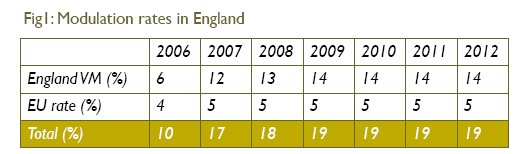
The English rates of modulation are set out in Figure 1. The rate in 2007 will be 12%, double that of 2006, and it will rise thereafter to 14%. Remember that the rates of national ‘voluntary’ modulation are in addition to the 5% ‘compulsory’ EU modulation that will apply throughout the period. The money raised through VM will be partially co-funded by the Treasury. The 80% of VM money to be spent on agri-environmental schemes is going to be match-funded at a rate of 40%, i.e. for each £6 raised through modulation, the Government will add £4.
Overall, this will generate £3.9bn for the Rural Development Programme of England for 2007-13. Of this, £3.3bn of the total budget will be allocated to agrienvironment and other land management schemes – mainly Environmental Stewardship, but also hill support. The remaining £600m will be made available to agriculture and forestry through capital grant schemes run by the Regional Development Agencies.
Announcements on the level of VM in Scotland and Wales have been delayed due to the May regional elections, which recently took place. The new administrations will decide on the modulation rate.
All EU members will now be applying to the EU Commission for approval of their RD plans. In the past, it has taken six months for EU approval. Even if the Commission accelerates the process, it is unlikely that it will be completed before the EU summer break in August. Therefore, it is now almost certain to be the autumn before money under the new programmes starts to flow, and various schemes can be launched.
The content of this article is intended to provide a general guide to the subject matter. Specialist advice should be sought about your specific circumstances.





