
All businesses – some more than others - rely on the use of temporary labour or sub-contractors, whether to work on a specific project, fill a temporary gap or to take up the slack when times are busy. These workers are often supplied by third party employment agencies. For some time there have been typical assumptions associated with the benefits and legal responsibilities arising from the use of temporary workers, however, these have been upset by a series of recent cases and employers need to take these into account.
The UK Government recognises the need for a flexible labour force and that the use of temporary or agency workers has been an area of consistent growth in the labour market. It is also keen to ensure temporary workers enjoy adequate employment protection rights – but the courts have been reluctant to wait for clarification from Parliament. Many rights (including working time, minimum wage, discrimination and whistleblowing) are available to all workers, regardless of whether they are employees or not. However, other rights (such as unfair dismissal, statutory minimum notice, written particulars of employment, TUPE, collective consultation and the new statutory minimum dismissal, disciplinary and grievance procedures) apply only to employees.
The distinction between an employee working under a contract of service and an independent contractor working under a contract for services has always been a difficult one. However, end-users have insulated themselves from the risks of employment liabilities by arranging for temporary workers to be supplied via a third party employment agency. Where the employment agency operates as an employment business, it contracts as principal directly with the temporary worker. In theory, even if the temporary worker can show that he is really an employee, any employment claims should lie against the employment business as principal, rather than the end-user, with which no contractual relationship exists. However, all is not always as it seems.
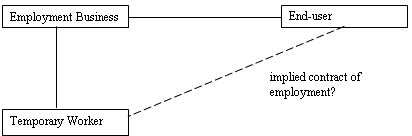
Not only are the courts increasingly likely to find that a so-called temporary worker is in fact an employee, but also that he may be an employee of the end-user - despite the deliberate structuring of the arrangements to avoid that conclusion. End-users must consider how to counter the additional risks to which they are vulnerable.
Brook Street Bureau (UK) Limited v Dacas
The recent starting point is the Court of Appeal’s decision in Brook Street Bureau (UK) Limited v Dacas, subsequently described by the Employment Appeal Tribunal (EAT), HH Judge D Serota QC in Cable and Wireless plc v Muscat, as "a conscious decision to extend radically the circumstances in which a contract of employment might be implied."
Mrs Dacas was a cleaner supplied by the employment business Brook Street to Wandsworth Borough Council. She worked under the day-to-day direction of the Council for four years. Her "Temporary Worker Agreement" made with Brook Street contained fairly standard industry terms, including express statements that the arrangements did not give rise to a contract of employment with either Brook Street or the Council and that she was under no obligation to accept work (ie there was no mutuality of obligation). Mrs Dacas claimed unfair dismissal when the Council asked Brook Street to withdraw her and Brook Street had no further work to offer her.
The Court of Appeal described the status of an individual working in the triangular relationship between an employment business, the worker and the client end-user as "now the most intractable, as well as the most basic, in the whole of employment law." However, it recognised the issue as being of "fundamental importance … to the whole of an industry."
The court was unashamed in its policy desire to find a contract of employment and duly found one - with the Council. However, it could only reach a majority decision, which differed from the conclusions of both the employment tribunal (which found there was no contract of employment at all) and the EAT (which found Mrs Dacas was an employee of Brook Street). The complexity of the problem is illustrated by the fact that three different courts reached three different decisions - not always unanimously.
The key factors upon which the court focussed in deciding whether an employment relationship existed and, if so, with whom, were control and mutuality of obligation. The majority found that Mrs Dacas was an employee of the Council for the following reasons:
- due to the high degree of actual control exercised over her by the Council, which was crucial and
- because the necessary mutuality of obligation between the worker and the end-user "could be read across the triangular arrangements into an implied contract." It therefore did not matter that the Council’s obligation to pay for the work done was contained in one contract made between the employment business and the end-user whereas the worker’s obligation to undertake work was contained in a separate contract made between the employment business and the worker.
The Court of Appeal made it clear that contracts of employment may be implied or deduced from all the circumstances, including "the totality of the triangular arrangements" and the conduct of the parties - ie the form and structure of the written arrangements is not decisive. Most significantly, the Court of Appeal stated that employment tribunals must "at least" consider the possibility that an implied contract of employment might exist between the worker and the end-user. Whilst Dacas does not mean that workers supplied by employment businesses are employees of the end-user client, any tribunal which fails to consider this distinct possibility will be misdirecting itself and will make its decision vulnerable to appeal.
Subsequent decisions have demonstrated the significance of Dacas and that end-user clients might inherit liability for workers for whom they neither wanted nor expected to be responsible.
When does a temporary worker become an employee?
It was not clear at what point Mrs Dacas became an employee. Only one judge, Sedley LJ, commented upon the importance of the length of an assignment, even though Mrs Dacas’ four years service was perhaps a powerful influence in the policy desire to find a contract of employment. Sedley LJ indicated that the parties’ conduct might not give rise to an employment relationship if it only lasted for "a brief time" but may do so "if maintained over weeks or months." He then gave a fairly firm hint that one year is the crucial threshold, commenting that "an inexorable inference" of an implied contract of employment arose once the arrangements had been in place for a year or more.
There is no logical reason why the nature of a relationship should change merely because it continues for a certain time – unless perhaps the parties envisaged a short term arrangement, the continuation of which is taken to mean they each intended to change the nature of that relationship. Applying any time threshold could be a pragmatic attempt to allow parties to operate arrangements, for a limited period, as they purport to be on the face of the contract documents. Similarly, choosing a threshold of one year may be a pragmatic attempt to make sure that a worker is not deprived of the most important statutory employment protection right – the right not to be unfairly dismissed.
However, in RNLI v Bushaway, the EAT found that a temporary worker supplied by an employment agency (which contracted with the worker as agent on behalf of the end-user client) was an employee of the end-user from the start of her assignment, enabling her to count the so-called temporary assignment for the purposes of unfair dismissal qualification. Nevertheless, the EAT was heavily influenced in reaching this decision by the fact that both parties understood that the temporary assignment could become a permanent one and that the role and responsibilities of the permanent job were identical to those during the temporary assignment
Can an express term preclude the finding of an implied term?
Most contracts between employment agencies and workers state that no contract of employment arises with either the employment agency or the end-user. In Cable and Wireless plc v Muscat, the end-user argued that Dacas was wrong because a court should not imply a contractual term (to find an implied contract of employment) when it would be contrary to the express terms of an agreement.
However, the EAT rejected the suggestion that Dacas was wrong and observed that the Court of Appeal in Dacas may have felt it necessary to find an implied contract of employment in order to achieve its objective of ensuring that the outcome should "accord with practical reality and commonsense" if it were legally and factually permissible to do so.
A quadrangular solution?
In Cable and Wireless plc v Muscat, the EAT considered a quadrangular relationship in which the worker was employed by a personal service company which, in turn, contracted with an employment business.
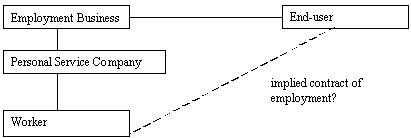
However, it found that the interposition of that fourth party did not prevent an implied contract of employment arising between the worker and the end-user client.
Is an "entire agreement" clause the solution?
An "entire agreement" clause states that the terms of a written agreement represent an exhaustive statement of the parties’ agreement and intentions. In RNLI v Bushaway, the client argued that the presence in the contractual documentation of an "entire agreement" clause precluded the court from looking outside the express written terms of those contracts to all facts and circumstances in deciding whether a contract of employment arose.
The EAT accepted that there may be cases where tribunals should not look beyond the contracts. However, in this case it was able to find important inconsistencies and discrepancies in the contractual documents, which justified the court looking beyond the written terms.
Therefore, an "entire agreement" clause can be helpful – but only if the documents are accurate and consistent, so that tribunals do not have the excuse to delve beyond the written terms. The widespread use of standard form terms and conditions suggest that discrepancies in individual assignments will commonly arise.
Guilty without being accused
End-users of temporary or agency workers can be forgiven for complacency in believing that they cannot be found liable in proceedings which have not been commenced against them. Not so.
In Astbury v Gist, the EAT considered Dacas and noted that it was "highly desirable" that each of the three parties in such a triangular relationship should be involved in the proceedings to help achieve the right result. Therefore, if a worker has not sued both the employment agency and the end-user in the alternative, it encouraged tribunals to use their powers to add the missing party to the action.
End-users will not be pleased with the prospect that, whenever a triangular relationship is being considered, both employment agencies and end-users will be dragged in to face the time, costs and potential liabilities of court – even where the worker does not initially sue them.
Conclusion
The one point upon which all agree is that the rights and status of parties in these triangular relationships are complex, confused and require legislation. The Government reserved the right in section 23 of the Employment Relations Act 1999 to extend employment rights from employees to workers but has not yet done so. However, it is no longer opposing the Temporary Workers’ Directive which would give equal treatment for temporary workers engaged on assignments of six weeks or more. In the meantime, the courts are plugging the gaps.
Each case depends on its own facts and narrow distinctions are sometimes drawn by the courts to achieve and justify particular results – often to give workers an effective remedy. End-users cannot assume that the courts will find the structure operating in practice is the same as that set out in contractual documents, because the courts will look beyond these.
Practical steps to reduce the risk of inheriting unwanted employment liabilities could include:
- seeking indemnity protection from employment agencies
- ensuring assignments do not exceed the 12 month qualifying threshold for unfair dismissal – although this may be impractical or disruptive on large projects
- requiring using employment agencies to provide a genuine on-site management presence and control over temporary staff supplied
- requiring employment agencies to employ the labour they supply
Failing to consider such steps could undermine much of the commercial rationale in using temporary third-party labour.
Trevor Bettany is partner in Speechly Bircham’s Employment Group.
The content of this article is intended to provide a general guide to the subject matter. Specialist advice should be sought about your specific circumstances.







