
Emerging issues in electronic discovery Most companies involved in civil litigation have grown accustomed to collecting and producing paper documents. They know from experience where the documents are kept, how they are organized, and approximately what quantity will be collected. But the rules of the discovery game are changing.
We live in a digital society. More than 50% of U.S. workers over the age of 25 use computers at work, and they send more than 3.5 billion emails daily. Parties in civil litigation and government regulators now routinely request and obtain production of emails and other electronic data.
Given the growing quantity of electronic documents and their unique characteristics, companies can no longer afford to treat them like paper. They must learn to collect and produce electronic data in a comprehensive and cost-effective manner.
This article identifies several key differences between paper and electronic documents and discusses some of the emerging issues in electronic discovery, including (1) preserving electronic documents and (2) shifting costs of electronic discovery to the requesting party.
1. Paper versus eDocuments
The most important difference between paper and electronic documents for purposes of document production is the quantity of electronic data retained by most companies. Because the storage costs for electronic documents are relatively low, many companies have ignored them. Yet a single printed document may be replicated many times in a company’s computer files:
Email is responsible for much of this proliferation of electronic data. If 1000 employees in a company each send and receive a total of 25 emails per day for 250 working days, the company will send and receive 6,250,000 messages annually. While some of these emails will be deleted in the ordinary course of business, many will be saved in the email system and on backup tapes.
Second, in contrast to paper documents that are often separated into project or transaction files, emails are generally organized by user and date like a massive correspondence file. This makes it time consuming and difficult to identify precisely which imemails are responsive to a particular document request.
|
Electronic copy on author ’s hard drive |
1 |
|
Electronic copy on network server |
1 |
|
Electronic copies on network backup tapes |
52 |
|
Electronic copies emailed to 5 recipients, saved on their hard drives, & copied weekly on backup tapes |
265 |
|
Total electronic copies |
319 |
The recent investigation of investment banks by New York Attorney General Eliot Spitzer reportedly began as a fishing expedition. Investigators discovered emails that suggested analysts at one bank had downgraded an Internet company because it refused to do business with the bank. After this email was discovered, Spitzer reportedly told investigators to get "all" the emails.
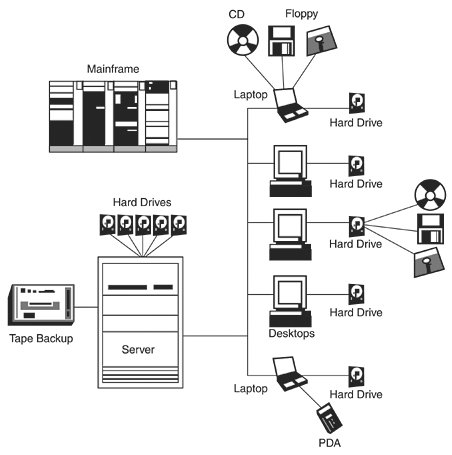
Third, electronic documents may be scattered throughout a computer system—in the hard drives of desktop and laptop computers, computer fileservers, mainframes, personal digital assistants (PDAs), backup tapes, floppy disks, CD-ROMS, and other storage devices.
Special computer expertise may be required to extract electronic documents from these locations without altering them, and the quantity of electronic documents in these storage devices may be significant. A typical box of paper documents contains 3000 pages, but a 650 megabyte CD-ROM may contain as many as 15,000 pages when printed. A 65-gigabyte backup tape may contain as many as 500 boxes of documents, or 1,500,000 pages, when printed.
Fourth, electronic documents may include information that does not appear in their printed counterparts. For example, word processing and emails may include "metadata" that identifies when a document was created, who created it or sent it, and the history of changes made to the document. This information can be particularly useful in a litigation context. Some have used metadata to uncover prior edits to a document or to track email messages throughout the Internet. For this reason, many companies now regularly remove metadata from documents they send externally.
Finally, even when individuals "delete" electronic documents and metadata, they may not be permanently removed from a computer system. Electronic documents are not physically deleted from a computer’s hard drive until they are overwritten by new data. Even when they are overwritten, some portion of the deleted document may remain in what is known as "file slack." In addition, copies of documents deleted from one part of a computer network may remain on network backup tapes or in "temporary" files of a laptop computer.
With these differences in mind, we now address two of the emerging issues in electronic discovery.
2. Preserving Electronic Documents
Companies in litigation have a duty to identify and preserve electronic documents that are responsive to discovery requests. Companies that fail to comply in good faith with requests for production may be sanctioned, and companies that intentionally destroy relevant data may be charged with spoliation. The most common sanction for spoliation is an award of fees and costs to the innocent party, but some courts allow the jury to infer that the evidence destroyed was damaging to the spoliator’s case. For example, in Minnesota Mining & Mfg. Co. v. Pribyl, 259 F.3d 587, 606 n.5 (7th Cir. 2001), the defendant downloaded six gigabytes of music files onto his computer the night before it was turned over for examination and the court instructed the jury they could draw a negative inference from this action.
The ABA’s Civil Discovery Standards suggest that a client should preserve potentially relevant documents once it learns that litigation is probable or has been commenced. In an effort to impose this obligation on defendants as early as possible, some plaintiffs’ attorneys now send defendants letters detailing the electronic documents they intend to request and what they believe should be preserved. One sample letter prepared by an electronic discovery consultant requests preservation of the following types of electronic documents relevant to the dispute:
• All electronic mail and information about electronic mail (including message contents, header information and logs of electronic mail usage);
• All databases (including all records and fields and structural information in such databases);
• All logs of activity on computer systems that may have been used to process or store electronic data;
• All word processing files and file fragments;
• All electronic data and file fragments created by application programs which process financial, accounting and billing information;
• All electronic data and file fragments created by application programs which process financial, accounting and billing information;
• All electronic data files and file fragments created or used by electronic spreadsheet programs.
3. Shifting Costs in Electronic Discovery
Given the voluminous number of electronic documents potentially available and the cost of retrieving and producing them, it is not surprising that both federal and state courts have had to address the proper scope of electronic discovery and limits on requests for production of electronic documents. Rule 26(b)(2)(i) of the Federal Rules of Civil Procedure allows courts to limit discovery if it is "obtainable from some other source that is more convenient, less burdensome, or less expensive." In this context, producing parties have objected to production of electronic documents beyond active files on a company’s computer network such as computer hard drives, backup tapes, emails, and other data.
The battleground for most of these disputes centers around who will pay the cost of collecting and producing electronic data. Under traditional discovery rules, the producing party is expected to bear the expense of collecting, reviewing, and producing documents. See Oppenheimer Fund, Inc. v. Sanders, 437 U.S. 340, 358 (1978). To reduce the cost of reviewing, numbering and copying paper documents, some parties first make them available for inspection and let the opposing party select what will be produced. This approach is less desirable with electronic data where substantial costs are incurred in collecting rather than producing data. In addition, since email may contain more informal communications and is often less organized than paper files, parties are reluctant to give opposing counsel first crack at electronic documents in case they contain privileged, trade secret, or personal data.
Courts have shown some willingness to shift costs to parties who request electronic data. In McPeek v. Ashcroft, 202 F.R.D. 31 (D.D.C. 2001), the plaintiff demanded that defendants search eight years of backup tapes and produce responsive emails. The plaintiff argued that the cost of producing backup tapes was a cost of doing business in the computer age. See, e.g., In re Brand Name Prescription Drugs Antitrust Litig., 1995 WL 360526 (N.D. Ill. June 15, 1995) (refusing to shift costs to plaintiffs caused by defendants’ "record-keeping scheme" and requiring defendant to pay $50,000 - $70,000 to retrieve, format and search for emails). The McPeek court rejected this argument, noting that "[t]here is certainly no controlling authority for the proposition that restoring all backup tapes is necessary in every case." 202 F.R.D. at 33. The court further noted there was some advantage to requiring the plaintiff to pay since it would force him to be more selective in his requests. "If the likelihood of finding something was the only criterion, there is a risk that someone will have to spend hundreds of thousands of dollars to produce a single email. That is an awfully expensive needle to justify searching a haystack." Id. Instead, the court required the defendant to pay the costs of restoring and producing responsive emails saved on a single user’s computer for a one-year period. Id. at 34.
In Rowe Entertainment, Inc. v. William Morris Agency, Inc., 205 F.R.D. 421, 429 (S.D.N.Y. 2002), the defendants respectively estimated the costs of producing electronic documents at (a) $395,944 to restore eight selected backup tapes; (b) $9,750,000 to restore all backup tapes; (c) $43,110 - $84,060 to restore 200,000 emails and $247,000 to review them for privilege; (d) $395,000 to restore 523 backup tapes and $120,000 to review them; and (e) $403,000 to restore emails from 47 backup tapes and 126 personal computers. To determine whether costs should be shifted, the court developed a balancing test based on the following factors:
• the specificity of the discovery request;
• the likelihood of discovering critical information;
• the availability of information from other sources;
• the reason why the party maintains the data;
• the relative benefits of obtaining the data;
• the total cost of production;
• the relative ability of parties to control costs; and
• the resources available to each party.
Based on these factors, the court in Rowe shifted the anticipated costs of electronic discovery to the requesting parties.
The Rowe court also suggested a novel protocol for review and production of electronic data. First, the plaintiffs’ forensic computing expert would obtain copies of the backup tapes and any hard drives containing emails or electronic data. Second, plaintiffs’ counsel would develop word searches and other procedures for identifying responsive documents and give defendants the opportunity to object. Third, the plaintiffs’ expert would implement the search procedures agreed upon by the parties. Fourth, plaintiffs’ counsel would review the documents, identify those that were material, and provide copies to defense counsel. Until this step, the plaintiffs would bear all costs and no waiver of privilege would occur from the review of documents by plaintiffs’ counsel. Finally, defense counsel would review the documents, designate those that were confidential, and assert any privileges.
Many courts have adopted Rowe’s balancing test, but some have modified its protocol for review and production of electronic data. In Murphy Oil USA, Inc. v. Fluor Daniel, Inc., 2002 WL 246439 (E.D. La. Feb. 19, 2002), the court shifted the costs of electronic discovery to the plaintiff. Defendants estimated that it would cost $6.2 million to restore and produce email and other data from 93 backup tapes. The court gave the defendant two options for reviewing documents. The first option followed the Rowe protocol and allowed plaintiff ’s counsel to conduct the initial review of documents responsive to search terms without any waiver of defendant’s privileges. The second option allowed defense counsel to make the initial review of documents responsive to search terms, cull documents that were not responsive to plaintiff ’s actual requests, and prepare a log of privileged and proprietary documents. Plaintiff ’s counsel would then be given the opportunity to review the remaining documents and challenge any they believed were inappropriately marked as privileged or proprietary by defense counsel.
In contrast to the federal courts, the Texas Rules of Civil Procedure have a specific fee-shifting provision relating to electronic discovery. Rule 196.4 requires parties to produce electronic data that is responsive to a request and "reasonably available to the responding party in its ordinary course of business." If a responding party objects to a request and is ordered to comply, the court "must also order that the requesting party pay the reasonable expenses of any extraordinary steps required to retrieve and produce the information." Tex. R. Civ. P. 196.4 (emphasis added). While no reported cases have yet applied this rule or interpreted the meaning of phrases such as "reasonably available," "in the ordinary course of business," and "extraordinary steps," the Texas Rule clearly provides for cost-shifting in electronic discovery.
4. Conclusion
As the law governing electronic discovery continues to evolve, companies should expect litigants to demand greater access to electronic documents. In-house lawyers and outside counsel knowledgeable about electronic discovery can help companies ensure that responsive electronic documents are properly preserved and that unreasonable collection and production costs are voided. If computer forensic experts are employed, experienced counsel can help coordinate their work and monitor expenses.
This material is not intended to create, and does not create, an attorney-client relationship between you and Vinson & Elkins L.L.P., and you should not act or rely on any of this information. As legal advice must be tailored to the specific circumstances of each case, nothing provided herein should be used as a substitute for advice of competent counsel. These materials do not constitute legal advice, do not necessarily reflect the opinions of Vinson & Elkins L.L.P. or any of its attorneys or clients, and are not guaranteed to be correct, complete, or up-to-date.
Vinson & Elkins L.L.P. assumes no liability for the use or interpretation of information contained herein. This publication is provided "AS IS" WITHOUT WARRANTY OF ANY KIND, EITHER EXPRESSED OR IMPLIED, INCLUDING, BUT NOT LIMITED TO, THE IMPLIED WARRANTIES OF MERCHANTABILITY, FITNESS FOR A PARTICULAR PURPOSE, OR NON-INFRINGEMENT. Unless otherwise indicated, V&E attorneys listed are: not Certified by the Texas Board of Legal Specialization. None of the attorneys listed on this website is certified as an "expert" or "specialist" pursuant to any authority governing the practice of law in New York.Vinson & Elkins is a registered limited liability partnership. Principal office-Houston.




