INTRODUCTION
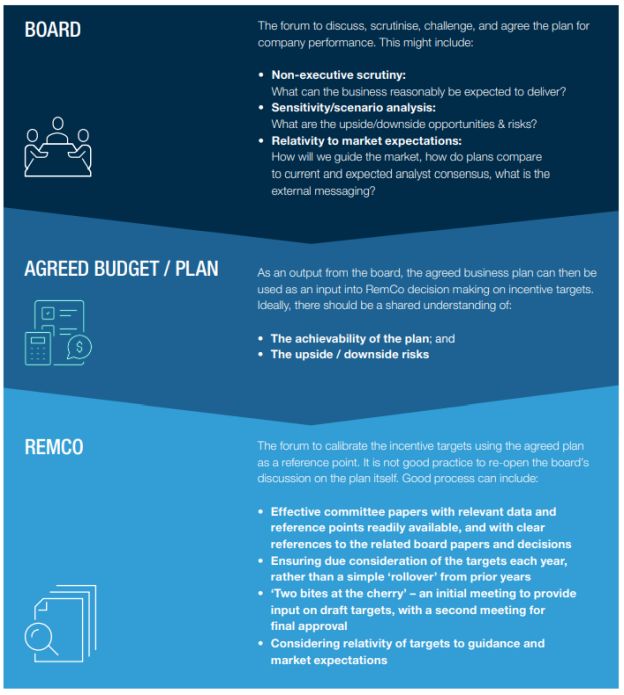
Effective target setting starts with process. This includes ensuring that the company's expected performance, as it is captured in the annual budget or the long-term business plan, is scrutinised and agreed upon by the board before being used as the basis for incentive target-setting by the remuneration committee. Then relevant data and reference points need to be provided to the remuneration committee to support their judgment in calibrating the target ranges.
As with any decision for a remuneration committee, it is important that the targets are set in the context of the specific circumstances and needs of the business, rather than by simply following market norms. At the same time, it is only natural for remuneration committees to ask, "how does this compare to what others do?" Therefore, providing relevant market reference points can help the committee make an informed judgment when target setting.
The purpose of this 'toolkit' is to support remuneration committees and reward teams in this task by providing a range of market reference points on performance targets for profit metrics within both the annual bonus and longterm incentive of companies in the FTSE 100, FTSE 250 and FTSE Small Cap. We focus on profit, as it is the most used metric - often with the largest weighting, in UK-listed incentive plans.
The data points in this report are sourced from our A&M incentive targets database, which is based on the latest available public disclosure from companies with year-ends up to 30 June 2023.
OVERVIEW OF A GOOD TARGET-SETTING PROCESS
Effective target setting starts with process. While this report is focused on targets for financial metrics, the principle below are relevant for any type of performance measure used in incentives, both short and long term.
CALIBRATING INCENTIVE TARGETS: MAKING AN INFORMED JUDGEMENT
In the context of the board's plan, the remuneration committee must then calibrate the performance target ranges. There is unlikely to be a 'formulaic' answer to this excercise and therefore judgement is required.
In making an informed judgement on the calibration of performance ranges, a variety of factors and references points may be relevant.
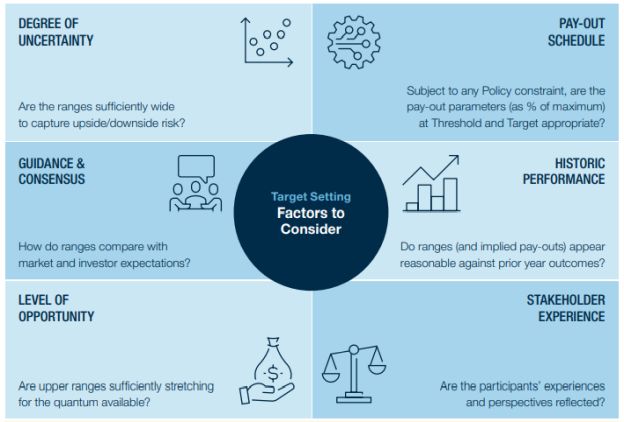
While not providing 'the answer', market data can offer useful supporting reference points when considering some of these issues (with data potentially provided for the whole market, a specific industry, and/or a bespoke peer group). This 'toolkit' therefore provides data on the following aspects of market practice for bonus and LTIP target calibration:
- Structure of pay-out / vesting schedule
How many points are in the schedule? What level of pay-out at each point?
- 'Shape' of performance ranges
How 'symmetrical' are typical bonus ranges around the Target point?
- Implied profit growth in target ranges
What level of growth is required for Threshold, Target and Maximum pay-out?
- Relativity of profit ranges to market
expectations
What level of pay-out is normally triggered if the company meets sell-side analysts' consensus?
- Historic levels of pay-out / vesting in the
market
What can be expected to pay out, on average over time, in the market?
To view the full article, click here.
The content of this article is intended to provide a general guide to the subject matter. Specialist advice should be sought about your specific circumstances.
The content of this article is intended to provide a general guide to the subject matter. Specialist advice should be sought about your specific circumstances.