

An increasing number of EU Member States have introduced or are on the verge of introducing personal sanctions for competition law violations, including prison sentences and director disqualification orders. The European Commission does not intend to follow this trend and finds that criminal sanctions are not warranted in the EU's competition enforcement system. 1
According to the Commission, the introduction of criminal sanctions on individuals in the EU system may lead to fewer successful cartel investigations since it would provide individuals with higher incentives to obstruct inspections and destroy evidence.2 Member States remain free to introduce criminal sanctions on individuals under national law, although the Commission will refuse to pass on information to a national competition authority if it will be used to impose custodial sanctions.3
This ban on information exchange has, however, not refrained Member States from introducing prison sentences for competition law violations. Prison sentences can be imposed on individuals for competition law infringements in: Austria (for bid rigging), Cyprus, Czech Republic, Estonia, France, Germany (for bid rigging), Greece, Ireland, Hungary (for bid rigging), Norway, Poland (for bid rigging), Romania, Slovakia, Slovenia and the UK. In addition, most national competition authorities are authorised to impose personal fines. In the Netherlands, for instance, the NMa can impose fines of up to EUR 450,000 on individuals who have instructed or have exercised de facto leadership in regard to anti-competitive conduct. The NMa used this power for the first time in November 2010.4 In addition, the Minister of Economic Affairs, Agriculture and Innovation is working on a bill introducing criminal sanctions for competition law infringements which will not only include the possibility to impose prison sentences on individuals, but also to disqualify individuals. Similar discussions on personal (and criminal) fines are taking place in Belgium.5 Greece takes the cake in the personalisation of competition law violations by recently introducing joint liability for senior executives for fines imposed on the company6; thus taking the AKZO-doctrine7 to another level.
Bottom line to this personalisation trend is that company executives need to keep their eyes open and their compliance officers busy, as in most cases an "active involvement" in the infringement is not required for the competition authorities to impose penalties on them. In other words: ignorance is no longer bliss. An overview of personal criminal sanctions per EU Member State is provided below.
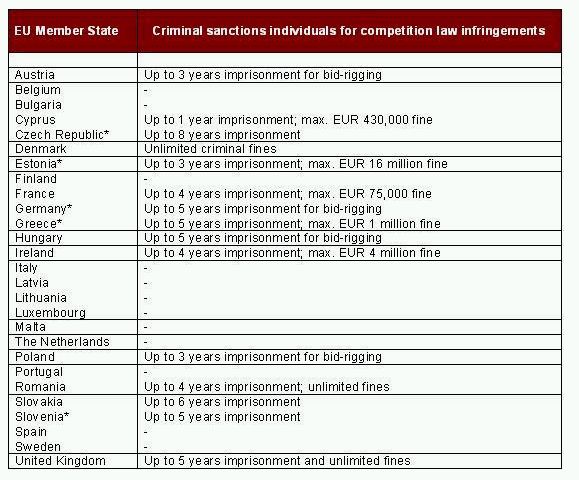
* In this jurisdiction, criminal and administrative sanctions can be imposed on individuals.
Footnotes
1. Speech by C. Madero Villarejo, Deputy Director
General for Antitrust of DG Competition,
28 April 2011.
2. This loss of effectiveness can only be resolved by extending the Commission's investigatory powers. According to the Commission, currently no such changes are sought as it considers the EU system to be effective in its current form. See the Speech by C. Madero Villarejo, Deputy Director General for Antitrust of DG Competition, 28 April 2011.
3. See Article 12(3) of Regulation 1/2003 on the implementation of the rules on competition laid down in Articles 81 and 82 of the Treaty (now: Articles 101 and 102 TFEU), OJ 2003, L1/1.
4. See our Competition Newsletter of October/November 2010. Since 1 October 2007 it is possible for the NMa to fine individuals who have instructed or have exercised de facto leadership in respect of practices contrary to the cartel prohibition or the prohibition on abuse of a dominant position. See "New Competition Act in force" in our Competition Newsletter of August/September 2007.
5. See Cartels & Leniency 2011 – Belgium, International Comparative Legal Guide Series.
6. On 15 April 2011, the Greek Parliament adopted a new competition law. See ECN Brief 02/2011 – Greece: New Greek Competition Act enters into force.
7. In case C-97/08 P, Akzo Nobel, ECR [2009] I-8237, the European Court of Justice ruled that there is a rebuttable liability presumption of parent companies for their subsidiary's cartel offences in the case of a 100% shareholding.
The content of this article is intended to provide a general guide to the subject matter. Specialist advice should be sought about your specific circumstances.



