



On June 15, 2026, the Honourable Evan Solomon, Minister of Artificial Intelligence and Digital Innovation, tabled Bill C-36, the Protecting Privacy and Consumer Data Act, in the House of Commons, marking the federal government’s latest effort to modernize Canada’s federal private-sector privacy framework. The bill would establish the Digital Safety and Data Protection Commission of Canada, recognize privacy as a fundamental right, and introduce enhanced enforcement powers, penalties, transparency obligations, and individual rights.
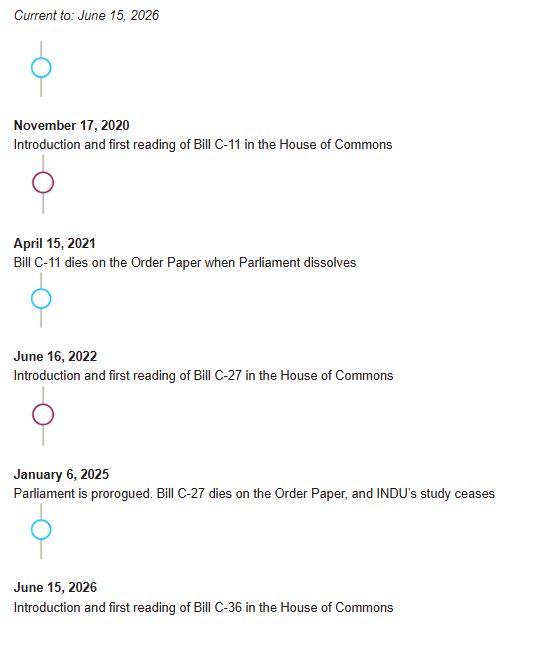
Gowling WLG’s Bill C-36 timeline tracks key developments in the bill’s progress, from introduction and first reading through the next stages of the parliamentary process. As Parliament prepares for summer adjournment, stakeholders should watch for consultation opportunities, with the legislative process slated to continue in earnest in the fall.
Timeline of developments
Next steps
- Account for summer timing: Parliament is scheduled to rise for the summer by June 19, 2026, with regular sittings set to resume on September 21, 2026.
- Prepare for stakeholder engagement: The government is expected to consult stakeholders on the bill over the summer, making this a key window for businesses and industry groups to identify issues and develop submissions.
- Watch for second reading: The next formal parliamentary milestone will be second reading in the House of Commons, where MPs debate the bill’s principle and scope and vote on whether it should proceed to committee.
- Monitor committee referral and study: Committee review will be among the most important stages for stakeholders if the bill passes at second reading, as committees may hear witnesses, study the bill clause by clause, propose amendments, and report the bill back to the House.
- Assess implementation timing: Even if the bill receives Royal Assent, compliance obligations may take years to come into effect.
Insights from Gowling WLG
- Ottawa tables long-awaited federal privacy reform legislation
- Canada launches "AI for All" national artificial intelligence strategy
- Bulletin: Committee study of Bill C-27 to start on September 26
- Bill C-27: Canada Reintroduces Sweeping Changes to Federal Privacy Law, Proposes New AI Legislation
- Bill C-27: A Deeper Dive into Canada's Proposed Artificial Intelligence and Data Act
- Canada's Proposed Privacy Law Moves to Second Reading in the House of Commons
- The Artificial Intelligence and Data Act (AIDA)
- Preparing for the Consumer Privacy Protection Act: Overview
- Much-needed clarification: Canada sheds new light on proposed Artificial Intelligence and Data Act in companion document
- Bulletin: Minister Champagne Provides Details on Proposed Amendments to Canada's Bill C-27
- Opening remarks, as an individual, of Antoine Guilmain, Partner and Co-Leader of the Cyber Security and Data Protection Law Group
Read the original article on GowlingWLG.com
The content of this article is intended to provide a general guide to the subject matter. Specialist advice should be sought about your specific circumstances.






