
What should you do when a construction dispute first arises in Western Australia?
When a construction dispute1 first arises, start by reviewing the executed contract2, including any amendments and special conditions, and identify the applicable notice3 requirements, deadlines and dispute4 resolution process. Preserve relevant project records, confirm important discussions in writing and prepare a chronology of key events. Keep contractual notices separate from settlement5 discussions, and consider any statutory rights or time limits6 that may also apply. Before taking significant action such as suspending work, terminating the contract7 or making a settlement8 offer, obtain advice so that legal rights, evidence9 and commercial options are preserved.
Our Dispute Resolution Team discuss this important topic.
Summary
Construction disputes rarely become difficult because nobody knew there was a problem. They become difficult when early decisions are made without enough regard to the contract10, the project record or the commercial objective.
The Housing Industry Association (HIA) has recently updated the dispute11 resolution provisions in its Western Australian contracts. Its public summary describes a more structured process, including written notice12, an early meeting and, where agreed, mediation13 or expert appraisal. The updated clauses also address continuing performance while a dispute14 is being resolved.
The detail varies between contracts, including between contracts covered by the Home Building Contracts Act 1991 (WA) and those outside that regime. The executed contract15 therefore remains the starting point.
The practical point is however broader than the HIA changes: the way a party responds when an issue first appears can affect its legal and commercial position later. The objective is usually to preserve rights, Evidence16 and commercial options while determining what outcome the business actually needs.
Start with the contract
Before sending a formal notice17 or responding to a claim18, check the executed contract19, including any special conditions and amendments.
Identify:
- how a dispute20 must be notified;
- what information the notice21 must contain;
- who must receive it and how it must be served;
- any time limit for giving or responding to the notice22;
- whether the contract23 requires a meeting, mediation24, expert determination or arbitration to resolve a dispute25;
- whether work must continue during the dispute26; and
- any separate rights concerning payment, suspension or termination.
A valid concern can be weakened by a late notice27, an incomplete claim28 or service on the wrong person.
The contract29 should also be considered alongside applicable legislation30. Depending on the work and the nature of the dispute31, separate statutory rights and short deadlines may apply, including under the Building and Construction Industry (Security of Payment) Act 2021 (WA), the Building Services (Complaint Resolution and Administration) Act 2011 (WA) or the Home Building Contracts Act 1991 (WA).
A contractual dispute32 procedure does not necessarily displace those rights.
Put the issue in writing
A dispute33 notice34 should identify the issue clearly enough for the other party to understand the position and respond. Its form, content, recipient and method of service should comply with the contract35.
Before sending it, check the relevant facts, supporting documents and deadlines. Avoid unnecessary admissions or allegations that may weaken the commercial or legal position.
Oral directions and discussions should be confirmed in writing. Record who said what, when and where the discussion occurred and any effect on scope, cost or program.
Control the project record
When a dispute36 emerges, preserve the available evidence37 before records are lost or people’s recollections fade.
This may include:
- the signed contract38, amendments and special conditions;
- notices, directions, responses, variation and extension-of-time records;
- payment claims, payment schedules, programs and delay records;
- site diaries, photographs and videos;
- meeting minutes, requests for information and project communications; and
- records showing who had authority to give directions.
Prepare a chronology linking the significant events to the relevant documents. This allows the business and its advisers to determine what happened, what can be proved and which deadlines remain open.
Keep project administration and settlement discussions separate
Contractual notices, payment documents and directions should remain in open correspondence.
Genuine settlement39 negotiations may attract without prejudice40 privilege, but adding the words ‘without prejudice41’ to an email does not of itself determine whether the communication is protected. Its purpose and context are key considerations and they matter.
Do not includea contractual notice42 within a without prejudice43 communication. Mixing the two can create uncertainty about whether the notice44 has been properly given and whether the communication can later be used as evidence45.
Where a formal settlement46 offer may affect a later costs47 decision, obtain advice about its wording, supporting reasons and the period allowed for acceptance.
Put important decisions into practice
Families do not need every answer before they begin. A useful first step is to identify what has been decided, what decisions still need to be made and who should be involved in the next conversation. That may include the family’s accountant, financial adviser and lawyer48, all working from the same understanding of the family’s objectives.
Good lawyers know the law. Excellent lawyers apply good judgement to the way legal, financial and family considerations meet in real life. For farming families, that means helping you consider the practical effect of a decision on the business you have built and the people you hope it will support.
A considered plan gives the next generation a clearer basis on which to contribute. It also gives every member of the family a better chance of understanding the path ahead, before a difficult event requires decisions to be made quickly.
A practical construction dispute checklist
When an issue first arises:
1. Find the contract49
Locate the signed contract50, amendments and special conditions.
2. Check deadlines
Review all notice51, response and dispute52 resolution time limits53.
3. Preserve records
Secure the project documents and relevant communications.
4. Build the chronology
Link the important events to the available evidence54.
5. Control communications
Coordinate external project communications so instructions, notices and responses remain consistent.
6. Pause before material action
Obtain advice before suspending work, terminating the contract55 or sending a material admission or settlement56 offer.
Construction disputes are easier to manage while options remain open. Understanding the contract57, preserving the project record and deciding on the commercial objectives should happen before positions harden, not after.
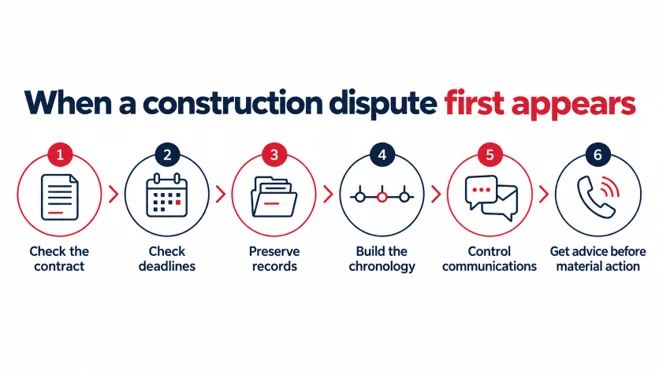
A practical construction dispute58 checklist
Footnotes
1. A conflict.
2. An agreement or promise between two or more parties that is legally enforceable
3. To be on notice or put on notice is to be forewarned and aware of what is to occur.
4. A conflict.
5. Negotiated agreement between parties to a dispute. When a legal proceeding has been commenced but then settles, the parties will generally prepare written terms of settlement or minutes of proposed consent orders for the court to make.
6. A defined and strict time period to commence a legal action.
7. An agreement or promise between two or more parties that is legally enforceable
8. Negotiated agreement between parties to a dispute. When a legal proceeding has been commenced but then settles, the parties will generally prepare written terms of settlement or minutes of proposed consent orders for the court to make.
9. Information used to prove a legal matter.
10. An agreement or promise between two or more parties that is legally enforceable
11. A conflict.
12. To be on notice or put on notice is to be forewarned and aware of what is to occur.
13. A process in which a mediator assists parties to resolve a dispute by agreement.
14. A conflict.
15. An agreement or promise between two or more parties that is legally enforceable
16. Information used to prove a legal matter.
17. To be on notice or put on notice is to be forewarned and aware of what is to occur.
18. A formal request for something you believe you are due.
19. An agreement or promise between two or more parties that is legally enforceable
20. A conflict.
21. To be on notice or put on notice is to be forewarned and aware of what is to occur.
22. To be on notice or put on notice is to be forewarned and aware of what is to occur.
23. An agreement or promise between two or more parties that is legally enforceable
24. A process in which a mediator assists parties to resolve a dispute by agreement.
25. A conflict.
26. A conflict.
27. To be on notice or put on notice is to be forewarned and aware of what is to occur.
28. A formal request for something you believe you are due.
29. An agreement or promise between two or more parties that is legally enforceable
30. Laws made by government in the form of statutes; Acts and regulations.
31. A conflict.
32. A conflict.
33. A conflict.
34. To be on notice or put on notice is to be forewarned and aware of what is to occur.
35. An agreement or promise between two or more parties that is legally enforceable
36. A conflict.
37. Information used to prove a legal matter.
38. An agreement or promise between two or more parties that is legally enforceable
39. Negotiated agreement between parties to a dispute. When a legal proceeding has been commenced but then settles, the parties will generally prepare written terms of settlement or minutes of proposed consent orders for the court to make.
40. To mark a letter ‘without prejudice’ is to signal to the other party’s solicitor that what is set out in the letter is a non-binding communication in the course of a negotiation, and that it cannot be used against the sender’s own client in order to alter the parties’ respective rights.
41. To mark a letter ‘without prejudice’ is to signal to the other party’s solicitor that what is set out in the letter is a non-binding communication in the course of a negotiation, and that it cannot be used against the sender’s own client in order to alter the parties’ respective rights.
42. To be on notice or put on notice is to be forewarned and aware of what is to occur.
43. To mark a letter ‘without prejudice’ is to signal to the other party’s solicitor that what is set out in the letter is a non-binding communication in the course of a negotiation, and that it cannot be used against the sender’s own client in order to alter the parties’ respective rights.
44. To be on notice or put on notice is to be forewarned and aware of what is to occur.
45. Information used to prove a legal matter.
46. Negotiated agreement between parties to a dispute. When a legal proceeding has been commenced but then settles, the parties will generally prepare written terms of settlement or minutes of proposed consent orders for the court to make.
47. This is the total sum of the lawyer's fees (for the time and work on your case) and the out-of-pocket costs required to run your case (see 'Disbursements').
48. As defined in the legal profession acts and the legal profession uniform law, an Australian lawyer is a person who has been admitted to the legal profession and is entitled to practice as a lawyer. This necessarily includes all judges, barristers and solicitors, but it does not include a person who merely holds a law degree.
49. An agreement or promise between two or more parties that is legally enforceable
50. An agreement or promise between two or more parties that is legally enforceable
51. To be on notice or put on notice is to be forewarned and aware of what is to occur.
52. A conflict.
53. A defined and strict time period to commence a legal action.
54. Information used to prove a legal matter.
55. An agreement or promise between two or more parties that is legally enforceable
56. Negotiated agreement between parties to a dispute. When a legal proceeding has been commenced but then settles, the parties will generally prepare written terms of settlement or minutes of proposed consent orders for the court to make.
57. An agreement or promise between two or more parties that is legally enforceable
58. A conflict.
The content of this article is intended to provide a general guide to the subject matter. Specialist advice should be sought about your specific circumstances.




