
News and developments
A conversation with Kristine T. Torres, Partner and Head of ESG and Project Finance, Gorriceta Africa Cauton & Saavedra
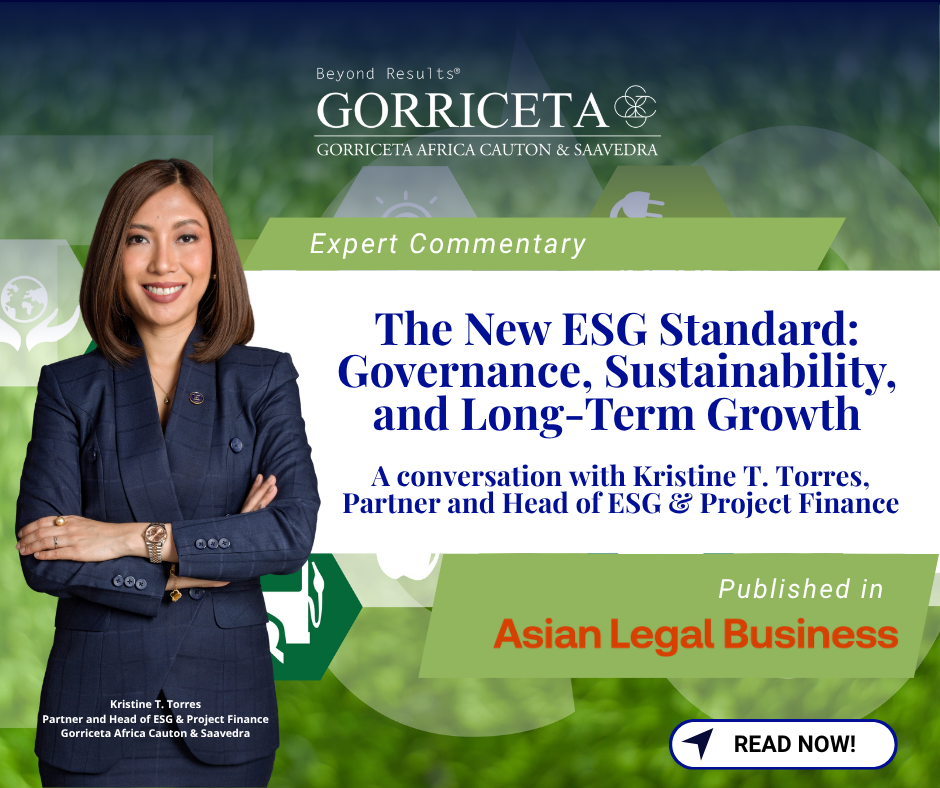
[As published at Asian Legal Business]
The sole Philippine firm on the ALB Asia Top ESG Law Firms 2026 list, Gorriceta Africa Cauton & Saavedra has built a deliberately multidisciplinary ESG practice — and partner and head of ESG and project finance Kristine T. Torres explains how the firm is helping clients navigate the country’s accelerating shift from voluntary principles to mandatory, standardised obligations.
What are the defining pillars of Gorriceta Africa Cauton & Saavedra’s ESG practice, and what has been your most landmark matter?
Our Firm’s ESG practice is anchored on a deliberate multidisciplinary approach that reflects our capabilities across emerging ESG-related disciplines and the breadth of our experience as a full-service law firm. By leveraging the Firm’s expertise across corporate and commercial law, M&A, banking and finance, energy, technology, data privacy, capital markets, regulatory compliance, taxation, labor, and dispute resolution, we are able to provide clients with comprehensive and commercially integrated ESG advisory tailored to increasingly complex business and regulatory environments.
We recognize that ESG is no longer a standalone compliance issue, but has evolved into a business-critical consideration that influences modern business operations, investment strategies, governance frameworks, and long-term enterprise value. ESG considerations now cut across corporate governance, regulatory strategy, finance, technology, energy, risk management, and long-term value creation. As such, our approach is designed not only to address legal and regulatory requirements, but also to help clients navigate broader strategic, operational, and transactional considerations arising from the evolving ESG landscape. Given the developing nature of ESG standards globally and locally, we continuously invest in internal capacity-building and closely monitor emerging regulatory and market developments to ensure that our advice remains practical, commercially responsive, and forward-looking.
A significant area of our ESG-related experience has been in the renewable energy sector, particularly involving solar and wind energy projects and sustainability-driven impact investments. We have advised on transactions involving the acquisition of renewable energy project companies, including transactional ESG and legal due diligence, transaction structuring, and regulatory compliance with applicable energy laws and sector-specific requirements. In parallel, we have also supported clients on impact investment transactions and strategic acquisitions involving businesses and projects aligned with sustainability and long-term value creation objectives. These engagements have enabled the Firm to develop strong capabilities in navigating the legal, commercial, and regulatory complexities surrounding sustainable infrastructure, energy transition initiatives, and ESG-focused investments.
How do you help clients navigate Asia’s uneven ESG regulatory landscape, and where are the biggest gaps?
In the Philippines, the ESG regulatory landscape continues to evolve. Against this backdrop, our approach is grounded in providing clients with a holistic and commercially practical advice that assesses their specific regulatory exposure while applying a risk-based perspective tailored to their industry, operations, and strategic objectives.
We support clients by navigating the regulatory requirements and aligning these with applicable global ESG standards. We also provide forward-looking guidance on compliance, particularly in areas where Philippine rules remain evolving or principles-based. A significant aspect of our role involves bridging the gap between local regulatory requirements and international investor expectations, which are often more rigorous and standardized.
What separates companies genuinely embedding ESG into their strategy from those merely box-ticking?
Companies that genuinely embed ESG into their core strategy adopt a broader, holistic, and long-term view of their business growth, value creation, operations and corporate responsibility. In this context, ESG extends beyond mere regulatory compliance or disclosure obligation, and becomes integral to how they operate, manage risk, render strategic decisions, and deal with stakeholders, including investors, employees, customers, and the broader community. It reflects a sustained commitment to responsible growth and to contributing to a more sustainable and inclusive future.
Importantly, companies that meaningfully integrate ESG into their core strategy often create a multiplier effect across the ecosystem. By setting higher standards in governance, environmental stewardship, and social responsibility, they encourage peer institutions, business partners, and even smaller market players to adopt similar practices. This contributes to stronger market awareness, higher governance benchmarks, and greater alignment with evolving global ESG expectations. In many respects, effective ESG integration serves not only as an internal business strategy, but also as a catalyst for broader industry development, collaboration, investment opportunities, and innovation.
In contrast, purely compliance-driven or “box-ticking” approaches to ESG tend to focus narrowly on meeting minimum regulatory or disclosure requirements, without meaningfully integrating ESG principles into the company’s broader governance and decision-making framework. While these approaches may achieve technical compliance, they frequently fall short of capturing the broader strategic value that ESG can offer to an organization. Without genuine integration into corporate culture, operational strategy, and leadership priorities, ESG initiatives risk becoming fragmented, reactive, and ultimately unsustainable.
This distinction has become increasingly significant as investors, regulators, financial institutions, and other stakeholders place greater emphasis on ESG performance and long-term sustainability metrics. Companies that approach ESG solely from a compliance lens may find themselves at a disadvantage in attracting investment, accessing financing, building stakeholder trust, and responding to evolving market expectations. In contrast, organizations that treat ESG as a strategic business imperative are generally better positioned to enhance resilience, strengthen long-term credibility, unlock new opportunities, and create sustainable enterprise value.
What practical guidance do you give clients to communicate ESG commitments accurately and avoid greenwashing liability?
One of the key practical guidance points we give clients is that ESG communications should be approached with the same level of diligence, substantiation, and governance as any other material corporate disclosure. It starts with having a good understanding of its organization, its current operations, what it needs, and what its stakeholders expect. As regulatory scrutiny and stakeholder expectations continue to increase globally, companies can no longer treat ESG statements as purely aspirational marketing narratives or optics. ESG-related representations—whether made in sustainability reports, investor presentations, websites, marketing materials, or public announcements—must be capable of substantiation, and should be supported by credible data, measurable initiatives, and verifiable internal practices.
As a practical approach, we guide clients in first identifying gaps in their existing systems, policies, and processes and advise them to avoid broad or absolute sustainability claims unless these can be clearly substantiated through reliable methodologies, and adequate supporting documentation. We likewise encourage clients to implement robust internal governance and review mechanisms for ESG-related disclosures. Effective ESG communication should involve coordinated oversight across legal, compliance, sustainability, investor relations, and operational teams to ensure consistency, accuracy, and proper substantiation. Lastly, we advise them of the importance of maintaining clear documentation, audit trails, and supporting records, particularly as ESG statements are increasingly subject to scrutiny from regulators, investors, counterparties, and other stakeholders.
What are the most common legal challenges clients face when structuring sustainable finance instruments?
In the Philippines, one of the most common legal challenges in structuring sustainable finance instruments is navigating an evolving and still fragmented ESG regulatory landscape. While sustainable finance has gained significant traction across the banking, capital markets, and investment sectors, the regulatory framework remains developing, with requirements and guidance dispersed across various regulators, including the Bangko Sentral ng Pilipinas (BSP), the Securities and Exchange Commission (SEC), and industry-specific agencies. In particular, with the Security Exchange Commission’s adoption of IFRS-based sustainability reporting standards (PFRS S1 and S2), companies are now required to align their disclosures with global frameworks, which raises the bar in terms of consistency, comparability, and accountability.
Another key challenge is harmonizing commercial objectives with evolving ESG compliance and reporting obligations. Sustainable finance instruments often require ongoing monitoring, performance reporting, and covenant compliance tied to sustainability metrics or transition targets. Structuring these obligations in a commercially practical and legally enforceable manner can be complex, particularly in industries where ESG standards and reporting methodologies are still developing or lack uniformity.
There are also practical considerations surrounding governance and internal readiness. Many organizations are still in the process of developing internal ESG policies, data collection systems, and sustainability governance frameworks capable of supporting sustainable finance transactions on an ongoing basis. As such, legal structuring increasingly requires close coordination not only with management and finance teams, but also with sustainability, compliance, operational, and technical stakeholders.
Which single development will most fundamentally reshape ESG law in Asia over the next five years?
One of the developments that will most fundamentally reshape ESG law in Asia over the next five years is the continued shift from voluntary and best-principles led initiative toward mandatory, standardized, and increasingly enforceable ESG disclosure and sustainability-related obligations anchored on IFRS/ISSB standards. We are already seeing this trend across the region, with regulators moving toward more structured and comparable disclosure regimes, even if implementation varies per jurisdiction.
In the Philippines, this is particularly evident with the SEC’s adoption of PFRS S1 and PFRS S2 under a phased approach. This signals a clear transition from principles-based sustainability reporting to a more standardized and enforceable framework. From a legal perspective, this is a significant shift because ESG is no longer just a disclosure or compliance exercise as it directly impacts governance, risk management, and potential liability.
Looking ahead, ESG compliance is no longer likely to be confined to large, publicly listed companies. We are already seeing a clear trend toward broader adoption, with expectations gradually extending to private companies, and probably even to SMEs signaling that ESG will become a baseline standard for doing business rather than a differentiator.