Trial lawyers often file summary judgment motions. Most motions
for summary judgment require supporting evidence. That evidence
often takes the form of affidavit. An "affidavit" is
"a statement in writing of a fact or facts signed by the party
making it, sworn to before an officer authorized to administer
oaths, and officially certified to by the officer under his seal of
office. TEX. GOV'T CODE 312.011(1). A "jurat" is a
certification by an authorized officer stating that the writing was
sworn to before the officer. Perkins v. Crittenden, 462
S.W.2d 565, 568 (Tex. 1970). This is a jurat:
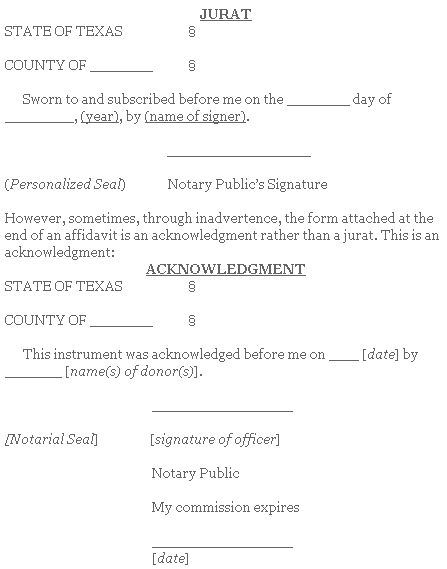
That is what happened in The Mansions in the Forest, L.P. v.
Montgomery County, 365 S.W. 3d 314 (Tex.2012). In an
affidavit in opposition to a summary judgment motion, the notary
certification stated that the affiant acknowledged, rather than
swore to, his statements. The opponent objected to the affidavit
but not because it lacked a jurat. The trial court sustained



