

Regulatory Developments Affecting Compensation at Financial Institutions: A Comparative Perspective
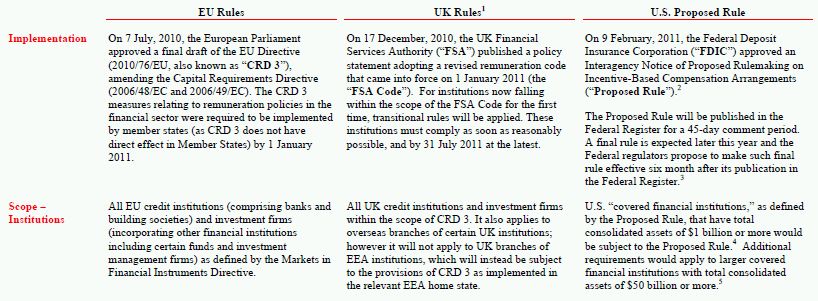
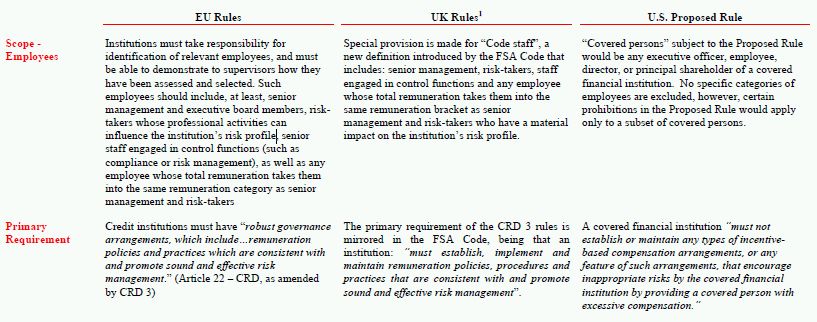
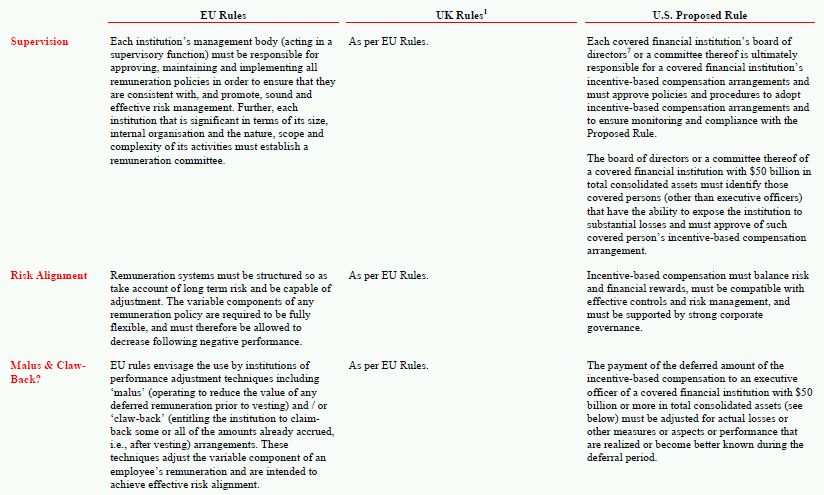
In the aftermath of the financial crisis, regulators in the United States and in Europe have focused on modifying compensation practices at financial institutions. In prior alerts, we have provided an overview of the regulations in the UK and in the EU affecting compensation at financial institutions. Please see http://www.mofo.com/files/Uploads/Images/110124-Financial-Sector-Remuneration-in-the-UK-and-the-EU.pdf . Likewise, we have discussed the initiatives in the United States affecting compensation policies and compensation instruments http://www.mofo.com/files/Uploads/Images/101019-Incentive-Compensation-for-Financial-Institutions.pdf . Most recently, on February 7, 2011, the FDIC approved an interagency notice of proposed rulemaking regarding incentive-based compensation arrangements by "covered financial institutions." A covered financial institution is a bank that has total consolidated assets of more than $1 billion. Incentive-based compensation arrangements at covered financial institutions that provide for excessive compensation would be prohibited. Arrangements that encourage or expose the institution to inappropriate risk also would be prohibited. These institutions would be required to file regular reports detailing the design and structure of their incentivebased compensation plans and arrangements and explaining how these plans and arrangements are intended to mitigate excessive risk-taking. In addition, institutions that have total consolidated assets of more than $50 billion are subject to other restrictions and must detail the compensation policies applicable to senior executives and others that may expose the institution to substantial risk of losses (based on the institution's business). The rule requires that at least 50% of incentive-based compensation payments be deferred over a period of not less than three years for designated executives at these larger institutions. In many respects, this rule moves the compensation policies applicable to U.S. financial institutions more in line with those applicable to financial institutions in the UK and EU.
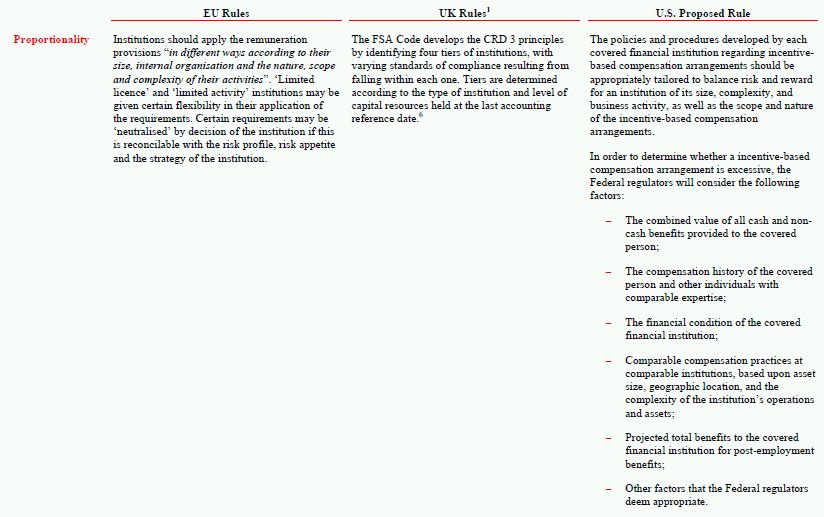
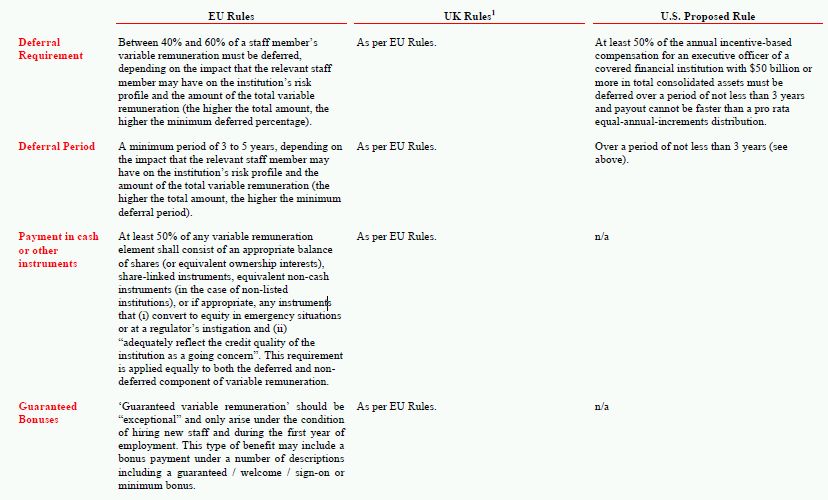
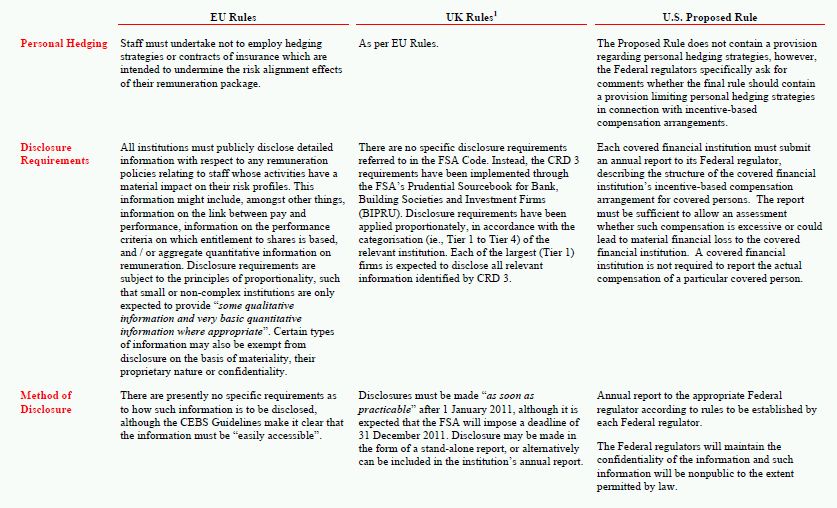
The following table summarises and compares the principal legislation relating to remuneration in each of the EU, the UK and the proposed rule recently published in the U.S. with regard to financial institutions:
Footnotes
1 The UK Rules are based primarily upon the revised FSA Code, which serves to incorporate many of the provisions of CRD 3 into UK law, and carry over certain provisions from the existing code. In addition, it also includes rules made under powers provided to the FSA by the Financial Services Act 2010, and takes account of the principles set out in the Financial Stability Board's "Principles for Sound Compensation Practices".
2 The Federal regulator, i.e., the Board of Governors of the Federal Reserve System ("Federal Reserve"), the Office of the Comptroller of the Currency ("OCC"), the Office of Thrift Supervision ("OTS"), the FDIC, the National Credit Union Administration ("NCUA"), the U.S. Securities and Exchange Commission ("SEC"), and the Federal Housing Finance Agency ("FHFA"), are mandated by section 956 of the Dodd-Frank Wall Street Reform and Consumer Protection Act ("Dodd-Frank Act") to jointly prescribe regulations or guidelines with respect to incentive-based compensation practices at covered financial institutions. Each Federal regulator must approve the Proposed Rule independently.
3 The Proposed Rule would supplement existing rules and guidance adopted by the Federal regulators regarding compensation and incentive-based compensation, such as the Interagency Guidance on Sound Incentive Compensation Policies and the Standards for Safety and Soundness adopted by the Federal Reserve, the OCC, the FDIC, and the OTS, the compensation related disclosure requirements for public companies adopted by the SEC, the rules and guidance adopted by the FHFA, and compensation rules adopted by the NCUA.
4 Covered financial institutions include: depository institutions or depository holding institutions (including branches and agencies of foreign banking organizations), broker-dealers, credit unions, investment advisers, the Federal National Mortgage Association ("Fannie Mae"), the Federal Home Loan Mortgage Association ("Freddie Mac"), and any other financial institution that the appropriate Federal regulators determine should be treated as a covered financial institution. For a branch or agency of a foreign banking organization the consolidated assets would be determined based on their U.S. assets.
5 For covered financial institutions supervised by the NCUA or the FHFA, the threshold remains at $1 billion in total consolidated assets.
6 Tier 1 comprises UK banks and building societies with capital resources in excess of £1 billion, BIPRU 730k firms which are full-scope BIPRU investment firms (all as defined in the FSA Handbook) with capital resources in excess of £750 million and third country BIPRU firms with assets exceeding £25 billion.
Tier 2 comprises UK banks and building societies with capital resources between £50 million and £1 billion, BIPRU 730k firms which are full-scope BIPRU investment firms with capital resources between £100 million and £750 million and third country BIPRU firms (other than limited licence/limited activity firms) with assets between £2 billion and £25 billion. Tier 3 comprises UK banks and building societies and full-scope BIPRU firms not within tiers 1 and 2, and third country BIPRU firms not within tiers 1, 2 and 4. Tier 4 comprises limited licence and limited activity firms.
7 The FDIC Proposed Rule defines the board of directors of an insured U.S. branch of a foreign bank as the "senior management of [the] parent bank."
Because of the generality of this update, the information provided herein may not be applicable in all situations and should not be acted upon without specific legal advice based on particular situations.
© Morrison & Foerster LLP. All rights reserved





