Our data shows that adjustment escrows are lower on high-value
deals — but variability in adjustment escrows is higher
across lower-value deals.
What is the typical size of an adjustment escrow? A common rule
of thumb is 1% of overall deal value, but the size varies depending
on deal value and the underlying characteristics of the business
(including the net working capital trailing average).
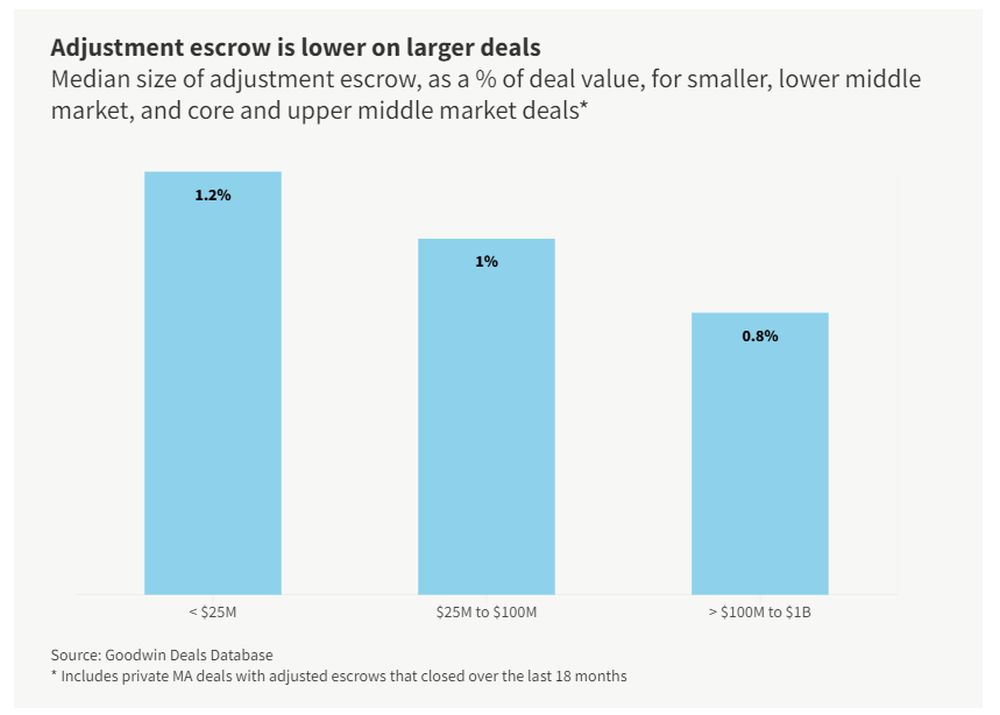
Analysis of the Goodwin Deals Database shows that the median
adjustment escrow is less than 1% on larger deals. The median is
more than 1% on smaller deals, but variability in adjustment
escrows is higher across deals in this group.
This makes sense because many companies that are sold for $25
million or less are fast-growing startups that may not have
developed the level of sophistication across internal functions
that is common in more mature companies, which often achieve higher
valuations. Therefore, in lower-value deals, buyers may be more
likely to demand





