The face of the CAP is to change yet again with three separate exercises in the pipeline, in addition to a number of reviews added to the EU Commission’s agenda. There is welcome news for the milk industry and we also look at the draft Climate Change Bill.
Time For A Mid-Term Review Of The CAP?
The EU Commission has flagged up several issues to be addressed in the CAP. Initial proposals are due in the summer and may result in changes for the 2009 SPS year.
The Common Agricultural Policy (CAP) seems to be in a state of perpetual revolution – no sooner has one reform been agreed then the next is being prepared. Currently, there are three separate exercises in the pipeline, planned to change the face of the CAP. At the most basic level is the ‘Simplification Exercise’. This is a relatively minor tidying up of legislation – its main on-farm effect may be simplification of the cross-compliance rules. The other two parts are the CAP Health Check and the Budget Review.
In addition to these, the individual CAP regimes for wine, and fruit and vegetables, are also being reformed. With wine, it is unlikely to affect many in the UK as it concerns its production rather than consumption. However, with the latter, we may see the end of fruit, vegetable and potato authorisations for 2008. Also affecting agriculture are EU plans for binding targets for biofuels use.
The 2005 Fischler Reforms built in a number of reviews, and these are being pulled together with wider analysis of how the Single Payment Scheme (SPS) is working. The EU Commission is eager not to call it a ‘mid-term review’, as the last time that name was used the review turned into a full-scale reform of the CAP. The idea is to tinker with policy rather than radically change it. Initial proposals are due in the summer and may result in changes for the 2009 SPS year.
The Commission has flagged up several key issues for the agenda.
- It wants to reduce the level of intervention support for cereals. As part of the deal, this may see set-aside removed.
- With the end of quotas, there may be changes to the level of support in the milk market. They are guaranteed until 31 March 2015, which could be their final day of operation.
- Once again, the issue of capping aid payments is returning to the negotiating table. A limit of €300,000 has been proposed in previous reforms but never implemented. Such a ceiling might be politically attractive but the Commission is concerned that claimants will just avoid it (and that it will affect few businesses and save little money). Minimum payments may also be introduced, making the administration more simple.
- Compulsory EU modulation may be renegotiated. The Commission was disappointed about the low level of funds available for rural development in the budget settlement. Higher modulation would be a way of boosting funds. As the UK gets the majority of EU modulation funds back, high compulsory modulation should mean lower UK levels.
- In other parts of Europe, there may be pressure to reduce (or to start phasing out at least) the enterprise specific direct payments that have been retained.
- There may be discussion about moving other countries to the regional (flat-rate) system seen in England and Germany.
Big changes like the last point seem destined to be delayed until after 2012, as the EU Commissioner, Mariann Fischer- Boel, wants a period of "stability". These CAP discussions will feed into, and be influenced by, the Budget Review. This review would cover all EU policies, not just agriculture.
As part of the 2005 budget deal that set spending patterns for the period 2007-13, Tony Blair insisted that the entire EU spending be looked at again in 2008-09. The subtext to this is that the UK Government wants a big shift from pillar 1 CAP funding (still over a third of the total EU budget) to other areas. This would mean a drop in Single Payments. Indeed, the UK would like a commitment that by the end of the next budget period (2013-20), direct aid payments would be phased out altogether. This may be unrealistic, but there are certainly further changes ahead.
Rural Development And Modulation
The devolved UK governments have plans for their RD programmes for the 2007-13 period. But more money is required, and so VM will be used to cover the shortfall.
Pillar II of the CAP is rural development (RD). On her appointment, Commissioner Fischer-Boel announced that this pillar would be the primary focus of her term in office. Indeed, at that point, the name of the department quietly changed from ‘Agriculture and Fisheries’ to ‘Agriculture and Rural Development’. In 2005, when EU heads of state decided upon the overriding budget for the financial period 2007-13, these good intentions took a battering. The amounts of funding available for the CAP were constrained, and it was politically more acceptable to squeeze the RD spend for the period rather than the Single Payment.
Furthermore, when the total RD pot was divided among Member States, the UK came off rather badly. The accession countries had already been promised minimum amounts of RD funds. Some other countries also secured specific allocations. The remaining RD funds were allocated on the basis of historical spend, rather than land area or farm numbers. So, although the UK has over 9% of EU agricultural land area, it will receive only 2.2% of total RD funding. Historically, the UK has not made much use of European RD funds, as it would have reduced the budget rebate, which returns unspent UK money.
The various devolved UK governments all have plans for rolling out, or continuing, their RD programmes for the 2007-13 period. In order to do this, more money is required, and so voluntary modulation (VM) will be used to cover the shortfall. This continues a policy used over the last two years, where a portion of the Single Payment has been removed and the money used to fund RD schemes.
The European Parliament opposes VM in principle and, until recently, stalled progress of the entire RD policy in objection to it. However, with one or two negotiating concessions, the objections have now been lifted and each Member State can start its programmes. The RD deal allowed the UK to allocate differing VM rates in each devolved region, and to levy the modulation on all Single Payments (rather than just anything above €5,000). However, the concession was that the VM funds should be allocated with the same criteria as all other RD funds (meaning a maximum of 80% could go to environmental schemes).
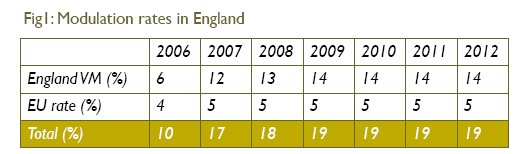
The English rates of modulation are set out in Figure 1. The rate in 2007 will be 12%, double that of 2006, and it will rise thereafter to 14%. Remember that the rates of national ‘voluntary’ modulation are in addition to the 5% ‘compulsory’ EU modulation that will apply throughout the period. The money raised through VM will be partially co-funded by the Treasury. The 80% of VM money to be spent on agri-environmental schemes is going to be match-funded at a rate of 40%, i.e. for each £6 raised through modulation, the Government will add £4.
Overall, this will generate £3.9bn for the Rural Development Programme of England for 2007-13. Of this, £3.3bn of the total budget will be allocated to agrienvironment and other land management schemes – mainly Environmental Stewardship, but also hill support. The remaining £600m will be made available to agriculture and forestry through capital grant schemes run by the Regional Development Agencies.
Announcements on the level of VM in Scotland and Wales have been delayed due to the May regional elections, which recently took place. The new administrations will decide on the modulation rate.
All EU members will now be applying to the EU Commission for approval of their RD plans. In the past, it has taken six months for EU approval. Even if the Commission accelerates the process, it is unlikely that it will be completed before the EU summer break in August. Therefore, it is now almost certain to be the autumn before money under the new programmes starts to flow, and various schemes can be launched.
Climate Change
The consultation process for the draft Climate Change Bill, which was published in March, is well underway. The deadline for submissions is 12 June.
The UK Government published the draft Climate Change Bill in March, aiming to set the UK on a path towards a low carbon economy. It was hailed at the time as the first of its kind in any country. As with any major draft bill, a consultation accompanies it, the deadline for submissions being 12 June.
The main features of the bill are as follows.
- A series of five-yearly ‘carbon-budgets’, planned 15 years ahead. The first of these could be in place by 2008. The aim is to provide certainty in business planning and for businesses investing in low carbon technologies.
- Mandatory cuts to greenhouse gas emissions of 60% by the year 2050.
- An interim target of 32% for CO2 emission reduction by 2020.
These targets are to be legally binding, although the legal sanctions should they be missed have yet to be decided. A new committee on climate change will be set up to provide advice and guidance to the Government. The commitee will produce an annual report, which will hold the Government to account on progress towards its carbon budgets. The draft bill and consultation document can be found on the Department for Environment Food and Rural Affairs website: www.defra.gov. uk/corporate/consult/climatechange-bill
EU targets
EU leaders, while meeting at the Spring Summit, endorsed binding targets for renewable energy use for the EU. There will be a minimum target of 10% for biofuels used in road transport by 2020. By the same date, 20% of EU energy usage should come from renewable sources, they decided. This confirms the stance previously taken by EU energy ministers and endorsed by environmental ministers earlier in the spring.
These targets are to be legally binding, although the devil is in the detail. In order to reach agreement, the German presidency accepted that individual countries could have different targets depending on "starting points and potentials". This effectively delays until autumn the arguments over which Member States are going to shoulder the burden of reaching the overall EU target. The 10% road fuel target will contribute to the overall 20% renewables target. But despite some earlier talk, no specific percentage goals were set out in the other two main energy sectors – electricity generation and heating and cooling.
Milk Prices Take A Step In The Right Direction
The announcement by Tesco to give milk suppliers a base price of 22ppl could be a turning point for all involved if everyone in the supply chain is open and transparent.
Extraordinary things have been taking place in the UK milk supply chain. On 3 April, Tesco made headlines with the almost unbelievable announcement that dedicated suppliers would receive a base price of 22 pence per litre (ppl). Tesco currently buys its milk from processors Wiseman (60%) and Arla (40%), totalling a near 900m litre contract. About 500 Wiseman suppliers and 350 Arla Foods Milk Partnership members will be the beneficiaries of the highestpaying contract on the market.
The 22ppl base price is almost all that is known so far. No details have been announced defining any specific membership requirements, or what adjustments for seasonality and quality would be included in the contract. Tesco has said that the contracts will run for 12 months, with the milk price reviewed every six months to ensure it reflects the true cost of production. The retailer insists the price paid will reflect price movements in key variables such as feed, fertiliser, energy and labour.
As outlined in Philip Moody’s profile on the back page, Tesco is also to sell milk under its new ‘local choice’ brand. This is in line with increasing customer demand for regional produce. Approximately 100m litres will be sourced from 150 small family dairy farms through the co-operative Dairy Farmers of Britain (DFB). Farmers fortunate enough to secure these contracts will receive an impressive 23ppl; almost a 6ppl rise on the current DFB contract. Likewise, the criteria is yet to be set, but is thought to centre on family farms with less than 100 cows.
Supermarket supply groups already exist, with Waitrose, Marks & Spencer and Asda already offering premium liquid milk contracts. In addition, Sainsbury’s has begun a Dairy Development Group, although it is yet to return any real benefits to the farmer. Tesco’s announcement, although lacking in detail so far, overshadows these other deals in what has been a huge PR exercise. So why has Tesco done this?
The supermarket has built an empire on providing cheap food to the nation. Perhaps the continued decline in UK milk production concerned the supermarket. Interestingly, in the same week that Tesco made the announcement, the Milk Development Council released a forecast, based on a farmer survey, that milk production will plummet by 900m litres in the next two years. Did Tesco deliberately make this move just before the competition authorities were about to launch a major attack on the supermarkets alleged milk price fixing? Whatever the reason, the cost of the new scheme is small change for the supermarket. The old practice of milk being sold as a loss-leader is gone. The succession of hard-fought retail initiatives since 2000 has largely seen price rises end up in retailers’ hands. There now seems to be a fat retail margin, some of which is, at last, being passed back down to farmers. It is important to remember that only two weeks before the 22ppl announcement, the retail price was raised by the equivalent of 1.76ppl.
The Tesco deal will need to be studied carefully, but if everyone in the supply chain is open and transparent, it will be a turning point for all involved. The ‘big four’ hold 61.3% of the liquid milk market, with Tesco accounting for a colossal 27.2% share of the total. It is hoped that the other major retailers will follow suit, and that the same kind of process occurs with other dairy products such as cheese, thus pulling the whole milk supply chain towards more sustainable prices. Tesco has said that the new contracts will be in place by the end of the year.
Food For Thought
Philip Moody
Smith & Williamson’s Bristol office has more than 20 years’ experience of working with farmer-controlled businesses. The team is led by Philip Moody, head of corporate finance, who specialises in providing strategic planning and advice to businesses in the agrifood sector.
In their most recent deal, they acted as financial adviser in the merger of four leading European fresh berry companies. The transaction, which completed in February, combines the marketing, production and breeding capabilities of fruit companies KG Fruits, Alconeras UK, Berry Alliance and Driscoll European Genetics.
The merger created Berry Gardens B.V., with a head office in Holland and subsidiaries in the UK, Spain and Holland. The new group will market strawberries, raspberries, blueberries and blackberries, selling to major multiple retailers in the UK and Europe. It is expected to generate an initial turnover of about £150m and intends to grow into a truly pan-European marketing company. Philip was appointed non-executive chairman of the new company and is now playing a leading role in helping the business to achieve its plans.
From little acorns grow…
Philip’s involvement with farmer-controlled businesses dates back to 1983, when he set up his own specialist practice in the South West. His first client was Robert Adams & Co, a corn merchanting business based in Westbury, Wiltshire. He was then asked to provide advice to Centaur Grain, a grain co-operative that he still acts for today. Centaur is the largest marketeer of committed grains in the UK, marketing crops worth over £100m on behalf of over 2,000 farmer members.
Philip is a non-executive director of the Centaur business. He engineered a groundbreaking supply agreement with Warburtons, the leading UK family baker, which was recognised by the industry and government. He also implemented an innovative dual membership structure.
A growing reputation in agrifood has led to other opportunities. In 2002, Philip advised on the formation of DFB, a new generation co-operative formed from the merger of The Milk Group and Zenith Milk. Philip was appointed corporate development director of DFB in November 2003 and led the subsequent acquisition of the milk processing division of the Co-Operative Wholesale Society. The Co-Op Retail Group remains DFB’s largest customer.
DFB is the fourth largest processor of liquid milk in the UK. It processes around 1bn litres of milk through its dairies throughout the UK. It has recently announced a unique partnership with Tesco whereby selected DFB members will supply regional milk, to be marketed under a new Tesco ‘local choice’ brand. This will enable consumers to buy local milk, reducing food miles and supporting local farmers. DFB members will receive a premium price for their milk, helping them to build a profitable and sustainable future.
Making a difference
Philip’s reputation for innovation and strategic thinking was recognised when he was invited to join the board of English Farming and Food Partnerships (EFFP). EFFP is a non-profit organisation, supported by the public and private sectors, committed to promoting collaboration across the farming and food industry. Fellow board members include Chris Blundell of Morrison Supermarkets and Steve Ellwood, head of HSBC’s agricultural division.
Philip is also a governor of the Royal Agricultural College in Cirencester. But it’s not ‘all work and no play’. His love of walking and the countryside ensures that he keeps his life in balance, while his energy, enthusiasm and ambition for agrifood means there is always food for thought…
The content of this article is intended to provide a general guide to the subject matter. Specialist advice should be sought about your specific circumstances.






