In April, 15 amendments to 12 standards (10 IFRSs and 2 IFRICs) were published. Below we consider four of the changes and, while the application dates of the amendments arising from the entire project vary, all of these are effective for periods beginning 1 January 2010 with early adoption being permitted.
IAS 17 'Leases'
Under the amendment, a lease of land with an indefinite economic life is no longer required to be classified as an operating lease. It can now be classified as a finance lease even if at the end of the lease term the title will not pass to the lessee. The reason for this change is that the IASB considers that substantially all the risks and rewards of ownership are transferred to the lessee and the present value of the residual value of the leased asset is negligible. Where the amendment results in a lease being reclassified as a finance lease, it should be applied retrospectively. This will most probably be for those leases of both land and buildings where the building is already treated as a finance lease.
IFRS 8 'Operating segments'
IFRS 8 has been amended to state that segment information in relation to total assets is only required if such information is regularly reported to the chief operating decision maker.
IAS 1 'Presentation of financial statements'
IAS 1 is clarified by confirming that the potential settlement of a liability by the issue of equity is not relevant when considering whether it is classified as current or non-current. The standard now permits a liability to be classified as noncurrent notwithstanding the fact that the entity could be required to settle in shares at any time, provided that the entity has the right to defer settlement for at least 12 months after the end of the accounting period.
IAS 7 'Statement of cash flows'
IAS 7 now requires that only expenditure that results in the recognition of an asset can be classified as a cash flow from investing activities.
Other amendments
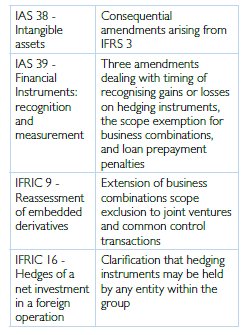
The other standards subject to amendment are as follows.

Smith & Williamson commentary
Most of the amendments not discussed in detail relate to inconsistencies or clarification of scope exclusions which are unlikely to affect most preparers. However, any entity currently applying one of these standards should make themselves familiar with the relevant changes.
The content of this article is intended to provide a general guide to the subject matter. Specialist advice should be sought about your specific circumstances.





