Share on LinkedInShare on LinkedIn

ARTICLE · 11 DECEMBER 2017

Hierarchy Of Courts For Civil Cases In India

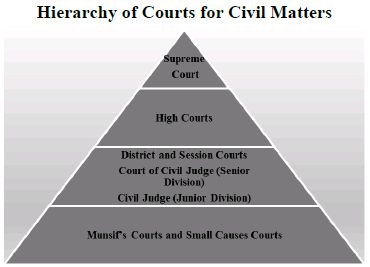
The Supreme Court has original, appellate and advisory jurisdiction. Its exclusive original jurisdiction includes any dispute between the Centre and State(s) or between States as well as matters concerning enforcement of fundamental rights of individuals.

IndiaLitigation, Mediation & Arbitration

Vinay Vaish, Joint Managing Partner, Vaish Associates Advocates
Email: [email protected] +919810200225

Supreme Court

The Supreme Court has original, appellate and advisory jurisdiction. Its exclusive original jurisdiction includes any dispute between the Centre and State(s) or between States as well as matters concerning enforcement of fundamental rights of individuals. The appellate jurisdiction of the Supreme Court can be invoked by a certificate granted by the High Court concerned in respect of any judgment, decree, or final order of a High Court, in both civil and criminal cases, involving substantial questions of law as to the interpretation of the Constitution. Supreme Court decisions are binding on all Courts/ Tribunals in the country and act as precedence for lower courts. Under Art 141 of the Constitution, all courts in India are bound to follow the decision of the Supreme Court as the rule of law.

We operate a free-to-view policy, asking only that you register in order to read all of our content. Please login or register to view the rest of this article.

See more popular content from
